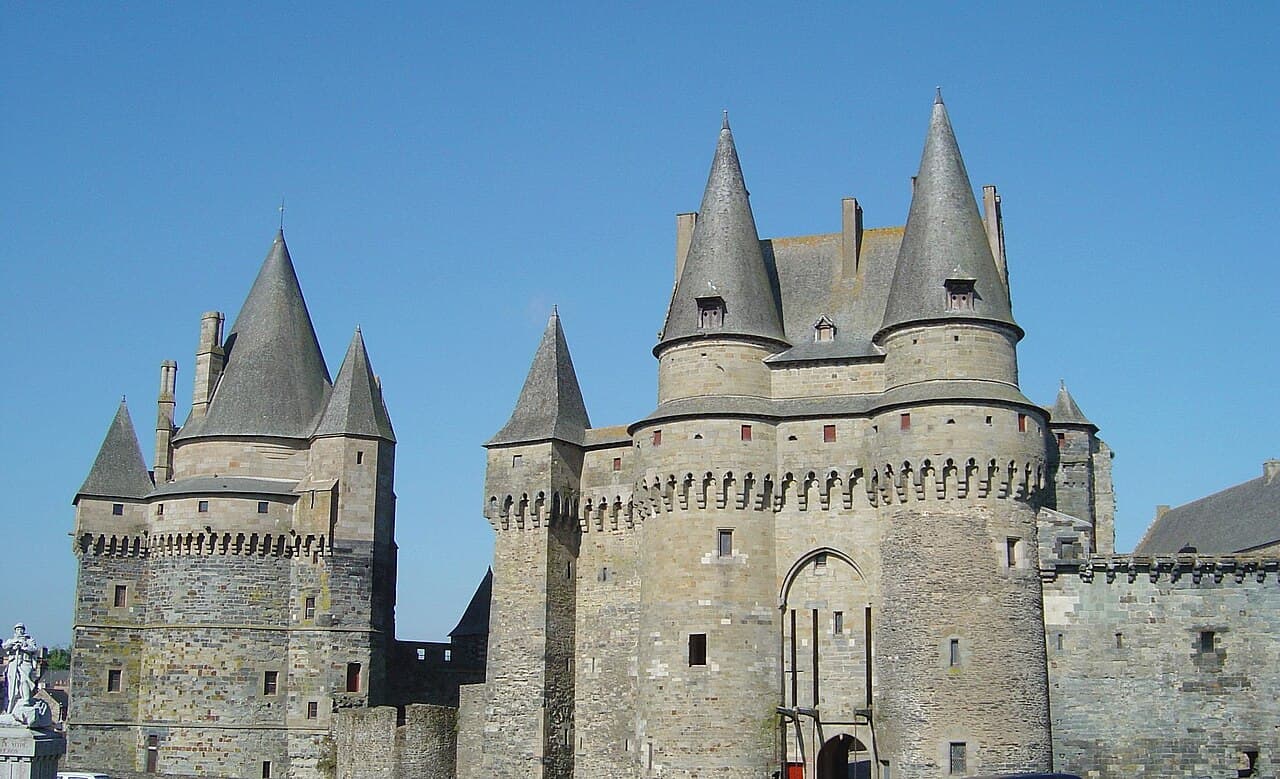
Vitré Castle — France castle

Vitré Castle

Vitré Castle: a medieval hill castle in Brittany, France
Vitré, France
High Medieval (11th–13th c.)
Restored

Vitré Castle, locally known as Château de Vitré, is a remarkable medieval fortress located in the heart of the town of Vitré, within the Ille-et-Vilaine department of Brittany, France. Perched on a prominent rocky promontory overlooking the Vilaine valley, this hill castle has played a significant role in the region's military and political history since its origins in the late 11th century.

The earliest fortification on the site was a wooden motte-and-bailey castle built around the year 1000 on Sainte-Croix hill. This initial structure was repeatedly destroyed by fire before the baron Robert I of Vitré commissioned the construction of the first stone castle at the end of the 11th century. A surviving Romanesque doorway from this period remains as a testament to the castle's early architectural heritage.

Medieval origins and 13th-century transformation

During the first half of the 13th century, baron André III of Vitré undertook a major reconstruction of the castle, reshaping it into the distinctive triangular form that follows the natural contours of the rocky outcrop. This design was reinforced by dry moats and robust defensive walls, creating a formidable stronghold. Upon André III's death, the castle passed into the hands of the Counts of Laval, a powerful noble family who would oversee significant expansions and modifications in the following centuries.

15th-century expansions and defensive upgrades

In the 15th century, under the influence of Guy XII de Laval and his successors, Vitré Castle was enlarged and its defenses enhanced to meet the evolving demands of warfare. Key features added during this period include the gatehouse with double drawbridge, the St Laurent Tower—the main keep later adapted with cannon apertures—and the Magdalene Tower. These improvements reflected the transition from medieval to early modern military architecture, integrating artillery defenses while maintaining traditional fortifications.

The castle's role as a military bastion was tested during the Mad War in 1487 when Guy XV de Laval surrendered the castle to French royal troops without resistance. Despite this, the fortress remained a critical defensive site within the Duchy of Brittany, part of a network of castles including Fougères, St. Aubin-du-Cormier, and Grand-Fougeray.

Comfort and political refuge in the late medieval and renaissance periods

From the late 15th century onward, modifications shifted focus from purely military concerns to enhancing the castle's habitability and comfort. Renaissance elements were introduced, such as the construction of galleries and a dedicated oratory built around 1530, reflecting contemporary architectural tastes and the castle's status as a noble residence.

During the 16th century, the castle served as a refuge for the Parliament of Brittany on three occasions (1564, 1582, and 1583) when plague outbreaks in Rennes necessitated relocation. The castle also became a stronghold for the Huguenots under the ownership of the Rieux and Cologny families, sheltering Protestants during the turbulent French Wars of Religion.

Siege and decline in the early modern era

In 1589, Vitré Castle withstood a prolonged five-month siege by Philippe Emmanuel, Duke of Mercœur, a Catholic leader during the Wars of Religion. This siege demonstrated the fortress's enduring military value despite the increasing obsolescence of medieval castles in the face of gunpowder weaponry.

Following the death of the last Count of Laval, Guy XX, in 1605, the castle passed to the La Trémoille family. However, they soon abandoned the residence, leading to gradual neglect. The partial collapse of the St Laurent Tower and a devastating fire in 1795 further contributed to the castle's deterioration.

19th-century uses and preservation efforts

In the 19th century, Vitré Castle was repurposed as a departmental prison and later housed an infantry regiment from 1867 to 1877. Recognizing its historical significance, the castle was among the first in France to be classified as a monument historique in 1872. Restoration efforts led by architect Darcy began in 1875, aiming to preserve the castle's medieval character while adapting it for public use.

Today, the castle serves as the town hall of Vitré and includes a museum showcasing sculptures, 15th- and 16th-century tapestries, and period engravings. Visitors can explore key architectural features such as the St Laurent Tower, the Tour de l'Argenterie with its unique collection of preserved specimens, and the Tour de l'Oratoire.

The fortifications and urban context

Vitré's fortifications extend beyond the castle itself, encompassing an extensive system of ramparts originally built between the 13th and 16th centuries. These walls, constructed from local sandstone and schist, enclosed the medieval town and included numerous towers and fortified gates such as Porte d’En Haut and Porte Gâtesel.

Deep moats and ditches, some fed by natural springs, surrounded the walls, enhancing the town's defenses. Although parts of the southern ramparts and gates were demolished in the 19th century to accommodate urban expansion and the railway, significant sections remain well-preserved and have been the focus of ongoing restoration.

Cultural heritage and visitor experience

Recognized as a remarkable heritage site, the historic center of Vitré and its fortifications were officially classified as a French historical monument in 2014. The castle and town offer a rich journey through medieval military architecture, noble residence evolution, and the complex history of Brittany.

Visitors to Vitré Castle can appreciate its imposing silhouette from various viewpoints, especially from across the Vilaine valley. The castle's blend of defensive strength and residential comfort illustrates the dual roles medieval castles played as fortresses and noble homes.

While the castle is currently open to the public, visitors should check seasonal opening times. The adjacent town of Vitré also offers charming streets, historic buildings, and cultural attractions that complement a visit to this impressive medieval site.

Frequently asked questions (FAQ)

What is the historical significance of Vitré Castle?
Vitré Castle is a remarkable example of medieval architecture and played a key role in the defense of the region during the 11th century. It stands as a symbol of the town's rich history and showcases the evolution of military architecture throughout the centuries.
When was Vitré Castle built?
Construction of Vitré Castle began in the early 11th century, with significant expansions and renovations occurring in the following centuries. The castle reflects various architectural styles, showcasing its long history and adaptation over time.
What are the opening hours for Vitré Castle?
Vitré Castle is typically open to visitors from 10 AM to 6 PM during the tourist season, which runs from April to September. During the off-season, hours may vary, so it’s advisable to check the official website before planning your visit.
Can I buy tickets online for Vitré Castle?
Yes, tickets for Vitré Castle can be purchased online through the official website, allowing you to secure your entry and avoid long queues. On-site ticket purchasing is also available, but online booking is recommended during peak tourist seasons.
Is Vitré Castle accessible for visitors with mobility impairments?
Vitré Castle has made efforts to improve accessibility for visitors with mobility impairments; however, due to the castle's historic structure, some areas may remain challenging to navigate. It is best to contact the site in advance to inquire about specific accessibility features and assistance options available.
What is the best time to visit Vitré Castle?
The best time to visit Vitré Castle is during the spring and early autumn months when the weather is mild, and the gardens are in full bloom. Additionally, visiting during weekdays can help you avoid larger crowds, allowing for a more enjoyable experience.
What nearby attractions should I visit while in Vitré?
While visiting Vitré, be sure to explore the medieval town center, which features charming streets and historic buildings. Other attractions include the Saint George's Church and the local museums, which provide a deeper insight into the region's history and culture.
How much is the entry fee for Vitré Castle?
The entry fee for Vitré Castle is generally affordable, with discounts available for children, students, and seniors. Check the official site for the most current pricing and any special events that might offer free admission days.

Photo gallery

Vitré Castle
Click to view
1 photo • Click any image to view in full screen

Information

Hill Castle

Address

Place du Château, Vitré, Ille-et-Vilaine, France

Sources & official resources

Verify the information above using these authoritative references.

Loading map...

Visitor reviews

No reviews yet. Been here? Write the first review and help other travelers!

Write the first review

Visited this castle? Share your experience

Your review helps other travelers and adds first-hand knowledge to our encyclopedia.

Write a review

(5/5)

0/2000 characters

Your review will be visible after admin approval

Nearby castles

6 km

Château des Rochers-Sévigné

Vitré, France

The Château des Rochers-Sévigné is a notable Renaissance château located in Vitré, France. This historic estate has deep roots dating back to the 12th century when it was originally owned by the Mathefelon family. In 1410, the château passed by marriage to the Sévigné family, who would transform and rebuild the estate into the elegant residence it is known for today. The architectural evolution and Renaissance rebuilding During the early 16th century, the Sévigné family undertook significant reconstruction of the château, reflecting the architectural trends of the Renaissance period. This rebuilding introduced refined stonework, symmetrical layouts, and classical details that marked a departure from medieval fortress styles. The château's design includes characteristic Renaissance elements such as large windows, ornate chimneys, and balanced proportions, which together create a harmonious and elegant appearance. Madame de Sévigné and her influence Between 1644 and 1690, the château gained historical prominence as the residence of Madame de Sévigné, a celebrated French aristocrat and letter writer. During her time at Les Rochers, she refurnished the house, enhancing its interiors to suit contemporary tastes and comfort. Madame de Sévigné also took a personal interest in the surrounding gardens, naming the various paths that wove through the grounds, reflecting her intimate connection to the estate. The French gardens by André Le Nôtre In 1689, Madame de Sévigné's son commissioned the renowned landscape architect André Le Nôtre to design the château's gardens. Le Nôtre, famous for his work on the gardens of Versailles, created a formal French garden characterized by geometric patterns, carefully trimmed hedges, and water features. These gardens exemplify the principles of order and symmetry that define the French formal garden style, enhancing the château's grandeur and aesthetic appeal. Later ownership and preservation In 1715, the estate was acquired by the Nétumières family, who undertook further building and restoration works to maintain and improve the château. Their efforts helped preserve the architectural integrity and historical significance of the property through the centuries. Current status and visitor experience Today, visitors to the Château des Rochers-Sévigné can explore the estate, including a 17th-century Orangerie that serves as a visitor centre. The centre hosts exhibitions dedicated to Madame de Sévigné and the château's history, providing rich cultural context and insight into the life and times of its notable residents. The preserved gardens and the château's Renaissance architecture offer a vivid glimpse into the estate's past. Architectural features and cultural significance The château's architectural ensemble includes stone façades with Renaissance ornamentation, large mullioned windows, and decorative chimneys. The layout balances residential comfort with aesthetic refinement, typical of French noble estates of the period. The gardens by Le Nôtre are a key highlight, illustrating the integration of architecture and landscape design in French heritage. The Château des Rochers-Sévigné remains an important cultural landmark in the Brittany region, reflecting centuries of French aristocratic life, architectural evolution, and garden artistry. Its preservation allows for ongoing appreciation of Renaissance architecture and the legacy of Madame de Sévigné, whose correspondence offers valuable historical insights.

Renaissance (15th–17th c.)
Details
9 km

Bois-Cornillé Castle

Château du Bois-Cornillé, France

Bois-Cornillé Castle, also known as Château du Bois-Cornillé or Boiscornillé, is a striking example of a French castle that blends medieval origins with later neo-Gothic architectural transformations. Located northeast of the village of Val-d'Izé in the Ille-et-Vilaine department, this castle offers a fascinating glimpse into the evolution of noble residences from the 13th century through the 19th century. The castle's history begins in the high medieval period, with its initial construction dating back to the 13th century. The original fortress was a typical medieval stronghold, designed for defense and residence. Its strategic location in Brittany made it a valuable asset during the turbulent medieval era. The only surviving element from this early phase is the octagonal entrance tower, known as the Gouyon Tower, which stands as a testament to the castle's medieval past. Medieval origins and ownership Bois-Cornillé Castle first came into prominence through its association with prominent Breton figures. Around 1482, it passed by marriage to Pierre Landais, who served as the Treasurer and Receiver General of the Duchy of Brittany. Landais was a key financier for Duke Francis II of Brittany, and his acquisition of the castle marked a significant chapter in its history. He undertook substantial rebuilding efforts, transforming the castle to suit the needs and tastes of the late 15th century. Following Landais's tenure, the castle changed hands multiple times through inheritance and sales during the 16th, 17th, and 18th centuries. Each family left its mark, though the core medieval structure gradually gave way to newer architectural styles and expansions. 18th-century transformation into a neo-Gothic mansion The most dramatic change to Bois-Cornillé Castle occurred in the late 18th century when the old medieval fortress was completely redesigned and enlarged. This transformation was commissioned by the Le Cardinal Kernier family, who had acquired the property in 1854 through Paul le Cardinal de Kernier, the Marquess of Kernier. The renovation was carried out by the architects Jules and Henri Mellet, who embraced the neo-Gothic architectural style that was fashionable at the time. The neo-Gothic style is characterized by its revival of medieval Gothic elements such as pointed arches, decorative tracery, and steeply pitched roofs. Bois-Cornillé Castle's redesign incorporated these features, turning the fortress into a grand mansion that combined romantic aesthetics with modern comforts. Despite the extensive remodeling, the Gouyon Tower was preserved as a historical relic, providing a tangible link to the castle's medieval origins. Architectural features and the chapel Alongside the main castle, the property includes a chapel dating from 1721, which adds a religious and cultural dimension to the estate. The chapel reflects the architectural tastes of the early 18th century and complements the overall historic ambiance of the castle grounds. The landscaped park and gardens The castle's surroundings were also enhanced in the 19th century with the creation of a landscaped park. This park was designed in 1876 by the renowned landscape architects Eugene Denis Bühler and Édouard André. Their work contributed to the romantic and picturesque setting of the castle, featuring carefully planned gardens, walking paths, and ornamental plantings that harmonize with the neo-Gothic mansion. The park remains accessible to the public during the summer months, offering visitors a chance to experience the beauty of the grounds and appreciate the integration of natural and architectural elements. Current status and visiting information Today, Bois-Cornillé Castle remains private property, owned by the descendants of the Marquess of Kernier. While the castle itself is not generally open to the public, the park is available for visitation in the summer, providing an opportunity to explore the estate's historic landscape. The castle stands as a remarkable example of how medieval fortifications were adapted and transformed over centuries to meet changing tastes and functions. Its blend of medieval remnants and neo-Gothic redesign makes it a valuable cultural heritage site in Brittany, representing the region's architectural evolution and noble history. Historical significance and architectural legacy Bois-Cornillé Castle exemplifies the transition from medieval fortress to romanticized neo-Gothic residence, illustrating broader trends in French aristocratic architecture. The preservation of the Gouyon Tower allows historians and visitors alike to connect with the castle's high medieval past, while the neo-Gothic mansion showcases 19th-century architectural revivalism. The castle's association with important historical figures such as Pierre Landais and the Le Cardinal Kernier family enriches its narrative, linking it to the political and social history of Brittany. Its park, designed by distinguished landscape architects, further enhances its cultural value. For enthusiasts of Gothic revival architecture and medieval history, Bois-Cornillé Castle offers a compelling destination that encapsulates centuries of architectural innovation and noble life in France.

High Medieval (11th–13th c.)
Details
20.2 km

St. Aubin-du-Cormier Castle

Saint-Aubin-du-Cormier, France

St. Aubin-du-Cormier Castle, known locally as Château de Saint-Aubin-du-Cormier, stands as a significant medieval fortress in the town of Saint-Aubin-du-Cormier, nestled in the Ille-et-Vilaine department of France. Constructed in the early 13th century by Peter I, Duke of Brittany, this hill castle was a strategic stronghold designed to secure the northeastern frontier of the Duchy of Brittany. Its position was crucial, forming part of a defensive chain of castles including Fougères, Vitré, and Grand-Fougeray, which stretched from the English Channel to the Atlantic Ocean. The castle's origins date back to 1225 when Duke Peter I commissioned its construction to assert control over the neighboring powerful lordships. This period marked intense rivalry between the Duchy of Brittany, the Kingdom of France, and the English crown. After the death of King Louis VIII of France in 1226, Peter shifted his allegiance to King Henry III of England, prompting a military response from France. Despite an unsuccessful siege led by forces under King Louis IX of France in 1231, the castle was surrendered in 1234, bringing it under French influence. Architectural features and fortifications The castle was originally enclosed by a roughly rectangular defensive wall, measuring approximately 86 to 100 meters in length and 30 meters in width. This enceinte was fortified by ten circular towers spaced evenly around its perimeter, creating a formidable barrier against attackers. The fortress formed a quadrilateral layout, emphasizing strong defensive geometry typical of high medieval military architecture. The most prominent surviving structure is the donjon or keep, located in the southwest corner of the castle grounds. This massive stone tower was constructed with walls about 3.5 meters thick, rising to approximately 15.5 meters over five levels. The keep's ground floor was solid and windowless, designed purely for defense. Access was gained through the first floor, which featured a fireplace with an oven and windows with seating recesses called cousièges, providing a degree of comfort for its inhabitants. The second floor contained latrines, demonstrating early attention to sanitation within the fortress, while the third floor, likely added during the 14th century, included a chemin de ronde—a protected wall-walk allowing defenders to patrol the battlements safely. The castle also featured an external enclosure that was later integrated into the town's defensive walls, including three large half-moon towers and a southern rampart overlooking a pond. Historical significance and military role St. Aubin-du-Cormier Castle played a pivotal role in the complex political and military struggles of medieval Brittany. During the Breton War of Succession in the 14th century, the castle changed hands between rival factions. In 1342, it was seized by Charles de Blois, Duke of Brittany, and later returned to John of Montfort in 1381. These events highlight the castle's strategic importance in controlling the region. In 1430, the castle underwent significant remodeling, incorporating it within the newly constructed town walls of Saint-Aubin-du-Cormier. This renovation reflected the evolving military architecture of the period and the castle's continued role as a defensive hub. The castle's most decisive historical moment came during the Mad War (La Guerre Folle) in 1488. The Battle of Saint-Aubin-du-Cormier saw the forces of Duke François II of Brittany face the French royal army led by Louis II de La Trémoille. The French victory was crushing, resulting in heavy Breton casualties and marking the effective end of Brittany's independence. This defeat accelerated Brittany's submission to the French crown, culminating in the marriage of Anne of Brittany to King Charles VIII of France. The castle's dismantling and decline Following the battle, the castle lost its strategic value and was ordered to be dismantled in 1490 to prevent its future use in rebellion. The demolition was carried out by a royal artillery corps equipped with infantry, men-at-arms, gunners, and over thirty artillery pieces. The keep was specifically targeted through underground mining, reducing its height by about half and causing extensive damage to its eastern face. Despite this, the northern wall of the donjon remains remarkably intact, preserving much of its original masonry. Over time, the castle fell into ruin, with only partial remains of the walls, towers, and main building surviving. The external enclosure was absorbed into the town's fabric, with traces of the half-moon towers and southern rampart still visible today. Cultural heritage and current status Recognized for its historical and architectural significance, the ruins of Château de Saint-Aubin-du-Cormier were officially protected as a historic monument on December 15, 1926. The site offers valuable insight into medieval military architecture and the turbulent history of Brittany during the high medieval and late medieval periods. Today, visitors can freely explore the castle ruins, which, while not extensive, include an impressive partially preserved keep and visible remains of the defensive walls and towers. The site stands as a testament to the region's rich heritage and the complex interplay between Breton independence and French royal power. The castle's proximity to the forest of Rennes and its historical chapel dedicated to Saint Aubin further enrich its cultural landscape, linking military, spiritual, and regional narratives. Architectural legacy and influence The design of St. Aubin-du-Cormier Castle reflects the evolution of castle architecture from the early 13th century through the 15th century. Its robust stone keep with thick walls, circular towers, and chemin de ronde are characteristic features of high medieval fortifications aimed at both defense and residential comfort. The integration of the castle into town walls in the 15th century demonstrates the shift towards urban fortification strategies as military technology and political landscapes changed. The castle's partial destruction and preservation of key elements provide scholars and visitors with a tangible connection to medieval military engineering and the historic struggles that shaped Brittany and France.

High Medieval (11th–13th c.)
Details

