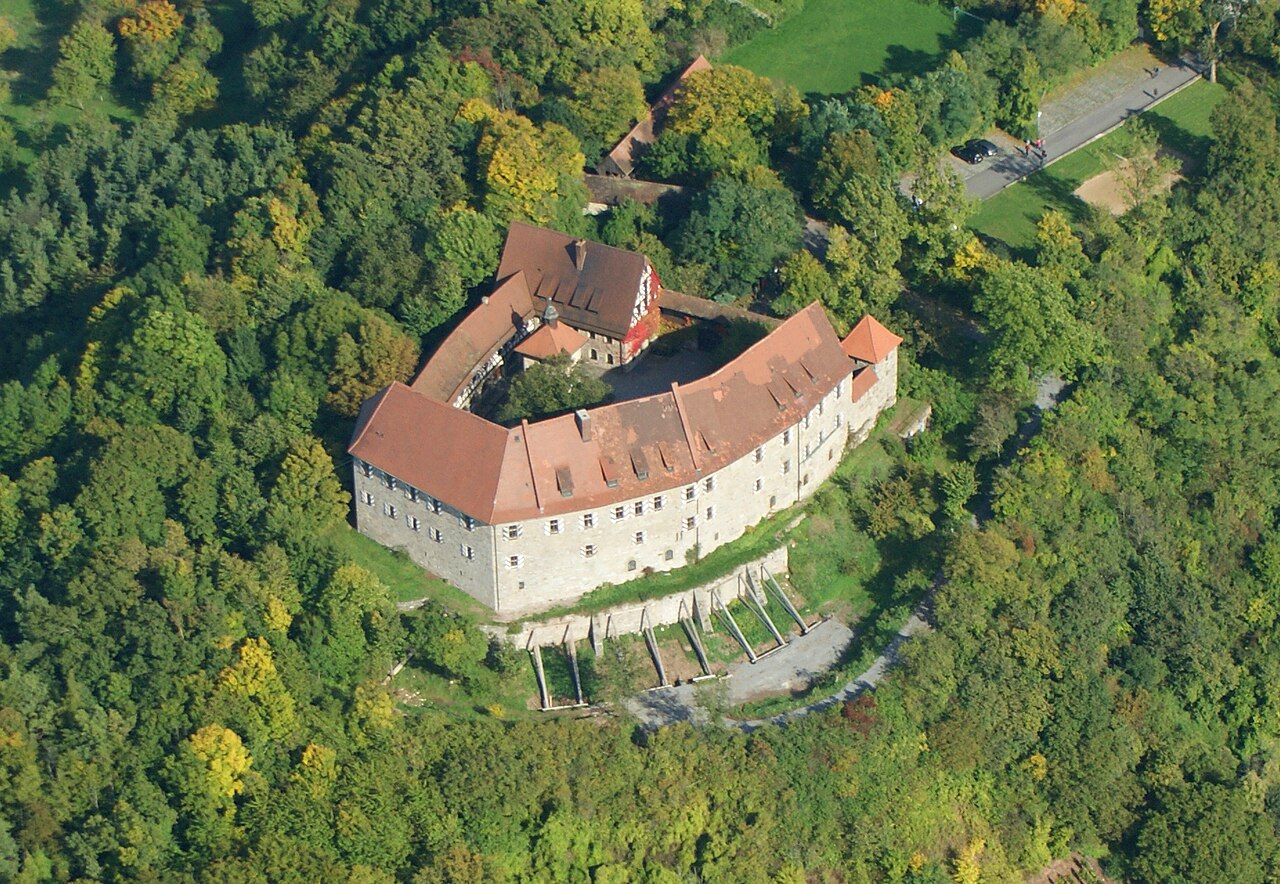
Virnsberg Castle
Virnsberg Castle, first mentioned in 1235, is a significant example of a high medieval hill castle located in Flachslanden, Germany. Originally owned by the imperial ministeriales family von Uffenheim, it has a complex history marked by shifting ownership, military conflict, and religious significance. The castle's architecture reflects its evolution from a medieval fortress to a fortified commandery with later Baroque additions, embodying centuries of German castle-building traditions.
Historical background and ownership
The castle first appears in records in 1235, when it was held by the Reichsministerialen von Uffenheim, a class of unfree knights serving the Holy Roman Emperor. That year, Ludwig von Virnsberg, a member of this family, rebelled against Emperor Frederick II. As a consequence, he was forced to cede half of the castle to the Counts of Hohenlohe. The Counts promptly sold their share to the powerful Burgraves of Nuremberg, who were key regional rulers in Franconia.
By 1259, Burgrave Konrad I consolidated ownership by acquiring the remaining half, bringing the entire castle under the Burgraviate of Nuremberg. This arrangement lasted until 1294, when the castle was transferred to the Teutonic Order. The castle then became a commandery within the Teutonic Order's Franconian bailiwick, serving as a religious and administrative center. This status made Virnsberg a Catholic enclave within the predominantly Protestant region of Ansbach, maintaining its ecclesiastical importance for over five centuries.
Following the secularization of 1803, which dissolved many ecclesiastical properties, Virnsberg Castle passed through various private and institutional owners, including the Evangelical Welfare. In 1977, lawyer Friedrich von Herford acquired the castle and later donated it to a nonprofit association dedicated to its preservation. In 2017, a Munich-based investment firm purchased the estate, which is now managed by Schloss Virnsberg GmbH & Co. KG.
Architectural layout and defensive features
Virnsberg Castle is strategically positioned on a hill overlooking the Kemnath valley, combining features of both a hill castle (Höhenburg) and a water castle (Wasserburg). This hybrid design uses natural elevation and water defenses to maximize protection.
Lower courtyard and agricultural buildings
The southern section of the complex contains the lower courtyard, characterized by horseshoe-shaped agricultural buildings dating from around 1700. Among these is a notable dovecote, used historically for housing pigeons. A moat surrounds the southern and western sides of this area, separating it from other parts of the castle and enhancing defense.
Middle courtyard and outer fortifications
From the lower courtyard, a ramp ascends clockwise to the middle courtyard, which is enclosed on the west by a late 15th-century outer ring wall. The entrance to this courtyard is marked by a gate tower and a gate zwinger, a narrow defensive passage designed to trap and expose attackers. The middle courtyard's northwest boundary features two obliquely positioned buildings, adding structural complexity.
On the northern side, two large rectangular gun towers project outward, each containing casemates—vaulted chambers used for artillery and firearms defense, typical of 15th and 16th-century military architecture. These adaptations reflect the castle's response to the evolving nature of siege warfare during the late medieval period.
Core castle and residential quarters
The heart of the complex is the core castle, surrounded by its own moat and defined by an irregular polygonal shape. The courtyard is fully enclosed by buildings, providing a secure and self-contained residential area. Access is through a vaulted gateway at the eastern corner of the northern wing, ensuring controlled entry.
A prominent feature within the core castle is the two-story Baroque chapel located in the northeast corner, illustrating the site's architectural evolution beyond the medieval era. Behind the northwest corner stands the octagonal bergfried, a free-standing tower typical of German castles, serving as both a lookout and last refuge.
Architectural styles and construction phases
The castle's main construction dates to the 13th century with significant expansions and fortifications added during the late 15th century. The defensive structures, including the outer ring wall, gate tower, and gun towers, reflect late medieval military architecture adapted for the use of early firearms.
The Baroque period contributed notable additions such as the chapel and agricultural buildings in the lower courtyard, dating from the 17th and early 18th centuries. These elements contrast with the medieval fortifications, highlighting the castle's continuous use and adaptation over centuries.
Current condition and preservation efforts
Today, Virnsberg Castle is in a partially preserved state but requires urgent restoration to stabilize its structures and preserve its historic fabric. The complex's combination of medieval fortifications and Baroque residential buildings presents challenges and opportunities for conservation.
Ownership by a nonprofit association and later a private investment firm reflects ongoing interest in maintaining the site. Preservation efforts focus on safeguarding the castle's architectural heritage while exploring adaptive reuse possibilities.
Cultural significance and visitor information
Virnsberg Castle stands as a rare example of a mixed hill and water castle with a long history tied to imperial ministeriales, regional rulers, and the Teutonic Order. Its role as a Catholic enclave in a Protestant region adds to its historical importance.
The castle's architectural features, including its gun towers, bergfried, and Baroque chapel, attract interest from scholars and visitors interested in medieval and early modern castle architecture. While not fully restored, the site offers valuable insights into the evolution of German castles from the medieval period through the Baroque era.
Frequently asked questions (FAQ)
- How do I get to Virnsberg Castle?
- Virnsberg Castle is located in Flachslanden, Germany. Visitors can reach the castle by car or local transport to Flachslanden, then walk to the hilltop site overlooking the Kemnath valley.
- What is the historical significance of Virnsberg Castle?
- Virnsberg Castle was a medieval stronghold originally owned by imperial ministeriales and later by the Teutonic Order, serving as a Catholic enclave in Protestant Ansbach for over five centuries.
- Can I visit the interior of Virnsberg Castle?
- The castle is partially preserved and not fully restored, so interior access may be limited. Visitors should check with local authorities or the managing entity for current access and guided tours.
- When was Virnsberg Castle built?
- The castle was constructed in the 13th century, with significant expansions and fortifications added in the late 15th century.
- What architectural styles are present at Virnsberg Castle?
- Virnsberg Castle features high medieval military architecture with late medieval fortifications and Baroque additions such as the chapel and agricultural buildings.
Information
Website
Visit websiteSources & official resources
Verify the information above using these authoritative references.
Loading map...
Visitor reviews
No reviews yet. Been here? Write the first review and help other travelers!
Write the first reviewVisited this castle? Share your experience
Your review helps other travelers and adds first-hand knowledge to our encyclopedia.