Vimianzo Castle
Vimianzo Castle stands as a prominent example of a high medieval hill castle in the region of Galicia, Spain. Its construction began in the 13th century and extended through the 14th and 15th centuries, reflecting the evolving military and residential needs of the Galician nobility. The castle's strategic location atop a hill provided a commanding view of the surrounding landscape, essential for defense and control during the turbulent medieval period.
The castle features a distinctive polygonal layout that follows the natural contours of the hill, a design that maximizes defensive capabilities. Its walls, nearly two metres thick, are constructed from finely cut granite blocks laid in regular courses, a testament to the skilled medieval stonemasonry in the region. Surrounding the fortress is a deep moat, over which a drawbridge once provided controlled access, enhancing the castle's defensibility.
Architectural features and design
Fortifications and towers
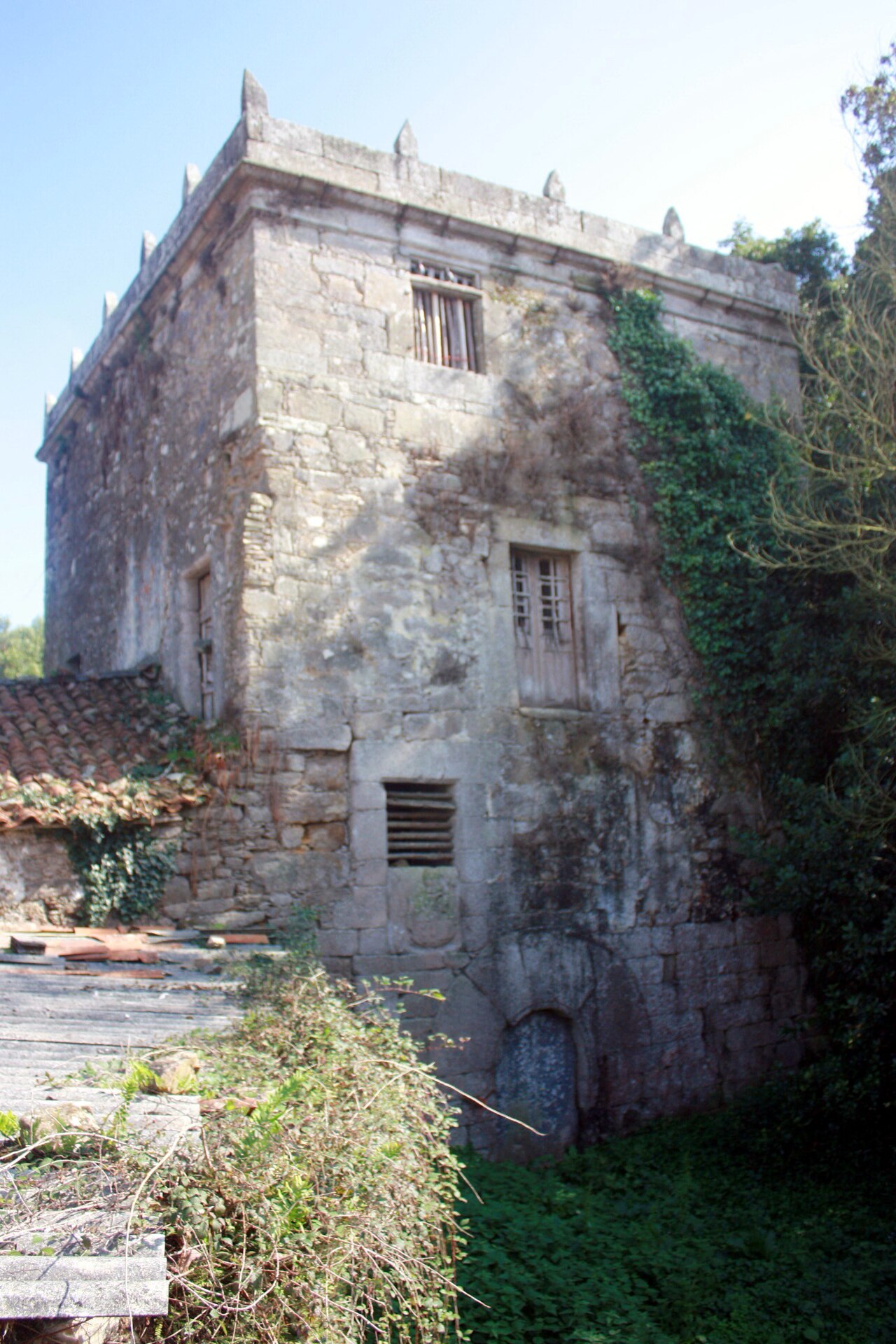
The castle is characterized by its four main towers, three of which are rectangular with four-sided roofs, and a central keep tower that served as the last line of defense and the lord's residence. The keep is notable for its machicolations, openings through which defenders could drop projectiles on attackers below, and battlements with diamond-shaped merlons, which are still partially preserved. The presence of a mullioned window in the keep adds a refined architectural detail, dividing the window into two sections with a vertical stone column.
Courtyard and defensive walkways
The heart of the castle is the patio de armas or arms courtyard, enclosed by the surrounding walls and towers. A raised passage known as the adarve or wall-walk connects the towers, allowing defenders to move safely around the perimeter. The outer walls also feature a chemin de ronde, a patrol path atop the battlements that provided guards with a vantage point to observe and repel attackers. Arrow slits and twin windows in the walls demonstrate the balance of function and form typical of medieval military architecture.
Historical context and significance
Origins and early ownership
The castle was likely constructed by the Mariño de Lobeira family, a powerful Galician noble house, between the late 12th and early 13th centuries. Excavations have uncovered the foundations of an early large keep tower in the courtyard, indicating the castle's initial role as a fortified stronghold. Over the centuries, Vimianzo Castle witnessed numerous ownership changes, reflecting the complex feudal politics of medieval Galicia.
Conflicts and sieges
In 1348, King Alfonso XI of Castile seized the castle from Roi Soga Mariño de Lobeira due to unpaid debts and later sold it to Archbishop Xoan García de Manrique of Santiago de Compostela. The castle later passed to Fadrique Enriquez, Duke of Arjona, and by the mid-15th century, it became part of the Moscoso family's holdings, closely linked to the Counts of Altamira.
During the Irmandiña Revolt of 1467, the castle was attacked and destroyed by rebel forces. It was rebuilt under the orders of Archbishop Alonso II de Fonseca. The castle also served as a prison, famously detaining Bishop Diego de Muros and Archbishop Alonso II de Fonseca himself, the latter confined in a cage reportedly made of gold.
Later history and restoration
In 1472, Lope Sánchez de Moscoso reclaimed the castle with a strong army, reestablishing it as the administrative center of his lordship, which included nearby towns such as Camariñas, Laxe, Zas, and Muxía. From the 16th century onward, the Altamira family managed the castle through appointed governors, as they preferred to reside at the royal court.
Following the abolition of feudal jurisdictions in 1833, the castle was sold in 1870 to Ramón Martelo Núñez. Later, Evaristo Martelo Paumán, the Marquis of Almeiras, undertook significant restorations to make the castle habitable again. Eventually, the property was donated to the Archbishopric of Santiago and later acquired by the Provincial Deputation of La Coruña in 1973, which restored it for cultural use.
Interior and museum collections
Today, Vimianzo Castle houses an ethnographic museum showcasing the traditional crafts of the region. Exhibits include stonework, basketry, lace-making, ceramics, wooden clogs, and linen textiles. These collections provide insight into the cultural heritage and artisanal skills of Galicia, connecting visitors with the local history beyond the castle's military past.
Preservation and current condition
The castle is in well-preserved condition, thanks to continuous restoration efforts. Its thick granite walls, defensive towers, and moat remain largely intact. The survival of original architectural elements such as ribbed barrel vaults, pointed arches, and the diamond-shaped battlements contribute to its historical authenticity. The castle's integration into the community as a museum and cultural venue ensures its ongoing maintenance and public accessibility.
Architectural and cultural importance
Vimianzo Castle exemplifies the high medieval military architecture of northwestern Spain, combining defensive innovation with residential functionality. Its polygonal design, robust fortifications, and strategic hilltop location highlight medieval approaches to castle construction in Galicia. The castle's layered history of noble ownership, conflict, and restoration reflects broader regional dynamics during the Middle Ages and beyond.
As a cultural landmark, the castle connects visitors to the historical narratives of Galicia, from feudal power struggles to artisanal traditions. Its preservation as a public museum allows for educational opportunities and promotes heritage tourism in the region.
Information
Website
Visit websiteSources & official resources
Verify the information above using these authoritative references.
Loading map...
Visitor reviews
No reviews yet. Been here? Write the first review and help other travelers!
Write the first reviewVisited this castle? Share your experience
Your review helps other travelers and adds first-hand knowledge to our encyclopedia.