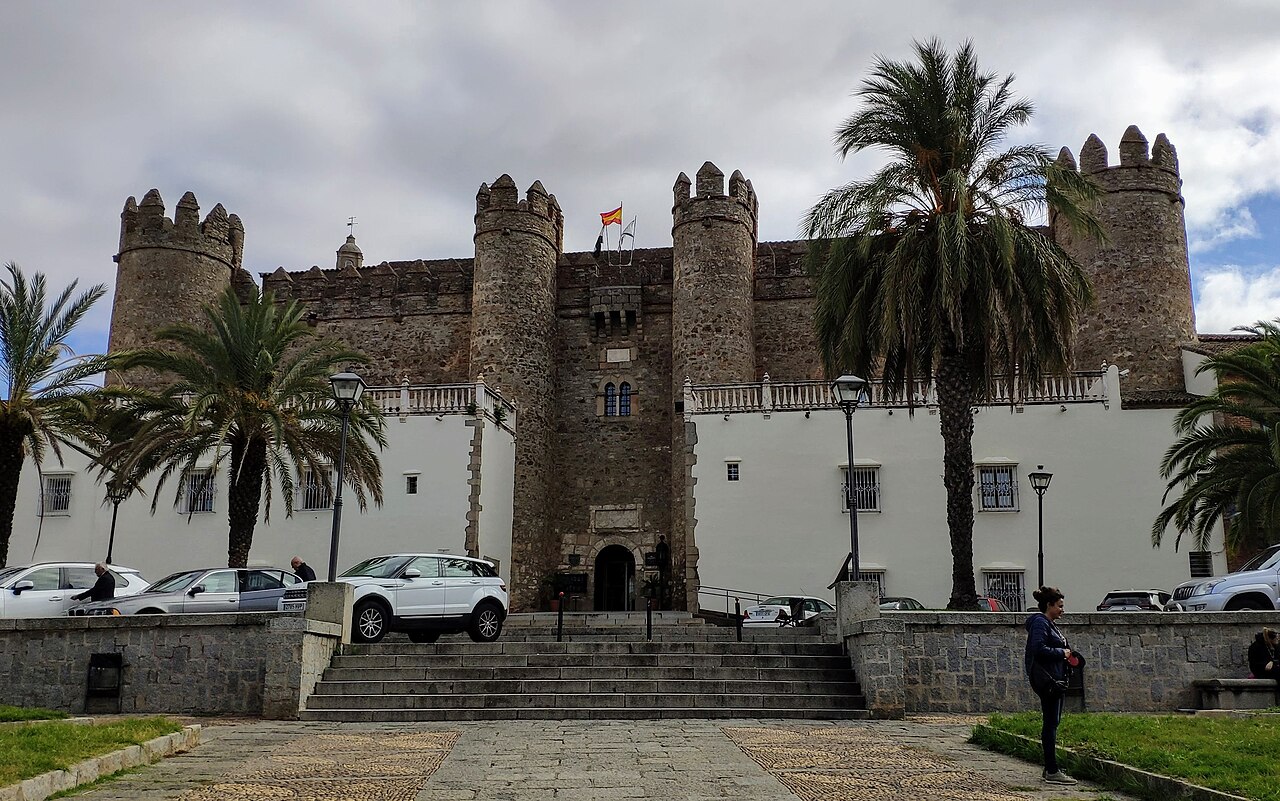
Villalba de los Barros Castle
Villalba de los Barros Castle stands as a significant example of a late medieval hill castle in Spain, embodying a rich history that intertwines Islamic and Christian architectural traditions. Constructed in the 15th century atop the remains of an ancient Almohad fortress, this castle reflects centuries of military, political, and cultural evolution in the region of Extremadura.
Its strategic location on a hill provided natural defense advantages, which were enhanced by robust fortifications. The castle’s layout centers around a small central courtyard, enclosed within a quadrangular walled perimeter. Four prominent buttresses topped with horseshoe arches punctuate the enclosure, a distinctive feature that echoes its Islamic heritage.
Historical background and development
The origins of Villalba de los Barros Castle trace back to the Almohad period, when the site hosted a Muslim fortress built using traditional rammed earth techniques. This early fortification was part of the broader Islamic presence in the Iberian Peninsula during the Middle Ages. The surrounding settlement, initially known as “don Falcón,” gained official recognition in the late 13th century under King Sancho IV of Castile. This royal authorization allowed Admiral Juan Mathé de Luna, the king’s Camarero Mayor, to develop the area into a recognized villa.
By the end of the 13th century, the settlement evolved under the leadership of the knight Juan Mateo, who formalized its status as a village. The castle and its lands changed hands in 1395 when Lorenzo Suárez de Figueroa, Master of the Order of Santiago, acquired them. This acquisition integrated Villalba de los Barros into the Señorío de Feria, a significant feudal domain.
During the late 14th century, the original Almohad fortress underwent substantial reconstruction, replacing rammed earth with more durable stone and masonry foundations. This transition marked the castle’s evolution into a fortified residence suitable for the turbulent political climate of the time. Further fortification efforts were authorized by King Enrique III before 1400, enabling Gómez I Suárez de Figueroa to reinforce the defenses.
In the mid-15th century, Lorenzo II Suárez de Figueroa continued these enhancements, ensuring the castle maintained its military relevance amid ongoing regional conflicts. However, by the 18th century, the castle fell into disuse and neglect, gradually deteriorating and suffering damage from looting and unauthorized occupation, as noted by Governor Gil de Tejada in 1748.
Architectural features and layout
The castle’s remains reveal a quadrangular fortress design that blends medieval and Islamic construction techniques. Each corner of the enclosure is anchored by a cylindrical tower, a defensive feature that provided wide fields of fire and structural stability against siege warfare. Three of the castle’s walls are further reinforced with semicylindrical bastions projecting outward to enhance its defensive capabilities.
Adjoining the fourth wall stands the imposing rectangular keep tower, or Torre del Homenaje, rising three stories above the rest of the structure. This keep is a dominant feature, designed to oversee and protect the courtyard and surrounding lands. It incorporates barrel vaults for structural strength and features a semicylindrical bastion on its outer face, adding to its fortification.
The interior of the castle is organized into four wings around the central courtyard, facilitating access among living quarters, service areas, and defensive positions. Despite centuries of decay, traces of the Mudéjar architectural style remain evident. This style, characteristic of the Iberian Peninsula, melds Islamic artistic influences with Christian building traditions. Notable elements include brick window frames and surviving fresco paintings that once adorned several rooms.
The castle’s flooring reflects practical considerations: pedestrian zones were paved with brick, while areas subject to the weight and movement of cavalry were constructed with a combination of brick and stone for durability. The upper floors featured decorative elements such as brick ribbed vault ceilings (known as bóveda de aristas), which used intersecting brick ribs set with lime mortar and stone to create rigidity and resistance. These vaults were treated externally to prevent moisture intrusion, underscoring the builders’ attention to longevity.
Above the main entrance, an inscription slab was positioned on the defensive wall walk, or adarve. While the exact wording has been lost, its presence indicates a commemorative or declarative purpose, emphasizing the castle’s status and historical significance.
Cultural and military significance
Villalba de los Barros Castle served as both a military stronghold and a noble residence throughout its active history. Its location within the Señorío de Feria linked it to one of the most influential feudal domains in Extremadura, playing a role in regional defense and administration. The castle’s integration of Islamic and Christian architectural elements exemplifies the cultural exchange that shaped medieval Spain.
The fortifications reflect adaptations to evolving military technology and tactics, including the use of bastions and cylindrical towers to improve defense against artillery and siege engines. The presence of decorative features such as frescoes and ribbed vaults also highlights the castle’s dual function as a residence and symbol of power.
Preservation and current state
Today, Villalba de los Barros Castle remains a valuable historical monument, though it is classified as partially preserved. The ruins provide insight into the architectural and cultural transitions of the Iberian Peninsula from the Almohad period through the late medieval era. Conservation efforts focus on stabilizing the remaining structures, protecting the Mudéjar elements, and facilitating public access for educational and touristic purposes.
Visitors to the site can explore the castle’s courtyard, observe the keep tower, and appreciate the blend of military and artistic features that characterize this unique fortress. Interpretive signage and guided tours help contextualize the castle’s historical importance within the broader narrative of Spanish medieval history.
Architectural details and construction techniques
The construction of Villalba de los Barros Castle showcases a combination of materials and methods reflecting its layered history. The original Almohad fortress employed rammed earth, a technique involving compacted layers of soil, which was later replaced by robust stone masonry foundations during the 14th-century reconstruction. This transition enhanced the castle’s durability and resistance to siege warfare.
The quadrangular layout with four corner cylindrical towers is typical of military architecture designed to maximize defensive coverage. The semicylindrical bastions added to three walls further strengthened the fortifications, allowing defenders to cover blind spots and repel attackers more effectively.
The keep tower served as the last line of defense and a residence for the lord. Its three stories and barrel vaults provided both security and structural integrity. The use of brick ribbed vault ceilings on the upper floors is notable for its aesthetic appeal and engineering sophistication, combining form and function.
Decorative elements such as the frescoes and Mudéjar brickwork highlight the cultural synthesis characteristic of the region during the medieval period. These artistic features contrast with the fortress’s martial purpose, underscoring the castle’s role as a noble residence as well as a military installation.
Visitor information and accessibility
While Villalba de los Barros Castle is a partially preserved ruin, it remains accessible to visitors interested in medieval architecture and Spanish history. The site offers a tangible connection to the Almohad and late medieval periods, with interpretive materials enhancing the visitor experience.
Exploring the castle provides insight into the architectural evolution from Islamic fortifications to Christian military residences. Visitors can appreciate the structural ingenuity of the cylindrical towers, the imposing keep, and the decorative Mudéjar details that survive despite centuries of wear.
Due to its hilltop location, the castle offers panoramic views of the surrounding Extremadura landscape, adding to its appeal as a cultural and historical destination. Visitors are advised to wear suitable footwear for uneven terrain and to check local resources for opening hours and guided tour availability.
Frequently asked questions (FAQ)
- How do I get to Villalba de los Barros Castle?
- Villalba de los Barros Castle is located in the town of Villalba de los Barros, Spain. You can reach the castle by car or public transport from nearby cities, with the nearest major city being Badajoz. Follow local signage to find the best routes and parking options available.
- What is the historical significance of Villalba de los Barros Castle?
- Villalba de los Barros Castle dates back to the 15th century and played a crucial role in the region's defense during various conflicts. Its strategic position allowed it to oversee important trade routes and protect the local populace. Today, it stands as a testament to the architectural and military history of Spain.
- When was Villalba de los Barros Castle built?
- The construction of Villalba de los Barros Castle began in the late 15th century, around 1480. It was built during a time of political unrest in Spain, reflecting the need for fortified structures. The castle has undergone various renovations over the centuries, but its original features can still be appreciated today.
- Can I visit Villalba de los Barros Castle?
- Yes, visitors are welcome to explore Villalba de los Barros Castle. There may be guided tours available that provide insights into its history and architecture. Be sure to check in advance for any visitor restrictions or special events that may affect access.
- Is it possible to access Villalba de los Barros Castle with a wheelchair?
- While efforts have been made to improve accessibility, some areas of Villalba de los Barros Castle may still pose challenges for wheelchair users due to uneven terrain and historical preservation efforts. It is recommended to contact the local tourism office for specific accessibility information and assistance before your visit.
- What are the opening hours of Villalba de los Barros Castle?
- Villalba de los Barros Castle typically opens to visitors from 10 AM to 6 PM, but hours may vary depending on the season or specific events. It is advisable to check the official website or contact local authorities for the most accurate and up-to-date information before planning your visit.
- What is the best time to visit Villalba de los Barros Castle?
- The best time to visit Villalba de los Barros Castle is during the spring and fall months when the weather is mild and pleasant. This allows for a comfortable exploration of the castle and its surroundings. Additionally, avoid visiting during extreme heat in summer or rainy days in winter for a more enjoyable experience.
- Are there any nearby attractions to visit while in Villalba de los Barros?
- Yes, there are several nearby attractions including the beautiful landscapes of the Extremadura region and other historical sites such as the towns of Zafra and Jerez de los Caballeros. Visitors can also enjoy local wineries and traditional Spanish cuisine in the area. Exploring these nearby attractions can enhance your overall experience in the region.
- What are the ticket prices for Villalba de los Barros Castle?
- Ticket prices for Villalba de los Barros Castle are generally affordable, with discounts available for children, students, and seniors. Prices may vary depending on whether you choose a guided tour or a self-guided visit. It is recommended to check the latest pricing information online or at the ticket office before your visit.
Information
Website
Visit websiteSources & official resources
Verify the information above using these authoritative references.
Loading map...
Visitor reviews
No reviews yet. Been here? Write the first review and help other travelers!
Write the first reviewVisited this castle? Share your experience
Your review helps other travelers and adds first-hand knowledge to our encyclopedia.