Villafuerte Castle
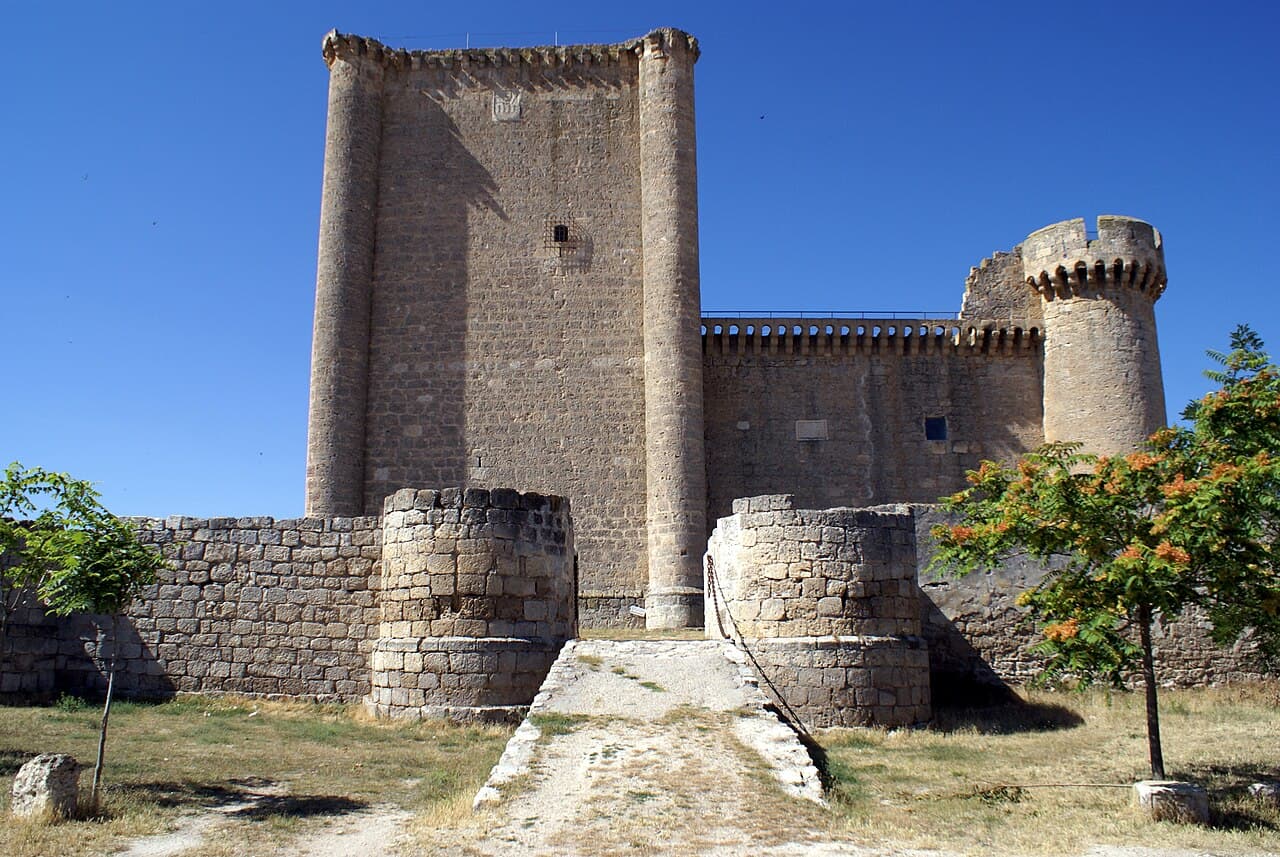
Villafuerte Castle is a notable late medieval hill castle located in the village of Villafuerte, within the province of Valladolid, Spain. Positioned strategically on a small hill, it overlooks the narrow valley carved by the Esgueva River, offering commanding views of the surrounding landscape. The castle's origins date back to around 1470, when it was constructed by the noble Franco de Toledo family, whose heraldic coats of arms, along with those of allied families such as Saravia, Mendoza, Osorio, and Guzmán, still adorn the main entrance gate and the keep's access point.
The architectural layout and defensive features
Villafuerte Castle exemplifies the tower castle typology, characterized by a compact, almost square enclosure fortified with round towers approximately 3 meters in diameter placed at three corners. The fourth corner is occupied by the imposing keep, measuring roughly 12 by 10.5 meters. This arrangement is reminiscent of other regional castles such as Torrelobatón Castle, reflecting common defensive design principles of the period.
The keep originally featured crenellations which have since been lost, and it rises to five floors, including two vaulted stone levels and three additional floors constructed with wooden frameworks. Vertical circulation within the keep is provided by a narrow, spiral staircase embedded within the thickness of the walls, connecting all floors. The main entrance to the keep is elevated about 7 meters above ground level, accessible via a separate spiral staircase from the courtyard and a movable wooden footbridge, enhancing its defensibility.
Within the courtyard, remnants suggest the presence of various auxiliary buildings, including stables with basements abutting the curtain walls. A portico supported by small columns likely stood opposite these structures, indicating a blend of defensive and domestic architectural elements.
Historical context and ownership
Villafuerte Castle was part of a broader defensive line established along the Esgueva River during the 15th century, a period marked by territorial consolidation and noble power assertion in Castile. Its first recorded lord was García Franco, a Jewish convert to Christianity, who may have commissioned the castle to secure his estates and assert his status within the region.
The castle's connection to prominent noble families is evidenced by the heraldry displayed on its gates, linking it to the influential Franco de Toledo lineage and their descendants. This underscores the castle's role not only as a military stronghold but also as a symbol of noble prestige and territorial control.
Preservation and current status
Despite periods of neglect and the use of its stones as a quarry by local villagers, Villafuerte Castle remains one of the few well-preserved examples of a 15th-century castle in the province of Valladolid. Significant portions of its outer walls, towers, and a small barbican survive intact, providing valuable insight into medieval military architecture in the region.
The castle has been officially recognized as a National Monument and is currently under the stewardship of the Spanish Castle Friends Association. Restoration efforts have focused on stabilizing the structure and furnishing the keep, which now houses a museum dedicated to the castle's history and architecture. Visitors can explore the interior spaces and ascend to the roof of the keep, gaining panoramic views of the surrounding countryside.
Visiting Villafuerte Castle and nearby attractions
Today, Villafuerte Castle is accessible to the public and offers a unique opportunity to experience a well-preserved medieval fortress firsthand. The museum inside the keep provides interpretive displays that contextualize the castle's historical significance and architectural features. The climb to the rooftop is a highlight, affording visitors a close-up look at the castle's defensive structures and the landscape it once dominated.
For those interested in exploring further, Encinas Castle lies just a few kilometers to the east, offering additional insight into the region's medieval fortifications and noble residences.
Frequently asked questions (FAQ)
- When was Villafuerte Castle built and by whom?
- Villafuerte Castle was built around 1470 by the noble Franco de Toledo family, with García Franco as its first lord.
- What is the architectural layout of Villafuerte Castle?
- The castle features a tower castle layout with a square enclosure, three round towers, and a keep at the fourth corner.
- Can visitors access the inside of Villafuerte Castle?
- Yes, visitors can explore the keep which houses a museum and climb to its roof for panoramic views.
- Is Villafuerte Castle well preserved?
- Yes, it is one of the best-preserved 15th-century castles in Valladolid, retaining much of its walls, towers, and barbican.
- Are there other castles near Villafuerte Castle worth visiting?
- Encinas Castle is located just a few kilometers east and is another medieval fortress to explore.
Photo gallery

Information
Current owner
Spanish Castle Friends Association
Address
Camino Castrillo, Villafuerte, Valladolid, Spain
Loading map...
Visitor reviews
No reviews yet. Been here? Write the first review and help other travelers!
Write the first reviewVisited this castle? Share your experience
Your review helps other travelers and adds first-hand knowledge to our encyclopedia.