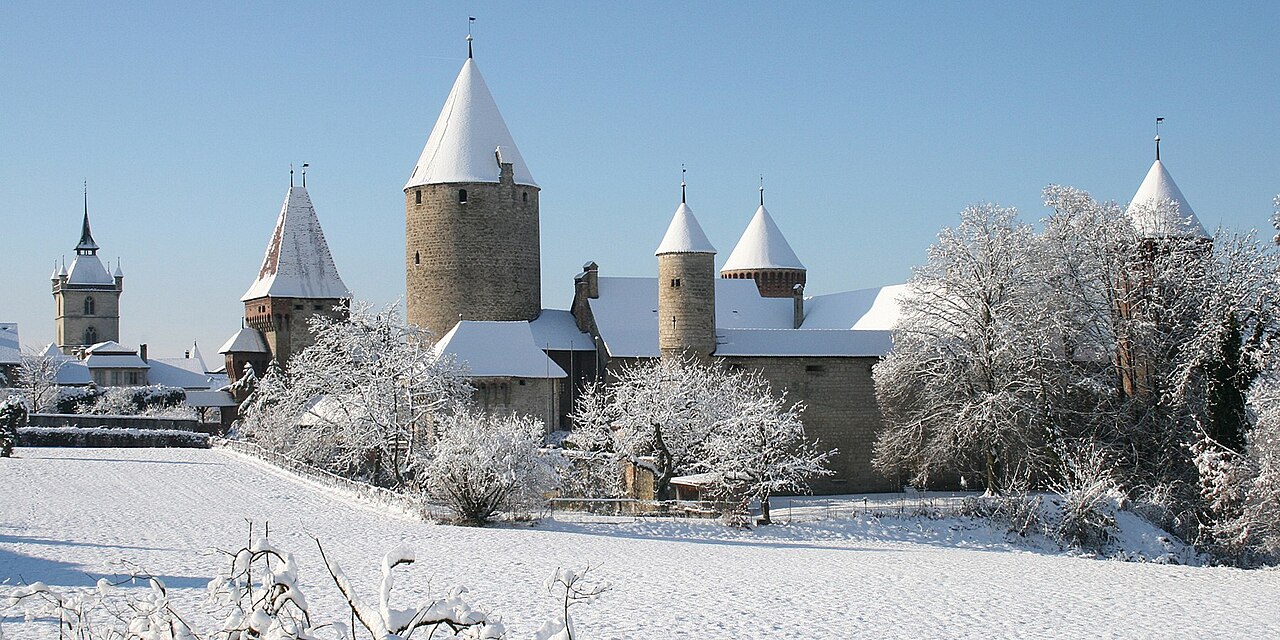
Vaumarcus Castle
Vaumarcus Castle stands as a remarkable example of medieval military architecture in Switzerland, embodying centuries of historical evolution and adaptation. Located in the village of Vaumarcus, this hill castle traces its origins to the 13th century, a period marked by significant advances in castle fortifications designed to counter emerging siege technologies such as throwing machines. The castle's strategic position atop a promontory overlooking the valley carved by the La Vaux stream and near the shores of Lake Neuchâtel provided both natural defense and control over the surrounding territories.
Originally constructed by the feudal lords of the region, Vaumarcus Castle served as the center of the barony (Freiherrschaft) of Vaumarcus. Its early history is closely tied to the noble families of Neuchâtel, with the castle first documented in 1285. The estate initially belonged to a junior branch of Rudolf II of Neuchâtel, before financial difficulties led to its sale to Count Rudolf IV of Neuchâtel in 1308. From that point forward, the castle was managed by appointed governors rather than hereditary lords, reflecting broader political shifts in the region.
Architectural evolution and defensive features
The castle's architectural development reflects the changing needs of medieval fortification. At its core stands a large bergfried or main tower, built in the 13th century, which functioned as both a defensive stronghold and residential space. Notably, the original entrance to this tower was situated approximately seven meters above ground level, accessible only by a wooden staircase that could be removed in times of danger to prevent enemy access. This elevated entrance was a common defensive feature in medieval castles, enhancing security against direct assault.
The ground floor of the bergfried housed the kitchen, evidenced by surviving fireplace remains that offer insight into the daily life of the castle's inhabitants. Subsequent enhancements after 1309 included the construction of a Gothic gate on the ground floor, equipped with a drawbridge to further fortify the entrance. Massive stone buttresses were added to the eastern corners facing the valley, reinforcing vulnerable points against siege attacks.
Additional defensive features include machicolations—openings in the parapets designed to drop projectiles or boiling liquids on attackers—strategically placed along the castle walls and above the main gate. A round tower adjacent to the entrance was constructed to better withstand siege engines, its curved walls deflecting projectiles more effectively than flat surfaces. A hexagonal stair tower at the rear facilitated safer movement between the different levels of the fortress.
Historical significance and ownership changes
Vaumarcus Castle's history is marked by episodes of conflict and changing ownership that mirror the tumultuous political landscape of medieval Switzerland. The castle was besieged and burned by the Swiss army following the Battle of Grandson in 1476 during the Burgundian Wars, a critical conflict that reshaped power dynamics in the region. After this destruction, Rudolf von Hochberg, having confiscated the property from his vassal, undertook a significant reconstruction of the fortress, restoring its defensive capabilities and residential functions.
Ownership disputes continued into the 16th century until the barony was transferred through marriage to the Bonstetten family in 1577. The lordship was elevated to the status of Freiherrschaft in 1595, reaffirming its noble standing. From 1675, the von Bürens family administered the estate until feudal rights were abolished in 1831 as part of regional reforms. The castle continued to serve judicial functions until 1832, after which civil administration responsibilities moved to nearby districts.
Later architectural additions and current use
In the 18th century, a significant architectural addition known as the "New Castle" was constructed on the northeastern part of the site around 1773. This Baroque-style residence features a hipped roof, decorative pilasters supporting cornices along the façade, and a prominent gable adorned with the von Bürens family coat of arms. The new building is surrounded by a terrace and formal gardens, contrasting with the medieval fortress's austere defensive structures.
Today, Vaumarcus Castle presents an asymmetrical silhouette shaped by its layered history, combining robust medieval fortifications like machicolations, buttressed towers, and thick stone walls with elegant Baroque residential elements. The castle has been repurposed to serve modern functions, housing an international central administration, a family and gastronomic restaurant, and a cultural center. This adaptive reuse preserves the castle's cultural heritage while integrating it into contemporary community life.
Location and landscape context
Perched on a hilltop, Vaumarcus Castle commands sweeping views over the valley and nearby Lake Neuchâtel, emphasizing its strategic importance in controlling regional trade routes and local settlements. The surrounding landscape, including the La Vaux stream, provided natural defensive advantages that were augmented by the castle's stone fortifications. The site also included a small village at the base of the hill, reflecting the typical medieval arrangement where the castle served as the administrative and military center for the surrounding populace.
Architectural details and defensive innovations
The castle's design incorporates several defensive innovations characteristic of the High Medieval period. The elevated entrance to the bergfried is a notable feature, reducing vulnerability to direct assault. The addition of a drawbridge and Gothic gate enhanced access control, while machicolations allowed defenders to repel attackers from protected positions. The round tower's curved walls were an advanced design to better resist siege engines, a response to evolving military technology.
The hexagonal stair tower improved internal mobility and safety during attacks, allowing defenders to move efficiently between floors without exposure to external threats. These architectural elements illustrate the castle's adaptation to the demands of medieval warfare and the need for both defense and residential comfort.
Cultural heritage and preservation
Vaumarcus Castle has been legally protected since 1978 due to its significant cultural and historical value. The castle's preservation allows visitors to explore a site that encapsulates the complex history of feudal Switzerland, medieval military architecture, and noble residence development. Its current use as a cultural center and restaurant ensures that the castle remains a vibrant part of the community, bridging past and present.
Visitors can appreciate the castle's architectural layers, from the imposing medieval bergfried and defensive walls to the elegant Baroque "New Castle" and landscaped terraces. The site offers insights into medieval life, feudal politics, and architectural innovation, making it a valuable destination for history enthusiasts and cultural tourists alike.
Frequently asked questions (FAQ)
- How do I visit Vaumarcus Castle?
- Vaumarcus Castle is open to visitors depending on scheduled events and services. It is recommended to check the official website or contact the administration for current visiting hours and ticket information.
- What architectural styles are present at Vaumarcus Castle?
- The castle features a combination of High Medieval military architecture with later Baroque residential additions, reflecting its long history of construction and renovation.
- When was Vaumarcus Castle originally built?
- Vaumarcus Castle was originally constructed in the 13th century and has undergone several phases of rebuilding and expansion since then.
- Can I dine at Vaumarcus Castle?
- Yes, the castle houses a family and gastronomic restaurant, offering visitors the opportunity to enjoy meals within a historic setting.
- Why is Vaumarcus Castle historically significant?
- Vaumarcus Castle played an important role as a feudal stronghold and administrative center, witnessing key events such as the Burgundian Wars and changes in regional governance.
Information
Opening hours
Varies depending on events and services
Ticket prices
Varies depending on events and services
Current owner
Private owner
Website
Visit websiteSources & official resources
Verify the information above using these authoritative references.
Loading map...
Visitor reviews
No reviews yet. Been here? Write the first review and help other travelers!
Write the first reviewVisited this castle? Share your experience
Your review helps other travelers and adds first-hand knowledge to our encyclopedia.