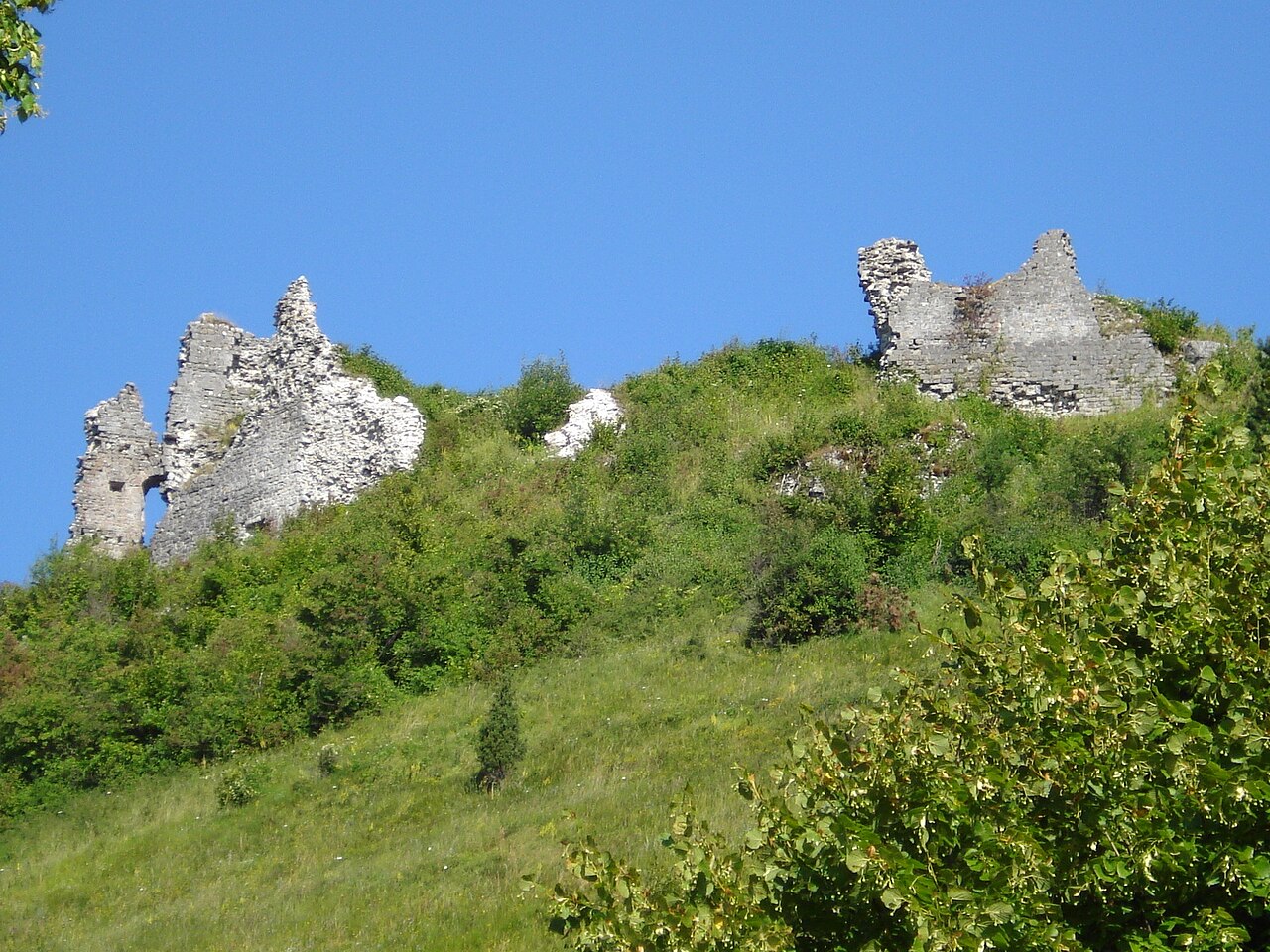
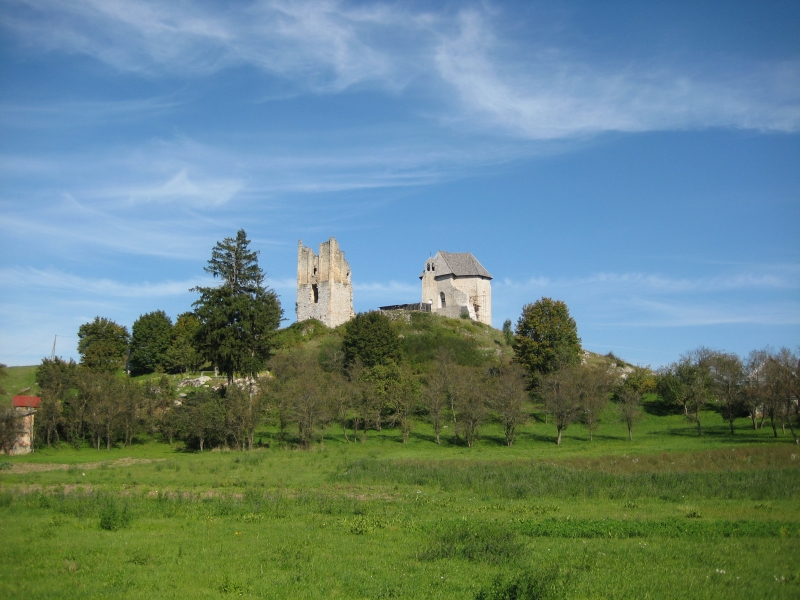
Trzan Castle, located above the village of Modruš near Josipdol in Croatia, is a significant medieval fortress with a rich history dating back to the early medieval period. Perched on a steep ridge approximately 670 metres above sea level on the eastern slopes of the Velika Kapela mountain, the castle commanded a strategic vantage point overlooking the ancient road connecting the Adriatic Sea to the Pannonian Basin. This crucial route had been a vital corridor for trade and military movements since antiquity, making the castle's location of great importance for regional control.
Historical records, including those of the renowned Croatian historian Vjekoslav Klaić (1849–1928), suggest that a stronghold or castle existed at this site as early as the 9th century AD. It likely played a role during the conflict between Borna, Duke of Dalmatian Croatia, and Ljudevit Posavski, Duke of Pannonian Croatia. Throughout its history, Trzan Castle maintained an almost impregnable position, never falling to enemy conquest despite the turbulent times and regional conflicts. Although the nearby town of Modruš suffered destruction during the Ottoman incursions in 1493, just before the Battle of Krbava Field, the castle itself withstood such threats.
Ownership and development under the Frankopans
From 1193, the castle became the property of the Princes of Krk, who later became known as the Frankopan family, one of Croatia's most distinguished noble lineages. The castle and its surrounding estate were granted to Bartol II Krčki by the Croato-Hungarian King Bela II (III) in recognition of his military service. For over three and a half centuries, Trzan Castle served as the main seat and stronghold of the Frankopans, who undertook significant reconstruction and expansion efforts.
Architectural enhancements and trade significance
The Frankopans rebuilt and enlarged the originally irregularly shaped fortress, which by around 1437 was known as Tržan-grad, reflecting the growth of trade activities within its walls. The castle's defensive structures, including its walls, bastions, and towers, were constructed using hewn stone (ashlar) in a fishbone pattern, showcasing advanced masonry techniques of the period. Evidence suggests that foreign master builders, likely from the Republic of Venice, contributed to the construction, introducing architectural influences from Venetian fortification styles.
The castle complex was divided into distinct sections: a central area featuring a large guard tower and a palace residence for the princely family and their staff; a northern section containing outbuildings for economic activities such as workshops, warehouses, and water tanks, along with a rectangular defensive tower; and a southern section dedicated to retail trade facilities and accommodation for merchants and travelers. This layout reflects the castle's dual role as both a military fortress and a commercial hub.
Defensive structures and town fortifications
Surrounding the castle were extensive defensive walls, approximately 1,200 metres in length, encircling the town of Modruš and descending the hillside. These fortifications protected the settlement below and reinforced the castle's strategic dominance over the region. The interconnected system of walls and bastions illustrates the importance placed on defense during a period marked by frequent raids and warfare.
Decline and military use
Bernardin Frankopan (1453–1529), a notable member of the Frankopan family, managed the estate during a time of increasing Ottoman pressure following the conquest of Bosnia to the east. The growing threat led to a gradual decline in the castle's significance by the late 15th century, as the local population began relocating to safer areas within Croatia and beyond.
In the first half of the 16th century, maintenance of the castle diminished, and by 1553 it came under the control of the military authorities of the Croatian Military Frontier. A small garrison was stationed at Trzan Castle to guard the frontier, but the fortress was increasingly neglected. Despite attempts in the 17th and 18th centuries to repair and rebuild parts of the castle, these efforts were insufficient to restore its former strength.
By 1791, with the Ottoman threat significantly reduced, military authorities decided to abandon the castle, deeming it unnecessary to maintain a garrison there. Since then, Trzan Castle has fallen into ruin, with its remains standing as a testament to its historical role in regional defense and noble residence.
Architectural features and construction techniques
The castle's construction utilized ashlar masonry laid in a distinctive fishbone pattern, a technique that enhanced the strength and durability of the walls. The presence of multiple bastions and towers provided overlapping fields of fire and strong defensive positions. The large guard tower served as a lookout and last refuge during sieges, while the palace within the castle walls offered residential comfort for the noble family.
The integration of economic and trade facilities within the fortress walls is notable, reflecting the castle's role as a center of commerce in addition to its military functions. Water tanks and workshops supported the self-sufficiency of the castle's inhabitants, especially during times of siege.
Cultural and historical significance
Trzan Castle is an important cultural monument in Croatia, illustrating the evolution of medieval fortifications and noble residences in the region. Its association with the Frankopan family, one of Croatia's most influential noble houses, adds to its historical value. The castle's resistance to conquest and its strategic location highlight the military and economic dynamics of medieval Croatia.
Today, the ruins of Trzan Castle attract visitors interested in medieval architecture, Croatian history, and the legacy of the Frankopan family. The site offers insights into the defensive strategies and lifestyle of Croatian nobility during the medieval period.
Information
Loading map...
Visitor reviews
No reviews yet. Been here? Write the first review and help other travelers!
Write the first reviewVisited this castle? Share your experience
Your review helps other travelers and adds first-hand knowledge to our encyclopedia.