Trekroner Fortress
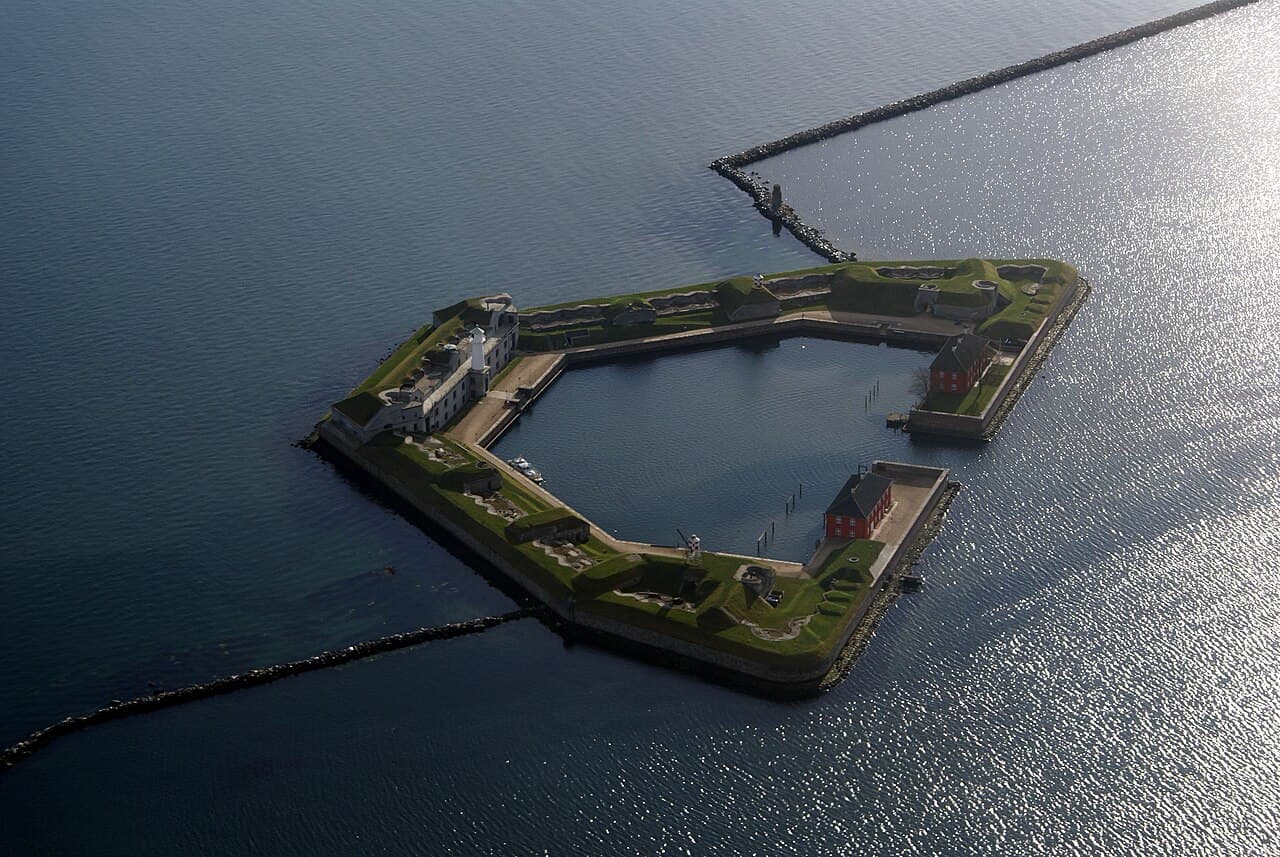
Trekroner Fortress, also known as Trekroner Søfort or the Three Crowns Sea Fortress, is a historic bastioned sea fort strategically positioned at the entrance to the Copenhagen harbour in Denmark. This fortress played a crucial role in the maritime defense system of Copenhagen from the early 18th century through the aftermath of the First World War. Its location on an artificial island allowed it to serve as a formidable barrier against naval attacks, protecting the Danish capital and its vital port facilities.
Early origins and naval foundation
The origins of Trekroner Fort date back to 1713, when the first iteration of the fortress was established a few hundred meters north of the current site. This initial fortification was ingeniously constructed by sinking three old ships of the line to form a stable foundation for a coastal battery. One of these ships bore the name Trekroner, which subsequently lent its name to the fortress itself. This early naval foundation was typical of maritime defenses of the period, utilizing decommissioned warships as a base for artillery emplacements.
Construction of the current fort and architectural features
The construction of the present-day fortress commenced in 1787, reflecting advancements in military architecture during the post-Renaissance period. Trekroner Fortress is classified as a bastioned fortress, a design characterized by angular bastions projecting outward from the main walls to provide overlapping fields of fire and eliminate blind spots. This style was prevalent in European military fortifications from the 16th to the 19th centuries.
The fortress was built on an artificial island, one of three created specifically to defend the harbor entrance, alongside Middelgrundsfortet and Flakfortet. The island's construction involved extensive maritime engineering to establish a stable platform for the heavy fortifications and artillery.
Military engagements and strategic importance
Trekroner Fortress played a significant role during the Battle of Copenhagen in 1801, where it formed part of the Danish naval defense against the British fleet. Its artillery batteries engaged the attacking forces, contributing to the city's resistance during this pivotal conflict.
Again in 1807, during the British attack on Copenhagen, the fortress was actively involved in the defense efforts. These engagements underscore the fortress's strategic importance in controlling access to the capital via the sea.
19th-century enhancements and decline
The fortress underwent substantial upgrades from 1818 to 1828 and again in 1860. These enhancements included strengthening the bastions, updating artillery emplacements, and improving the overall defensive capabilities to keep pace with evolving military technology.
Despite these improvements, the military significance of Trekroner Fortress gradually diminished after the First World War due to changes in naval warfare and the advent of new defense technologies.
20th-century usage and preservation
In 1934, the fortress was sold to the Copenhagen harbour services, marking a shift from military to civilian use. During the German occupation of Denmark in World War II, the fortress was repurposed as a barracks for German troops. After the war, it briefly served as a prison for German officers and the former German ambassador to Denmark.
Following this period, Trekroner Fortress fell into disuse and remained vacant until it was opened to the public in 1984. Today, it stands as a well-preserved example of bastioned maritime fortifications and is accessible to visitors interested in military history and coastal defense architecture.
Architectural significance and legacy
Trekroner Fortress exemplifies the bastioned fortress design adapted to a maritime environment. Its construction on an artificial island demonstrates advanced engineering skills of the late 18th century. The fortress's angular bastions, thick masonry walls, and strategic placement highlight the defensive priorities of the era, focusing on overlapping fields of fire and protection against naval bombardment.
As one of three artificial islands built to guard Copenhagen's harbor, it forms part of a unique coastal defense system that reflects Denmark's historical emphasis on securing its capital from seaborne threats. The fortress remains an important cultural and historical landmark, illustrating the evolution of military architecture and coastal defense strategies over several centuries.
Frequently asked questions (FAQ)
- How do I get to Trekroner Fortress?
- Trekroner Fortress is located on an artificial island at the entrance to Copenhagen harbour. Visitors typically reach it by boat tours departing from Copenhagen's waterfront. Check local tour operators for schedules and availability.
- What is the historical significance of Trekroner Fortress?
- Trekroner Fortress was a key bastioned sea fort defending Copenhagen from the early 18th century through World War I. It played active roles in the battles of 1801 and 1807 against British attacks.
- Can I visit Trekroner Fortress?
- Yes, Trekroner Fortress has been open to the public since 1984. Visitors can explore the well-preserved bastions and learn about its military history through guided tours and informational displays.
- When was Trekroner Fortress built?
- The current fortress was constructed starting in 1787, replacing an earlier fortification established in 1713 based on sunken ships of the line.
- Why is Trekroner Fortress important architecturally?
- Trekroner Fortress is a prime example of a bastioned fortress adapted for maritime defense, built on an artificial island with angular bastions designed for overlapping fields of fire.
Photo gallery

Information
Sources & official resources
Verify the information above using these authoritative references.
Loading map...
Visitor reviews
No reviews yet. Been here? Write the first review and help other travelers!
Write the first reviewVisited this castle? Share your experience
Your review helps other travelers and adds first-hand knowledge to our encyclopedia.