Copenhagen Castle
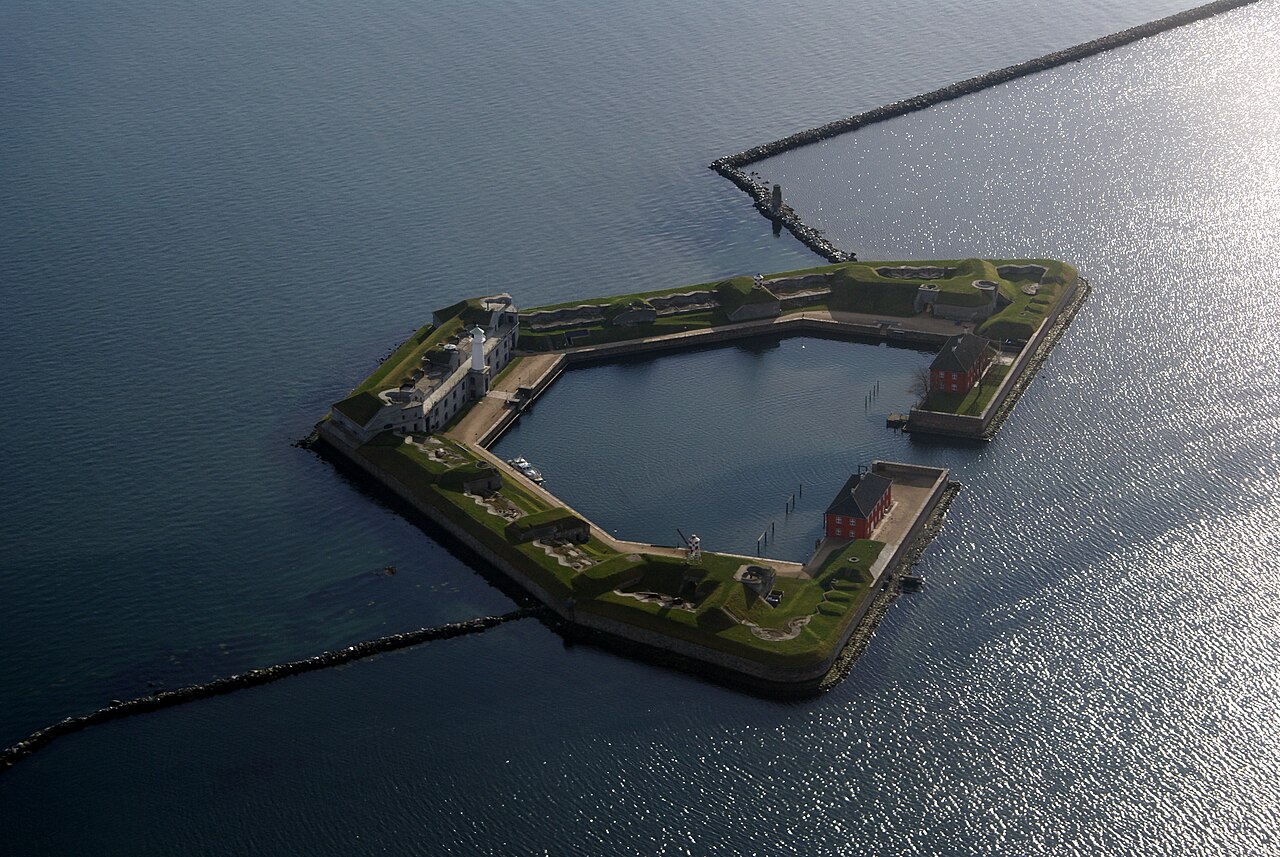
Copenhagen Castle, commonly referred to as Kastellet, is one of the best-preserved star fortresses in Northern Europe, situated in the northeast of Copenhagen, Denmark. Constructed in the shape of an almost regular pentagon with five bastions at its corners, Kastellet represents a prime example of Renaissance military architecture adapted to the evolving art of fortification during the 17th century. Its strategic location near the harbor entrance made it a critical component in the defense of Copenhagen for centuries.
Early origins and strategic importance
The origins of Kastellet date back to 1626 when King Christian IV initiated the construction of an advanced coastal redoubt known as Sankt Annæ Skanse (St. Anne's Redoubt). This initial fortification was designed to protect the harbor entrance and the newly founded district of Christianshavn, located across the strait between Zealand and Amager. The redoubt was part of a broader plan to extend Copenhagen's fortifications northward, replacing the old East Rampart and connecting the city's defenses directly to the coast.
By the mid-17th century, the fortification's significance grew considerably, especially after the loss of Danish territory east of the Øresund in 1658. The strategic vulnerability of Copenhagen's harbor necessitated a more robust defensive structure. Consequently, the fortification was expanded and modernized under the direction of the Dutch military engineer Henrik Ruse, who had expertise in bastioned fortifications, having worked on the Harburg fortress. The expansion was completed in 1667, transforming the site into a full-fledged citadel with a star-shaped layout featuring five bastions: Kongens Bastion, Dronningens Bastion, Prinsens Bastion, Prinsessens Bastion, and Grevens Bastion.
Architectural design and features
Kastellet's design follows the principles laid out by Italian Renaissance military architect Pietro Cataneo, emphasizing geometric regularity and overlapping fields of fire. The fortress is surrounded by a system of moats and ravelins (shield walls) that provide additional layers of defense. Access to the citadel is controlled through two main gates: the Sjaellandsporten gate (also known as Kongeporten), adorned with a bust of King Frederick III sculpted by François Dusart, and the Norwegian gate (Norgesporten), designed by architect Lambert van Haven.
Within the fortress grounds, several notable buildings contribute to its historical and architectural significance. The commandant's house (Kommandantbolig), designed by Elias David Häusser in 1725, served as the residence for the fortress commander. The citadel church is a rectangular hall featuring a wooden barrel vault aligned along the central axis of the complex, symbolizing the integration of spiritual life within the military installation. Adjacent to the church is the former prison, along with symmetrically arranged barracks and warehouses that supported the fortress's garrison. A windmill constructed on the Kongens Bastion added a practical element to the fortress's self-sufficiency.
Historical role and military significance
Kastellet played a crucial role in the defense of Copenhagen throughout its history. It was part of the city's extensive bastioned ramparts, which once encircled Copenhagen but now survive only in parts such as Christianshavn. The fortress was actively involved in several key conflicts, including the Swedish siege of Copenhagen (1658–1660), where its fortifications were vital in resisting the attackers.
During the Battle of Copenhagen in 1807, Kastellet was a central defensive position against the British naval assault. Later, on 9 April 1940, during the German invasion of Denmark in World War II, German forces captured the fortress with minimal resistance, which precipitated the Danish government's surrender.
Modern use and preservation
After centuries of military use, Kastellet has undergone several renovations, notably extensive restoration work from 1989 to 1999 funded by the A.P. Møller and Wife Chastine McKinney Møllers General Fund. Today, Kastellet serves primarily as a historic site and public park, while still hosting various military activities. The fortress is open to visitors who can explore its bastions, gates, historic buildings, and the peaceful green spaces within its walls.
Kastellet's preservation as a well-preserved Renaissance star fortress makes it a significant cultural landmark in Copenhagen, offering insight into the military architecture and urban development of Denmark from the 17th century onward.
Frequently asked questions (FAQ)
- What is the historical significance of Copenhagen Castle?
- Copenhagen Castle, originally built in the 12th century, served as the royal residence and a center of power for Danish monarchs. It reflects the evolution of Danish architecture and has witnessed many pivotal events in Denmark's history, from royal ceremonies to political intrigues.
- When was Copenhagen Castle constructed?
- The construction of Copenhagen Castle began in the early 12th century, with various renovations and expansions occurring over the centuries. The castle has undergone significant changes, particularly during the Renaissance and Baroque periods, leading to its current architectural style.
- Can I visit Copenhagen Castle?
- Yes, Copenhagen Castle is open to the public, allowing visitors to explore its historic grounds and exhibitions. However, it is advisable to check the official website for any special events or closures before planning your visit.
- What are the opening hours for Copenhagen Castle?
- Copenhagen Castle typically opens daily from 10:00 AM to 5:00 PM, with extended hours during the summer months. It is recommended to verify the current hours on the official website as they may vary seasonally or due to special events.
- Is it possible to access Copenhagen Castle with limited mobility?
- Yes, Copenhagen Castle is equipped with facilities to accommodate visitors with limited mobility. Wheelchair access is available in key areas, and staff are on hand to assist with any specific needs during your visit.
- What are the ticket prices for Copenhagen Castle?
- Tickets for Copenhagen Castle generally cost around 100 DKK for adults, with discounted rates for students and seniors. Children under a certain age can often enter for free, so it is best to check the official website for the most accurate and up-to-date pricing information.
- When is the best time to visit Copenhagen Castle?
- The best time to visit Copenhagen Castle is during the late spring and early summer months when the weather is pleasant, and the gardens are in full bloom. Additionally, visiting during weekdays can help you avoid the larger crowds typically seen on weekends.
- What nearby attractions can I explore while visiting Copenhagen Castle?
- While visiting Copenhagen Castle, you can also explore nearby attractions such as the National Museum of Denmark, the picturesque Nyhavn harbor, and the iconic Little Mermaid statue. These sites are within walking distance and provide a rich cultural experience of Copenhagen.
Photo gallery

Photo by Unknown authorUnknown author•Public domain
Information
Loading map...
Visitor reviews
No reviews yet. Been here? Write the first review and help other travelers!
Write the first reviewVisited this castle? Share your experience
Your review helps other travelers and adds first-hand knowledge to our encyclopedia.