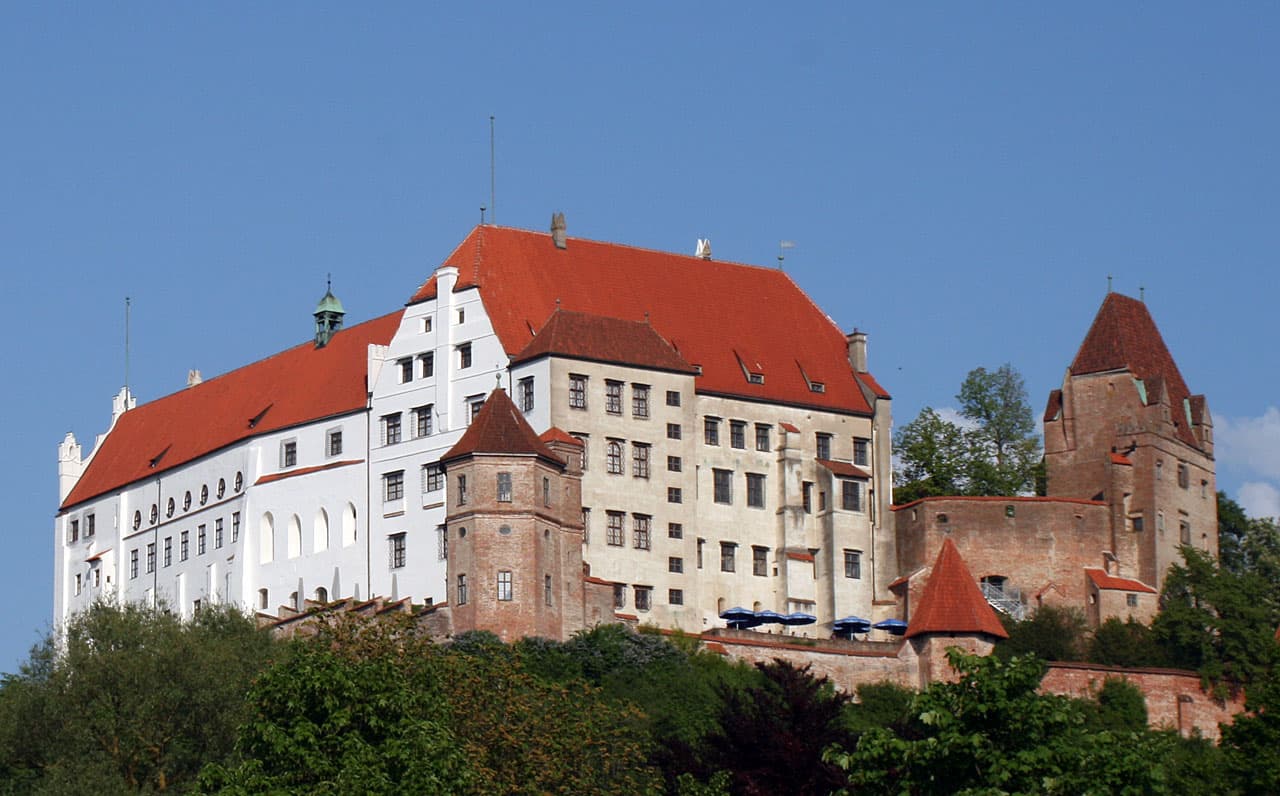
Trausnitz Castle
Trausnitz Castle stands prominently above the historic center of Landshut, Germany, embodying centuries of Bavarian political power, cultural development, and architectural evolution. Founded in 1204 by Duke Ludwig I, this hill castle served as the principal residence of the Wittelsbach dynasty for the duchy of Lower Bavaria from 1255 to 1503 and later became the seat of the hereditary rulers of the entire Bavarian territory. Its strategic location atop a hill not only provided defensive advantages but also symbolized the authority and prestige of its occupants.
The castle's origins trace back even further to prehistoric times, with archaeological evidence revealing fortifications from the Urnfield culture. Around 1150, a wooden watchtower known as Landeshuata occupied the site, giving the city of Landshut its name. The transition to a stone fortress began in the early 13th century, with the castle largely completed by 1235. It quickly emerged as a political and cultural center, hosting Emperor Frederick II and renowned Minnesänger such as Tannhäuser and Walther von der Vogelweide.
Medieval origins and the wittelsbach residence
Following the division of Bavaria in 1255, Trausnitz Castle became the ducal residence for Lower Bavaria. The castle's medieval core includes the original curtain walls, the palas (main residential building), and the bergfried or main tower known as the Wittelsbacher Turm. The St. George Chapel, a late-Romanesque structure with 13th-century sculptures, highlights the castle's religious and artistic significance during this period.
The Old Dürnitz or Knights' Hall, a two-nave vaulted hall measuring approximately 245 square meters, served as a ceremonial and residential space and remains in use today for banquets and exhibitions. The 15th century brought significant expansions under Dukes Ludwig IX and George the Rich, including the construction of the Princes' Building and the New Knights' Hall. The curtain walls were heightened and extended, and impressive towers were added, reinforcing both the castle's defense and its status as a princely residence.
The landshut wedding and cultural prominence
One of the castle's most enduring legacies is the Landshut Wedding, a lavish celebration originally held in 1475 by Duke Ludwig the Rich to mark the marriage of his son Georg to Hedwig, daughter of the Polish king. This event is reenacted every four years, drawing visitors worldwide and showcasing medieval pageantry and traditions.
Renaissance transformation and artistic flowering
In the early 16th century, Duke Ludwig X initiated a redesign of the castle interiors, blending late Gothic and emerging Renaissance styles. Although few original elements from this renovation survive, the period marked a shift towards more comfortable and stylistically sophisticated living spaces.
Between 1568 and 1579, Prince Wilhelm V, born at Trausnitz in 1548, fostered a vibrant cultural environment at the castle. He gathered artists, musicians, and comedians, elevating the court's artistic profile. Architect and painter Friedrich Sustris played a pivotal role, introducing arcaded galleries with flat pilasters and elaborate Florentine Mannerist wall paintings. These included the famous "Narrentreppe" or Staircase of Fools, adorned with frescoes depicting scenes from the Italian Commedia dell'arte by Alessandro Paduano.
During this Renaissance phase, the castle also housed Bavaria's first court brewery, established in 1573, which produced dark beer until 1590. The Söller terrace tower, known from 1493, was enhanced with decorative wooden ceilings and music platforms, exemplifying the blend of fortification and courtly leisure.
Later history, decline, and restoration
The castle's military significance was underscored during the Thirty Years' War when, in 1634, Swedish forces besieged Landshut and breached the eastern walls of Trausnitz. The entry point is commemorated by the Swedish Gate. Following this turbulent period, the castle's role shifted towards more utilitarian functions.
In the 18th century, Trausnitz served as barracks, a prison for aristocratic detainees, and briefly as a manufactory for wool and silk goods. The early 19th century saw its use as a military hospital and a cholera hospital from 1831. King Ludwig II prepared guest accommodations in the castle's second floor during the late 19th century, though these were never used.
The Fürstenbau wing suffered a devastating fire on October 21, 1961, which destroyed many Renaissance frescoes, furnishings, and King Ludwig II's apartments. However, the Narrentreppe and St. George Chapel survived. Subsequent restoration efforts have preserved the castle's historic fabric and adapted it for modern use.
Museum collections and cultural significance
Today, Trausnitz Castle houses the Chamber of Art and Curiosities in the former Ladies' Apartments, showcasing the Wittelsbach dukes' extensive collections of art, natural specimens, and exotic artifacts. This museum is a branch of the Bavarian National Museum and reflects the Renaissance passion for collecting and knowledge.
The castle's medieval halls, including the vaulted Old Knight's Hall and the castle chapel with its winged altarpieces, provide visitors with a glimpse into its storied past. The Renaissance is represented through the vaulted cabinets, panelled rooms, and the famous Fools' Staircase. The tour concludes with panoramic views of Landshut from the tower terrace, emphasizing the castle's commanding position over the city.
Architectural features and layout
Trausnitz Castle is a complex ensemble combining medieval fortifications and Renaissance modifications. The main castle or Hauptburg occupies the southwestern hilltop edge, featuring the bergfried (Wittelsbacher Turm), multiple residential wings, gates, and chapels arranged around inner courtyards.
The oldest surviving structures exhibit the Cistercian Gothic style with sturdy stone construction. The 15th-century expansions added the White Hall (Weißer Saal), a large festive hall, though it was never fully completed. The Renaissance period introduced three-story arcaded galleries and Italianate loggias, blending defensive and aesthetic functions.
The Damenstock, or Ladies' Wing, contains the Art and Curiosities Chamber museum, while the outer ward (zwinger) surrounds the castle with defensive walls and towers. The Outer Courtyard (Vorburg) once housed agricultural buildings but was damaged during the 1634 siege and is now an open meadow known as the "Swedish Meadow".
One notable feature is the Fürstentreppe or Princes' Staircase, a brick-built sloped path reinforced to allow horses to ascend from the old town to the castle's outer courtyard, highlighting the practical considerations of castle logistics.
Grounds and surrounding landscape
The castle is surrounded by forested areas and the Hofgarten, a former palace garden redesigned in the late 18th century in the Neoclassical style. Opened to the public in 1837, the garden offers a landscaped setting adjoining the castle's outer defenses, providing visitors with a serene environment to complement their historical exploration.
Frequently asked questions (FAQ)
- How do I visit Trausnitz Castle and what are its opening hours?
- Trausnitz Castle is open to visitors daily, typically from 10:00 to 16:00. It is advisable to check the official website or local tourist information for any seasonal changes or special events before planning your visit.
- What is the historical significance of Trausnitz Castle?
- Trausnitz Castle was the ducal residence of the Wittelsbach dynasty for Lower Bavaria and later the entire Bavarian territory. It played a key role in regional politics, culture, and hosted important events such as the Landshut Wedding.
- Can I see original Renaissance art and architecture at Trausnitz Castle?
- While many Renaissance frescoes were lost in the 1961 fire, visitors can still admire the castle's Renaissance arcaded galleries, the famous Fools' Staircase with its Commedia dell'arte frescoes, and the Art and Curiosities Chamber museum.
- Is Trausnitz Castle accessible for people with mobility challenges?
- Due to its medieval hilltop location and historic structures, accessibility may be limited in some areas. Visitors with mobility challenges should inquire in advance about available accommodations and accessible routes.
- When is the best time to experience the Landshut Wedding reenactment at Trausnitz Castle?
- The Landshut Wedding reenactment takes place every four years, typically in the summer months. Attending during this event offers a unique opportunity to witness medieval costumes, ceremonies, and festivities at the castle and throughout Landshut.
Photo gallery

Information
Sources & official resources
Verify the information above using these authoritative references.
Loading map...
Visitor reviews
No reviews yet. Been here? Write the first review and help other travelers!
Write the first reviewVisited this castle? Share your experience
Your review helps other travelers and adds first-hand knowledge to our encyclopedia.



