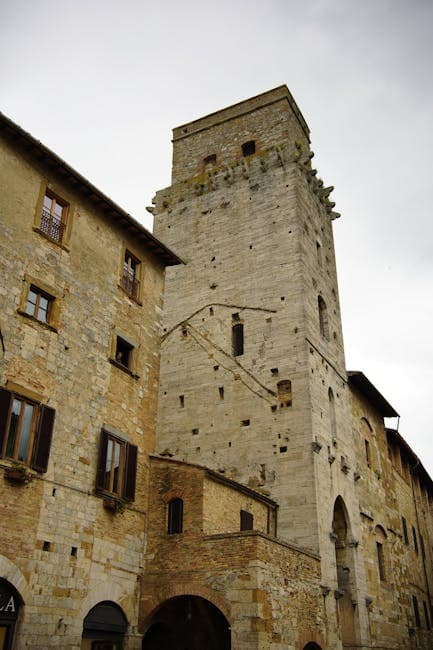
Towers of San Gimignano
The towers of San Gimignano stand as some of the most remarkable and evocative medieval architectural features in Italy, symbolizing the wealth, rivalry, and civic pride of merchant families in this Tuscan hill town. Located in the heart of Tuscany, San Gimignano's historic skyline was once dominated by as many as 72 stone towers, built primarily during the 12th to 14th centuries. These towers served as both defensive structures and status symbols for the powerful families who competed to build the tallest and most impressive edifices within the town walls.
San Gimignano's strategic position along the Via Francigena, a key medieval pilgrimage and trade route connecting northern Europe to Rome, contributed to its prosperity during the High and Late Medieval periods. The town's merchant families capitalized on the constant flow of pilgrims and traders, amassing wealth that they expressed architecturally through their towers. The towers not only provided protection but also demonstrated the social and economic standing of their owners in a period when urban fortification and family prestige were deeply intertwined.
The rise of tower building in San Gimignano
During the 12th and 13th centuries, San Gimignano experienced a building boom, with families erecting towers that could reach heights rivaling or exceeding the main public tower, the Torre Rognosa, which stands nearly 52 meters tall. The towers were constructed primarily from local stone, featuring a quadrangular plan and narrow slit windows designed for defense. The competition among families was fierce, leading to an informal contest to build the tallest tower, although a 1255 town decree prohibited any tower from surpassing the height of the communal towers.
Despite regulations, some towers, such as the Torri degli Ardinghelli, originally exceeded the height of Torre Rognosa, reflecting the intense rivalry between families like the Ardinghelli and the Salvucci. These towers were often connected by bridges, enabling safe passage between allied families' homes above the streets. Over time, concerns about structural stability and political decrees led to the reduction in height of certain towers, but their symbolic importance remained strong.
The Torri degli Ardinghelli
The Torri degli Ardinghelli are two prominent medieval towers built in the 12th century by the Ardinghelli family, wealthy merchants aligned with the Ghibelline faction. These towers exemplify the architectural style of the period, constructed with regularly cut stone blocks known as bozze regolari. The taller tower originally reached nearly 50 meters but was reduced in height in the 19th century due to stability concerns, then partially restored in the 1930s.
Architectural features include narrow single-light windows (monofore) and defensive loopholes for archers. The two towers were once linked by a bridge over the street, with surviving base supports visible above the roofs. The adjacent Pellari tower, allied to the Ardinghelli, was physically connected and later shortened, with some lower openings bricked up, reflecting changes over centuries.
Torre grossa: the tallest tower
Torre Grossa, built between 1300 and 1311, is the tallest surviving tower in San Gimignano, standing at 54 meters. Located in the Piazza del Duomo, it was closely associated with the municipal government, adjacent to the Palazzo Nuovo del Podestà. The tower's construction coincided with a culturally vibrant period marked by the visit of the poet Dante Alighieri.
The tower features a square base and is constructed from finely cut stone blocks arranged in regular masonry patterns. A vaulted passageway allows access at ground level. The bell chamber (cella campanaria) atop the tower is surrounded by a walkway protected by a parapet supported by hanging arches (archetti pensili), a hallmark of the Lombard architectural style. The pyramidal roof is distinctive among San Gimignano's towers, shared only with Torre Rognosa.
Today, Torre Grossa remains well preserved and accessible to visitors, offering panoramic views of the town and the surrounding Tuscan countryside, highlighting its enduring significance as a civic landmark.
The rocca di montestaffoli: florentine fortress
The Rocca di Montestaffoli is a fortress built in the 14th century by Florentine forces atop Montestaffoli hill, which overlooks San Gimignano. The site has earlier origins dating to the Early Middle Ages, when a castle controlled by the bishop of Volterra occupied the hill. The fortress was constructed following a period of plague, famine, and internal conflict, marking a shift in political control as San Gimignano came under Florentine influence.
The fortress walls, built in 1353, represent typical mid-14th century military architecture, designed to protect the town and its strategic trade routes. Although the internal buildings no longer survive, the robust stone walls remain, integrated with the town's defensive system. The elevated position of the Rocca offered commanding views and was vital for military observation.
In modern times, the Rocca di Montestaffoli has been partially restored and serves as a cultural venue, hosting events and exhibitions, preserving its historical legacy within the landscape of San Gimignano.
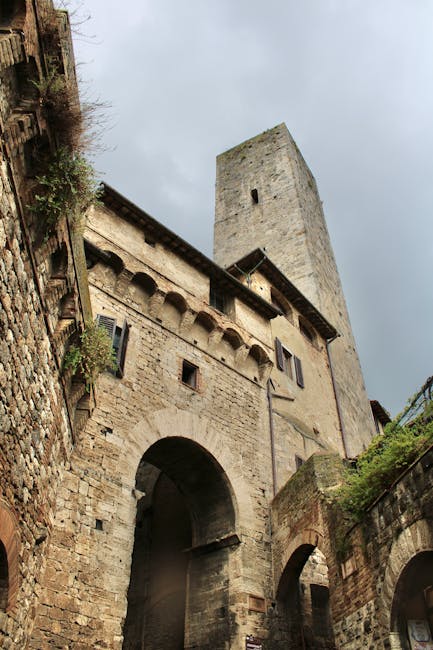
Photo by Alexandra Slivca
San gimignano's towers today
Of the original 72 towers, only 14 to 15 remain, preserved as a testament to the town's medieval heritage. The towers are a defining feature of San Gimignano's historic center, which is protected as a UNESCO World Heritage Site. Their preservation offers insight into medieval urban life, architecture, and the social dynamics of power and prestige in Tuscany.
Visitors to San Gimignano can explore several towers, including Torre Grossa and the Torri degli Ardinghelli, many of which are open to the public. The towers provide not only architectural interest but also spectacular views of the surrounding Tuscan landscape, making them a focal point for cultural tourism in the region.
The towers' enduring presence underscores their importance as cultural symbols, architectural achievements, and historical landmarks, reflecting the complex interplay of commerce, politics, and family rivalry that shaped medieval Tuscany.
Frequently asked questions (FAQ)
- What is the historical significance of the Towers of San Gimignano?
- The Towers of San Gimignano are a remarkable example of medieval architecture and were built between the 11th and 13th centuries. They served as both fortifications and symbols of wealth for noble families in the region, showcasing the town's importance as a trade center during the Middle Ages.
- When is the best time to visit the Towers of San Gimignano?
- The best time to visit the Towers of San Gimignano is during the spring (April to June) and fall (September to October) when the weather is mild and the tourist crowds are smaller. These seasons offer a pleasant climate for exploring the towers and the surrounding medieval town.
- Can I climb the towers for a better view?
- Yes, visitors can climb certain towers for breathtaking views of the Tuscan countryside and the historic town. Be sure to check which towers are open for climbing, as access may vary based on preservation efforts and visitor safety.
- What are the opening hours for the Towers of San Gimignano?
- The opening hours for the Towers of San Gimignano can vary by season, but generally, they are open from 9:00 AM to 7:00 PM. It is advisable to check the official website or local visitor information for any changes in hours before planning your visit.
- Is it possible to purchase tickets in advance for the Towers of San Gimignano?
- Yes, it is possible to purchase tickets in advance for the Towers of San Gimignano through various online platforms. Buying tickets ahead of time can help you avoid long lines and ensure your access to this popular attraction.
- What nearby attractions can I explore after visiting the Towers of San Gimignano?
- After visiting the Towers of San Gimignano, you can explore the beautiful Piazza della Cisterna, the Church of San Agostino, and local museums like the Museum of Sacred Art. The surrounding countryside also offers opportunities for wine tasting and scenic hikes in the stunning Tuscan landscape.
- How do I get to the Towers of San Gimignano?
- The Towers of San Gimignano are easily accessible by car or public transport. If traveling by bus, regular services connect San Gimignano with nearby cities like Florence and Siena, making it a convenient day trip destination.
- Are the Towers of San Gimignano accessible for visitors with disabilities?
- While some areas of the Towers of San Gimignano may be challenging due to stairs and uneven surfaces, efforts are made to accommodate visitors with disabilities. It is recommended to check in advance regarding specific accessibility options available for your visit.
Photo gallery

Photo by Giuseppe Di Maria


Information
Website
Visit websiteSources & official resources
Verify the information above using these authoritative references.
Loading map...
Visitor reviews
No reviews yet. Been here? Write the first review and help other travelers!
Write the first reviewVisited this castle? Share your experience
Your review helps other travelers and adds first-hand knowledge to our encyclopedia.


