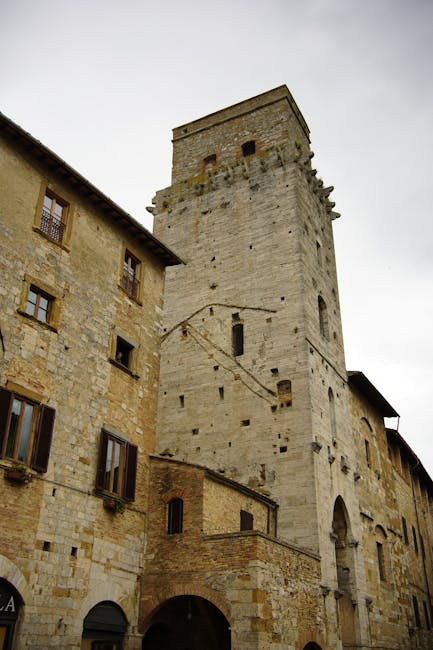
Fortezza di Poggio Imperiale
The Fortezza di Poggio Imperiale stands as a remarkable example of Renaissance military architecture in the heart of Tuscany. Located in the municipality of Poggibonsi, Italy, this fortress was constructed during a transformative period in the late 15th and early 16th centuries, reflecting the strategic and urban planning ambitions of the Florentine Republic. Its design and construction mark a pivotal moment in the evolution of fortifications, driven by the advent of gunpowder artillery and the changing nature of warfare.
Commissioned by the influential statesman Lorenzo de’ Medici, known as Lorenzo il Magnifico, the fortress was designed by the renowned architect Giuliano da Sangallo beginning in 1488. The site was chosen atop Poggio Imperiale hill, replacing the medieval settlement of Poggiobonizio, which had been destroyed centuries earlier. This location was not only strategic but also symbolic, situated near the site of the unfinished city project Monte Imperiale initiated by Emperor Henry VII in 1313. The fortress was intended to secure the vulnerable Florentine frontier against the rival city-state of Siena and to embody the ideals of Renaissance urbanism.
Historical context and construction
The construction of the Fortezza di Poggio Imperiale was a direct response to the military and political challenges faced by Florence in the late 15th century. The 1478 Aragonese sack of Poggibonsi exposed the weaknesses of existing defenses and underscored the need for a modern fortification capable of withstanding artillery assaults. Giuliano da Sangallo, along with his brother Antonio da Sangallo the Elder, introduced innovative design features that departed from traditional medieval fortifications.
One of the most significant architectural advancements was the adoption of polygonal bastions instead of the earlier circular towers. These bastions were designed to better deflect cannonballs and provide overlapping fields of fire, a crucial adaptation to the increasing use of gunpowder weapons. The fortress was part of a broader plan to create an ideal Renaissance city on the hill, integrating military, urban, and symbolic functions. However, the project was never fully completed. Following Lorenzo de’ Medici’s death in 1492, shifting political priorities and ongoing conflicts with Siena led to the cessation of construction by 1513.
Architectural features and layout
City walls and gates
The fortress complex includes an unfinished circuit of city walls extending over one kilometer along the western slope of Poggio Imperiale hill. These walls follow the natural contours of the terrain rather than a strict geometric plan, showcasing a pragmatic approach to fortification. Constructed primarily of brick with travertine stone accents, the walls feature polygonal bastions at key points, enhancing their defensive capability.
At the base of the walls lies a listening gallery tunnel, an ingenious feature designed to detect enemy mining operations aimed at undermining the defenses. This tunnel connects various bastions and gates, providing a secure internal communication route. Among the gates, Porta San Francesco stands out as the only fully completed entrance, characterized by a double stone doorway, vaulted passage, and the remnants of a drawbridge. This gate incorporates an older U-shaped tower dating back to the 13th century, originally part of Poggiobonizio’s medieval fortifications and later adapted into the Renaissance defenses.
Other gates include Porta del Giglio, facing towards Florence; Porta di Calcinaia, oriented toward Siena; Porta della Fonte, providing access to a nearby spring known as Fonte delle Fate; and a smaller emergency exit called Porta Piccola. These gates illustrate the fortress’s role in controlling access and movement across the region.
The fortress (cassero mediceo)
The central fortress, known as the Cassero Mediceo, is laid out in an irregular pentagonal shape. Each corner is crowned with polygonal bastions, while a ravelin—a triangular defensive outwork—is positioned at the eastern tip. The bastions feature double embrasures designed for mounting cannons, housed within circular, dome-shaped artillery platforms. Additional cannon openings are located where the bastions meet the courtines (connecting walls), providing comprehensive coverage against attackers.
The fortress walls are predominantly scarped or sloped to better deflect artillery fire. Constructed from brick reinforced with travertine stone at the corners and around cannon openings, the eastern section of the fortress is partially carved directly from the natural travertine outcrop of the hill, integrating the structure seamlessly with the terrain.
Access to the fortress is through a smaller gate similar in design to the city gates, leading into a long corridor. Within the fortress stands a four-story building known as the donjon or casern, which spans the width of the fortress from north to south. This building includes a chamber identified as a chapel, notable for its proportions and location. The exterior walls of the fortress exhibit superior craftsmanship compared to the interior, which was used for agricultural purposes for centuries until restoration efforts began in the late 20th century.
Strategic significance and views
The fortress’s elevated position atop Poggio Imperiale hill offers commanding views of the surrounding landscape, underscoring its strategic importance. From the bastions, visitors can observe the nearby town of Poggibonsi, the rolling Chianti hills to the south, the Metalliferous hills extending toward the Tyrrhenian Sea to the west, and the Apennine mountain range to the north. This vantage point allowed defenders to monitor key regional routes and anticipate potential threats.
Restoration and current use
After centuries of neglect, the fortress and its walls remained remarkably preserved, retaining much of their original Renaissance character due to the abandonment of further modifications. In the early 21st century, significant restoration efforts took place between 2014 and 2015, focusing on clearing vegetation, uncovering blocked gates, and stabilizing the structure.
Today, the interior of the fortress houses a Documentation Center dedicated to archaeological finds from Poggibonsi. Visitors can explore exhibits featuring coins, ceramics, glassware, seals, and everyday items spanning from late antiquity through the Renaissance period. This center highlights the cultural and historical significance of the site, connecting the fortress’s military past with the broader human history of the region.
The Fortezza di Poggio Imperiale remains a testament to the innovative spirit of Renaissance military engineering and the complex history of Tuscany’s borderlands. Its combination of medieval remnants with cutting-edge 15th-century fortification techniques provides valuable insight into the evolution of defensive architecture during a time of profound political and technological change.
Frequently asked questions (FAQ)
- How do I get to Fortezza di Poggio Imperiale?
- Fortezza di Poggio Imperiale is located in Poggibonsi, Italy, and is easily accessible by car and public transportation. If you are driving, there are designated parking areas nearby. For public transport, check local train and bus schedules that connect to Poggibonsi.
- What are the opening hours of the castle?
- The Fortezza di Poggio Imperiale is typically open to visitors from 10 AM to 6 PM, with extended hours during the summer months. It is advisable to check the official website or contact local tourism offices for any seasonal changes or special closures.
- Can I buy tickets online for the castle?
- Yes, tickets for Fortezza di Poggio Imperiale can be purchased online through the official website or authorized ticketing platforms. Buying tickets in advance is recommended, especially during peak tourist seasons to avoid long queues.
- When was Fortezza di Poggio Imperiale built?
- Fortezza di Poggio Imperiale was constructed in the mid-16th century, specifically between 1559 and 1561, under the direction of architect Francesco de’ Medici. It was built to strengthen the defenses of the region and played a significant role in the control of trade routes.
- Is it possible to guide myself through the castle?
- Visitors to Fortezza di Poggio Imperiale can explore the castle on their own, as there are informative signs and brochures available. However, guided tours are also offered, providing deeper insights into the history and architecture of the fortress.
- Why is Fortezza di Poggio Imperiale historically significant?
- The castle holds great historical significance as it was a strategic military fortification during the Renaissance period, influencing the power dynamics in Tuscany. It also served as a symbol of the Medici family's control over the region, showcasing their architectural prowess and military strategy.
- What is the best time to visit Fortezza di Poggio Imperiale?
- The best time to visit is during the spring and fall when the weather is mild, and the tourist crowds are smaller. Additionally, visiting during local festivals can enhance your experience with cultural events held at the castle.
- Are there any nearby attractions to explore?
- Yes, there are several nearby attractions, including the charming town of San Gimignano, famous for its medieval towers, and the Chianti wine region, known for its picturesque landscapes and vineyards. These sites can easily be incorporated into your visit to Fortezza di Poggio Imperiale.
- What architectural features can I expect to see?
- Fortezza di Poggio Imperiale is characterized by its star-shaped layout, thick walls, and impressive bastions, reflecting Renaissance military architecture. The castle's design integrates both defensive structures and living quarters, offering a glimpse into the military life of the time.
Information
Website
Visit websiteSources & official resources
Verify the information above using these authoritative references.
Loading map...
Visitor reviews
No reviews yet. Been here? Write the first review and help other travelers!
Write the first reviewVisited this castle? Share your experience
Your review helps other travelers and adds first-hand knowledge to our encyclopedia.