
Tourelles Castle
Château des Tourelles, located in the northern part of Vernon in the Eure department of France, is a remarkable example of medieval military architecture that has endured for over eight centuries. Originally constructed in 1196 under the orders of King Philip II Augustus during the late 12th century, this fortress was strategically built to protect the newly captured town and its vital bridge over the Seine River. The castle served as a critical military base during the ongoing conflicts between France and England, particularly during the struggle for control over Normandy.
The castle’s design is distinctive, featuring a compact square keep approximately 10.5 meters on each side, surrounded by four evenly spaced cylindrical towers each about 6.3 meters in diameter and rising to roughly 14 meters in height. These towers, along with the thick stone walls measuring between 1.1 and 1.8 meters, provided formidable defense capabilities. The castle was originally surrounded by a moat and connected to the stone bridge by a wooden drawbridge, emphasizing its role as a protective bridgehead.
Historical context and construction
The castle was built shortly after King Philip II seized Vernon from the English in 1196, during the captivity of Richard the Lionheart. This event marked a significant shift in territorial control in the region. The Château des Tourelles replaced an earlier fortification, possibly dating back to the time of Duke Henry I Beauclerc, underscoring Vernon’s longstanding strategic importance on the Seine’s right bank.
By 1202-1203, the castle was documented in royal records as the "tower of the bridge," with its guard entrusted to a figure known as Maître Hugues. Throughout the Ancien Régime, it remained under the jurisdiction of the local administrative district, the châtellenie of Vernon, serving primarily as a military stronghold overseeing river access and town defenses.
Architectural features and modifications
Medieval military design
The castle’s core structure consists of a central keep flanked by four round towers, each equipped with arrow slits designed for archers to defend the fortress effectively. Access between floors is provided by a spiral staircase located in the southern corner, notable for its shaft slightly encroaching on adjoining rooms. The building spans three floors: the ground level, the first floor, and an attic with a chemin de ronde walkway, all interconnected by this staircase.
The ground floor features a vaulted corridor leading to the south turret and the original staircase, illuminated by narrow arrow slits with semicircular vaults. This level also contains a vaulted hall with a wooden floor supported by stone corbels, a large fireplace, and several window openings, though many have been altered over time.
18th-century restoration and adaptations
Between 1760 and 1765, the castle underwent significant restoration led by Jean-Baptiste Lemoyne de Bellisle, steward to the Duke of Orléans. This renovation introduced new architectural elements, including updated entrances, windows, and a grand spiral staircase. The original battlemented parapet and roof were replaced to suit contemporary needs, reflecting a shift from purely military to residential and utilitarian functions.
Following this restoration, the castle was sold to a miller named Planter, who converted it into a flour mill. The southern courtyard was adapted with additional floors and enlarged openings to store grain, significantly altering the castle’s medieval appearance and internal layout.
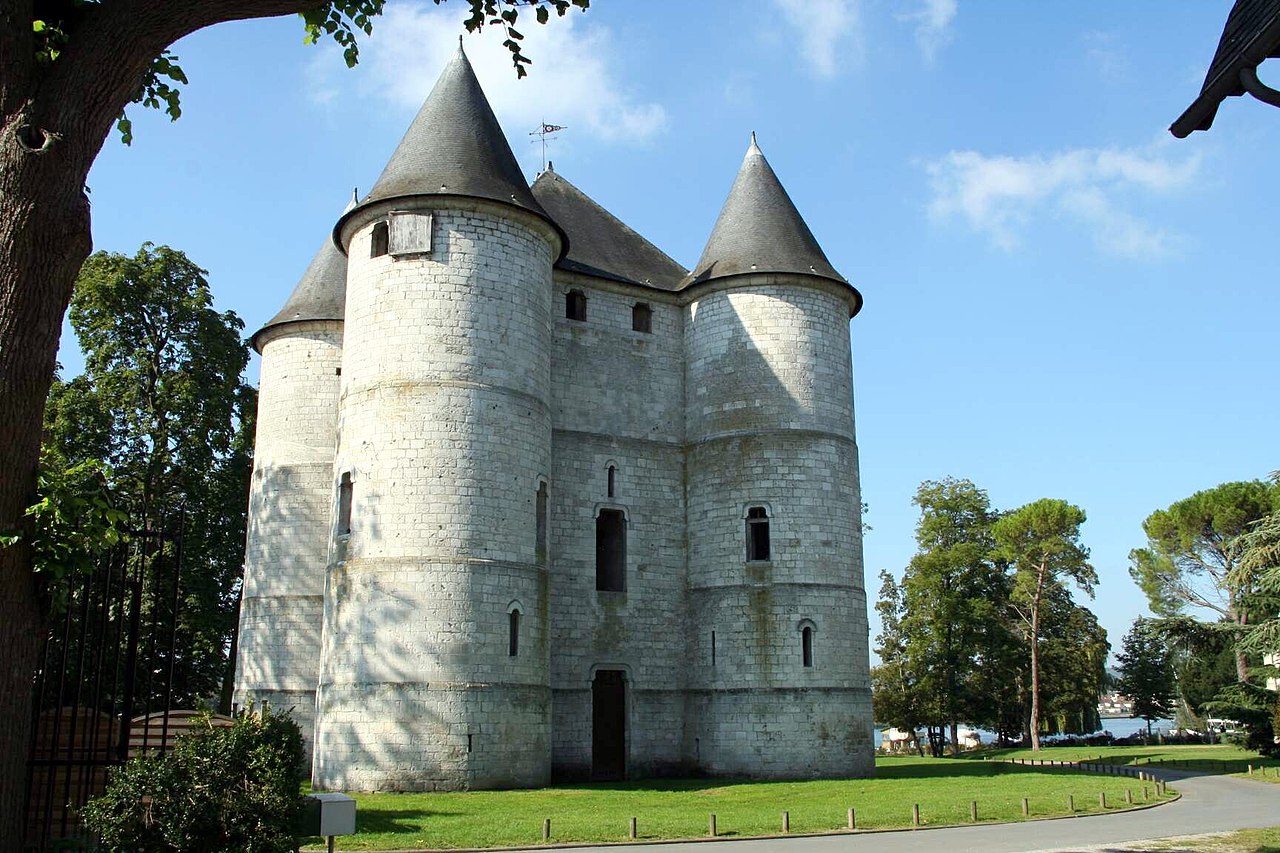
Photo by Spedona (Spedona) • CC BY-SA 3.0
Later uses and historical significance
During the French Revolution, the Château des Tourelles served as a prison, highlighting its continued role in local governance and security. In the mid-19th century, it functioned as military barracks before being purchased by industrialist Ogerau in 1854, who transformed the site into a tannery. His modifications included demolition of the mill’s warehouse and the addition of walkways and masonry reinforcements, some of which remain visible.
The castle sustained heavy damage during World War II, with the roof destroyed by German bombings in 1940 and the west turret demolished by Allied bombing in 1944. Restoration efforts were undertaken in two main phases in 1984 and 1997, employing historical revival techniques and modern materials such as plexiglass for upper-level windows. These restorations continued into the 21st century, concluding in 2019.
Preservation and cultural importance
The Château des Tourelles has been recognized for its historical and architectural significance, classified as a monument historique by the French Ministry of Culture since 1945. It is also part of a protected natural site since 1943. The castle remains one of the few in France that has retained much of its original medieval structure, offering valuable insight into 12th-century castle construction and military strategy.
Today, the castle is owned by the commune of Vernon and is situated within the grounds of a rafting school, although its interior is not open to the public. The exterior and surrounding gardens are freely accessible, allowing visitors to appreciate its imposing silhouette and architectural details. Since 2016, the castle has featured architectural lighting that highlights its turrets and foliage, enhancing its nighttime presence and cultural visibility.
Architectural details and technical specifications
- Dimensions: The central keep measures approximately 10.5 meters by 10.5 meters.
- Towers: Four round towers, each about 6.3 meters in diameter and 14 meters tall.
- Wall thickness: Between 1.1 and 1.8 meters, providing robust fortification.
- Height: The entire structure rises to about 20 meters.
- Materials: Constructed from finely cut limestone blocks sourced locally from Vernon quarries.
- Interior features: Vaulted corridors, ribbed vaults with decorative keystones, large fireplaces, arrow slits, and a spiral staircase.
- Defensive elements: Originally surrounded by a moat and curtain walls, with a wooden drawbridge connecting to the stone bridge.
Defensive adaptations
The castle’s design reflects its primary function as a defensive stronghold guarding the Seine bridge. The arrow slits allowed defenders to cover multiple angles, while the thick walls and towers provided protection against siege weapons. The moat and drawbridge further enhanced its defensibility, controlling access from the bridge and river.
Changes over time
While the castle retains much of its medieval character, various modifications reflect its changing uses. The raising of the interior floor level by nearly a meter likely served to prevent flooding from the Seine. The 18th-century renovations introduced more residential features, and industrial adaptations in the 19th century altered its external and internal appearance.
Visiting information and cultural events
Though the interior of the Château des Tourelles is not currently open for tours, visitors can explore the exterior and surrounding gardens freely. The castle’s location near the Seine and its historical significance make it a popular spot for photography and cultural appreciation. The architectural lighting installed in recent years enhances evening visits, providing a dramatic view of its medieval silhouette.
The castle has also been featured in French cinema, notably as a filming location for the movie "Les grandes vacances," starring Louis de Funès, adding to its cultural footprint.
Frequently asked questions (FAQ)
- How do I get to Tourelles Castle?
- Tourelles Castle is located in Vernon, France, easily accessible by car or public transportation. If you are traveling by train, the nearest station is Vernon-Giverny, which is about a 10-minute drive from the castle. Local buses also connect the train station to the castle, making it convenient for visitors.
- What is the historical significance of Tourelles Castle?
- Tourelles Castle dates back to the 15th century and played a crucial role during the Hundred Years' War. It was strategically positioned to defend the region and has witnessed many historical events. The castle stands as a testament to the medieval military architecture of the time and offers insight into France's rich history.
- When was Tourelles Castle built?
- Tourelles Castle was constructed in the late 15th century, specifically around 1450. It was built during a period of political turmoil and was designed to serve as a defensive fortress. Over the centuries, it has been renovated but still retains much of its original charm.
- Can I tour Tourelles Castle?
- Yes, visitors can tour Tourelles Castle during its opening hours. Guided tours are available, providing insights into the castle's history and architecture. It is advisable to book in advance, especially during peak tourist seasons, to ensure availability.
- Why is Tourelles Castle an important architectural site?
- Tourelles Castle is an important architectural site due to its unique blend of defensive and residential features. The castle showcases classic elements of medieval design, including thick stone walls, towers, and a moat. Its preservation allows visitors to appreciate the craftsmanship and engineering of the period.
- Is it possible to access Tourelles Castle with a wheelchair?
- Tourelles Castle has made efforts to improve accessibility for visitors with mobility challenges. While some areas may be difficult to navigate due to the castle's historic structure, there are designated accessible routes available. It is recommended to contact the castle management in advance for specific accessibility inquiries.
- What are the opening hours for Tourelles Castle?
- Tourelles Castle is generally open to visitors from 10 AM to 6 PM during the tourist season, which runs from April to October. In the off-season, the hours may vary, so it's best to check the official website for the latest information. Additionally, the castle may be closed on certain holidays.
- What are the ticket prices for Tourelles Castle?
- Ticket prices for Tourelles Castle are typically around €10 for adults, with discounts available for students and seniors. Children under a certain age may enter for free. It is advisable to check the official website for any special events or promotions that may affect ticket pricing.
- What are some nearby attractions to Tourelles Castle?
- Nearby attractions include the picturesque town of Giverny, home to Monet's Garden, and the historic Vernon town center. Visitors can also explore the Seine River and its scenic views. These attractions make for a perfect day trip combined with a visit to Tourelles Castle.
Photo gallery

Information
Address
Rue Ogereau, Vernon, France
Loading map...
Visitor reviews
No reviews yet. Been here? Write the first review and help other travelers!
Write the first reviewVisited this castle? Share your experience
Your review helps other travelers and adds first-hand knowledge to our encyclopedia.