Torrelobaton Castle
Torrelobaton Castle stands prominently in the village of Torrelobatón, located in the province of Valladolid, Spain. This late medieval fortress is a striking example of military architecture from the 15th century, built on a small hill that commands the surrounding landscape. Its strategic position allowed control over the Hornija valley, an important area during the Middle Ages.
The castle's construction began in the early 15th century, around 1406, under the authorization of Don Alfonso Enríquez, 1st Admiral of Castile, following a royal license from King John II of Castile. It replaced an earlier modest stone enclosure that had surrounded the village, transforming the site into a formidable fortress. The castle was further developed and completed under the influence of the Valladolid school of castle design, known for its robust, compact, and highly defensible structures.
Architectural design and features
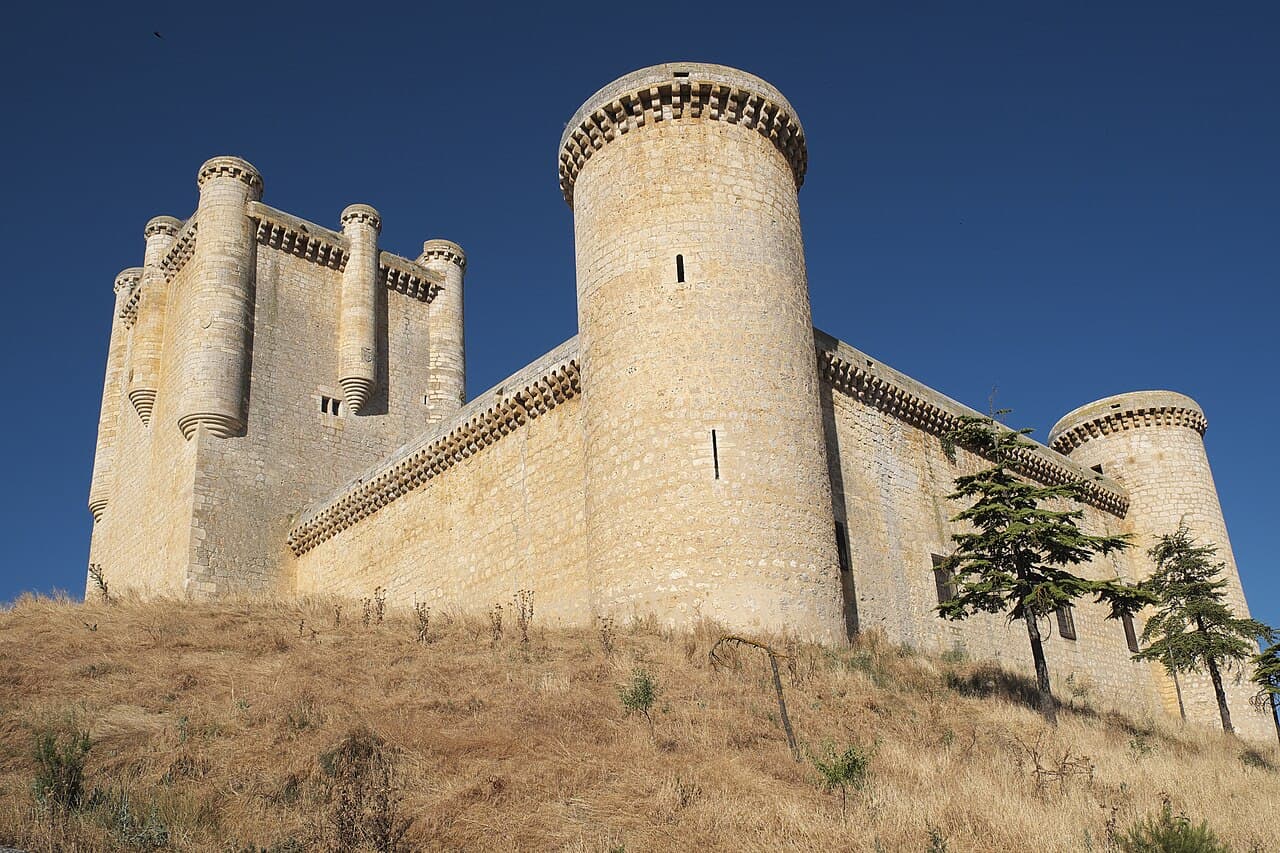
The layout of Torrelobatón Castle is nearly square, enclosed by very high curtain walls. Three of its corners are fortified with massive circular towers, locally known as cubos, each approximately 20 meters tall and 10 meters in diameter. These towers provided excellent vantage points for surveillance and defense. The fourth corner is dominated by a large square keep, or torre del homenaje, which rises about 40 meters high, measuring 20 meters wide and 5 meters thick.
This keep is one of the castle's most distinctive features, crowned by eight smaller circular turrets placed on each corner and midpoint of the walls. These turrets rest on accordion-shaped corbels, allowing defenders to cover all angles around the tower. The keep's walls are pierced with narrow arrow slits for crossbows and gun slits for early firearms, reflecting the adaptation of the castle to evolving military technology.
The main entrance to the castle leads through a gate with a semicircular arch, protected by a portcullis and vertical arrow slits. This gate opens into a courtyard that would have housed the garrison's quarters and service buildings. Remnants of an outer defensive wall, or muralla, and a moat once surrounded the castle, though today only fragments remain. A barbican, an outer defensive gate structure, is still visible on the western side, enhancing the castle's layered defenses.
Interior and defensive elements
Inside the keep, there are three vaulted floors accessed by a staircase of 143 steps interrupted by several doorways. The original entrance was located halfway up the tower, connected to the wall walk by a drawbridge. The lowest floor features a pointed barrel vault and an antechamber facing the wall, indicative of the original 14th-century construction with Portuguese architectural influences. The second floor boasts a ribbed vault from the late 15th century, while the third floor contains a large vaulted hall that may have been divided into two levels later on.
The castle also includes a postern in the northern wall, providing a secret exit through a small tunnel leading to the moat. There is historical mention of a secret underground passage, though its exact route remains uncertain. Approximately 50 meters from the castle, near the Church of Santa María, stands a stone cistern with a barrel vault, now used as a private wine cellar. Tradition suggests it might have been connected to the castle by an underground passage, adding to the fortress's defensive and logistical complexity.
Historical significance and events
Torrelobatón Castle was owned by the Enríquez family, who served as Admirals of Castile from 1455 to 1473. Their heraldic emblems are prominently displayed on the keep, symbolizing their authority and connection to the fortress. Don Fadrique Enríquez notably installed the main coat of arms on the torre del homenaje after receiving royal approval from King Juan II.
The castle played a crucial role during the Revolt of the Comuneros in 1521, a significant uprising against the rule of King Charles I (Holy Roman Emperor Charles V). The fortress was besieged by the comuneros' forces under the command of Juan de Padilla. After an eight-day siege, the defenders loyal to the crown were trapped within the keep, highlighting the castle's strategic importance and defensive strength.
Following the revolt, the castle underwent repairs in 1535, including the reshaping of its battlements into their distinctive "mailbox" form, reflecting advancements in military architecture. The Enríquez family maintained ties to the castle until the 19th century, although they lost ownership of the village and fortress during the 18th century.
Modern use and preservation
In the mid-20th century, Torrelobatón Castle was repurposed as a grain silo by the National Wheat Service under the Ministry of Agriculture. This agricultural use altered the interior but ensured the structure's continued maintenance. The castle was declared a historic heritage site in 1949, recognizing its cultural and architectural significance.
Ownership transferred to the local municipality in 2003, which undertook rehabilitation efforts. Since 2007, the castle has housed the Interpretation Center of the War of the Comuneros, providing educational exhibits about the castle's role in this pivotal historical event. The fortress also gained cinematic fame as a filming location for the 1961 historical epic "El Cid," starring Charlton Heston, where it represented the town of Vivar, the birthplace of the legendary Castilian hero.
Architectural legacy and cultural importance
Torrelobatón Castle exemplifies the Valladolid school of castle design, characterized by its compact, robust form and innovative defensive features. Its combination of circular towers and a massive square keep with multiple turrets demonstrates a sophisticated approach to fortification in the late medieval period. The castle's adaptation to early firearms, evident in its gun slits and remodeled battlements, marks a transitional phase in military architecture.
Despite its adaptation for agricultural storage, the castle's exterior remains remarkably well-preserved, retaining its imposing silhouette and distinctive architectural elements. It continues to attract visitors interested in medieval military history, Spanish heritage, and castle architecture.
Frequently asked questions (FAQ)
- How do I get to Torrelobaton Castle?
- Torrelobaton Castle is located in the village of Torrelobatón, Spain, which is easily accessible by car. The nearest major city is Valladolid, approximately 30 kilometers away, and there are local bus services that connect the village to nearby towns.
- What is the historical significance of Torrelobaton Castle?
- Torrelobaton Castle dates back to the 15th century and is an important example of medieval military architecture in the region. It played a crucial role in the defense strategies during the periods of conflict in Spain, showcasing the historical importance of fortifications in rural areas.
- When was Torrelobaton Castle built?
- Construction of Torrelobaton Castle began in the late 15th century, around 1460, and it was completed shortly thereafter. The castle reflects the architectural style of its time, combining defensive features with residential elements.
- Can I take guided tours of Torrelobaton Castle?
- Yes, guided tours are available and provide an in-depth look at the castle's history and architecture. It is recommended to book in advance, especially during peak tourist seasons, to ensure availability.
- Why is Torrelobaton Castle a popular tourist attraction?
- Torrelobaton Castle attracts visitors for its well-preserved structure and scenic views of the surrounding countryside. Its rich history and unique architectural features make it a fascinating destination for both history enthusiasts and casual tourists.
- Is it possible to visit Torrelobaton Castle year-round?
- Yes, Torrelobaton Castle is open to visitors throughout the year, although hours may vary by season. It’s advisable to check the official website for the most current opening times before your visit.
- What are the ticket prices for Torrelobaton Castle?
- Ticket prices for Torrelobaton Castle are generally affordable, with discounts available for students and seniors. Group rates may also apply, so it's best to inquire when booking your visit.
- What is the best time to visit Torrelobaton Castle?
- The best time to visit Torrelobaton Castle is during the spring and fall when the weather is mild and pleasant. These seasons also offer fewer crowds, allowing for a more enjoyable experience while exploring the castle.
- Are there any nearby attractions to visit after Torrelobaton Castle?
- Yes, nearby attractions include the historic town of Olmedo, known for its beautiful architecture and rich history, as well as the scenic natural parks in the surrounding area. Combining your visit to the castle with these sites can provide a full day of exploration.
Photo gallery

Information
Sources & official resources
Verify the information above using these authoritative references.
Loading map...
Visitor reviews
No reviews yet. Been here? Write the first review and help other travelers!
Write the first reviewVisited this castle? Share your experience
Your review helps other travelers and adds first-hand knowledge to our encyclopedia.