The Castle on Roanoke

The castle on roanoke in peoria
Peoria, Illinois, United States of America
Well Preserved

The Castle on Roanoke in Peoria, Illinois is a distinctive residential building designed to evoke the appearance of a traditional castle within an urban environment. This unique structure combines the aesthetic elements of medieval fortifications with the practical function of modern apartment living, offering a rare blend of historic architectural style and contemporary use. Its stone construction and castle-like features make it a notable landmark in the city.

Architectural features and design

The castle's most striking characteristic is its robust stone masonry, which gives the building a fortress-like presence uncommon in typical residential architecture. The prominent tower at the front of the building draws inspiration from medieval turrets, providing a vertical emphasis that enhances the castle silhouette. Decorative battlement-style parapets crown the roofline, reinforcing the fortress motif and adding to the visual impact. These architectural details, while evocative of defensive structures, serve primarily aesthetic purposes rather than functional military defense.

Stone construction and materials

The use of natural stone in the façade contributes to the building's historic ambiance and durability. The masonry work is carefully crafted to simulate the rugged texture of medieval castle walls, creating an authentic look that contrasts with the more common brick or siding found in the surrounding neighborhood. This choice of material not only enhances the castle theme but also provides substantial insulation and longevity.

Castle-inspired elements

Beyond the tower and battlements, the structure incorporates other castle motifs such as narrow window openings reminiscent of arrow slits, although adapted for residential use. The overall massing of the building is compact and vertical, echoing the form of a keep or donjon, which were central defensive towers in medieval castles. The entrance and window surrounds are framed with stone detailing that hints at medieval craftsmanship, further embedding the castle theme into the design.

Location and prominence in peoria

Located at a prominent corner on West Columbia Terrace, The Castle on Roanoke stands out amid the urban fabric of Peoria. Its commanding position and distinctive style make it a local landmark easily visible to pedestrians and motorists. The castle's presence adds architectural diversity to the area, drawing interest from residents and visitors who appreciate its uncommon design.

Urban context and neighborhood

The surrounding neighborhood consists mainly of residential and commercial buildings typical of Peoria's urban landscape. In this context, The Castle on Roanoke provides a striking contrast, offering a touch of medieval romanticism in an otherwise modern setting. Its location allows it to function as a visual anchor within the community, contributing to the local identity.

Current use and visitor experience

Unlike historical castles built for defense or noble residence, The Castle on Roanoke is a residential apartment building adapted for modern living. It is available as a vacation rental, notably through platforms such as Airbnb, allowing guests to experience the ambiance of castle-inspired architecture without leaving the city. The interior combines contemporary amenities with the exterior’s historic style, creating a unique living environment.

Accommodation features

The apartments within the castle offer modern conveniences while maintaining the thematic design. Guests can enjoy the novelty of staying in a building that visually references medieval castles, complete with stone walls and castle-like architectural details. This blend of old-world charm and new-world comfort is a key attraction for visitors seeking distinctive accommodations in Peoria.

Cultural significance and architectural inspiration

The Castle on Roanoke exemplifies a modern interpretation of medieval architecture within a residential context. Its design reflects the ongoing fascination with castle imagery in contemporary architecture, where elements of historic fortifications are adapted for aesthetic appeal rather than practical defense. This approach aligns with a broader trend of romanticizing medieval styles in urban residential buildings.

Influence of medieval architecture

Medieval castles, originally constructed for protection and residence of nobility, have long inspired architectural revival movements. The Castle on Roanoke draws on these influences to create a visually compelling structure that evokes the grandeur and solidity of castles while serving a modern function. Its decorative battlements, tower, and stonework are nods to this heritage, reinterpreted for a 20th or 21st-century urban setting.

Community and tourism impact

While not a historic fortress, The Castle on Roanoke contributes to local cultural identity by providing a unique architectural landmark. It attracts visitors interested in unusual buildings and offers a memorable accommodation experience. The property’s presence enhances Peoria’s architectural diversity and serves as a conversation piece within the community.

Access and visitor information

The Castle on Roanoke is primarily a private residential property but is accessible to visitors through vacation rentals. Interested guests can book stays via Airbnb and find additional information on social media platforms such as Facebook. Its location on West Columbia Terrace makes it easily reachable within Peoria, although it does not operate as a public tourist site.

Visiting tips

Visitors planning to stay at The Castle on Roanoke should book accommodations in advance due to its unique appeal and limited availability. While the exterior can be viewed from the street at any time, interior access is restricted to guests. The castle’s urban location provides convenient access to Peoria’s amenities and attractions.

Frequently asked questions (FAQ)

How do I book a stay at The Castle on Roanoke?
You can book a stay at The Castle on Roanoke through vacation rental platforms like Airbnb, where the property is listed for short-term rentals.
What architectural features make The Castle on Roanoke unique?
The castle features stone masonry, a prominent tower, battlement-style parapets, and window designs inspired by medieval castles, all adapted for residential use.
Is The Castle on Roanoke open for public tours?
The Castle on Roanoke is primarily a private residence available for vacation rentals and does not offer public tours. Visitors can view the exterior from the street.
Where is The Castle on Roanoke located?
It is located on West Columbia Terrace in Peoria, Illinois, at a prominent urban corner that makes it a local landmark.
What makes The Castle on Roanoke a notable building in Peoria?
Its unique castle-inspired architecture and stone construction distinguish it from typical residential buildings, making it a visually striking landmark in the city.

Information

Lowland Castle

Current owner

Private owner

Address

West Columbia Terrace, Peoria, Illinois

Loading map...

Visitor reviews

No reviews yet. Been here? Write the first review and help other travelers!

Write the first review

Visited this castle? Share your experience

Your review helps other travelers and adds first-hand knowledge to our encyclopedia.

Write a review

(5/5)

0/2000 characters

Your review will be visible after admin approval

Nearby castles

6.4 km

Soderstrom Castle

Peoria Heights, United States of America

Soderstrom Castle is a distinctive romantic neo-gothic chateau-style private residence located in Peoria Heights, Illinois. Completed in 1930, the castle is notable for its striking medieval-inspired architectural features such as turrets, towers, and crenellations, which create a silhouette reminiscent of European aristocratic castles. This design choice reflects the revivalist architectural trends popular among wealthy Americans in the early 20th century, who sought to emulate the grandeur and historic charm of European nobility. Architectural design and distinctive features The castle's architecture is heavily influenced by French chateau styles, characterized by its ornate turrets and battlement-style parapets. These features not only serve an aesthetic purpose but also contribute to the castle's commanding presence on the Peoria Heights skyline. The crenellations along the roofline evoke the defensive elements of medieval fortifications, lending the residence a romanticized historic appearance. Internally, although Soderstrom Castle remains a private home, it is known to retain much of its original architectural integrity. The interiors are believed to preserve period details that complement the exterior's historic style, reflecting the owners' dedication to maintaining the castle's authentic character during renovations. Historical context and notable ownership Constructed during the post-renaissance period of architectural revivalism in the United States, Soderstrom Castle exemplifies the American fascination with European aristocratic aesthetics in the early 20th century. The castle was commissioned and built as a private residence, embodying the aspirations of its original owners to project status and cultural refinement. Dr. Carl W. Soderstrom, the current owner, has played a pivotal role in preserving the castle's legacy. His stewardship emphasizes both the architectural preservation and the cultural significance of the property within the local community, ensuring that the castle remains a cherished landmark in Peoria Heights. Community engagement and cultural events Despite being a private residence, Soderstrom Castle serves as a focal point for local community activities. Dr. Soderstrom has hosted a variety of philanthropic and social events at the castle, including fundraisers, parties, and educational gatherings. These events have helped integrate the castle into the social fabric of Peoria Heights. One of the most well-known traditions associated with the castle is its annual Halloween celebration. This event features live music, dancers, and elaborate entertainment, transforming the castle grounds into a festive and theatrical venue that draws visitors from across the region. This celebration has become a beloved cultural event, enhancing the castle's role as more than just a private home but a community landmark. Preservation efforts and privacy considerations Soderstrom Castle remains a well-preserved example of romantic neo-gothic architecture from the early 20th century. Renovations and maintenance efforts have been carefully conducted to respect the castle's original design and historical aesthetics. The owners prioritize preserving the castle's historic character while adapting it for modern residential use. As a private property, the castle is not open to the public for tours, and visitors are encouraged to appreciate its architectural beauty from the exterior while respecting the privacy of its residents. The castle continues to stand as a symbol of cultural heritage and architectural elegance in Peoria Heights.

Post-Renaissance (17th–18th c.)
Details
120.3 km
Fort Armstrong — United States of America castle

Fort Armstrong

, United States of America

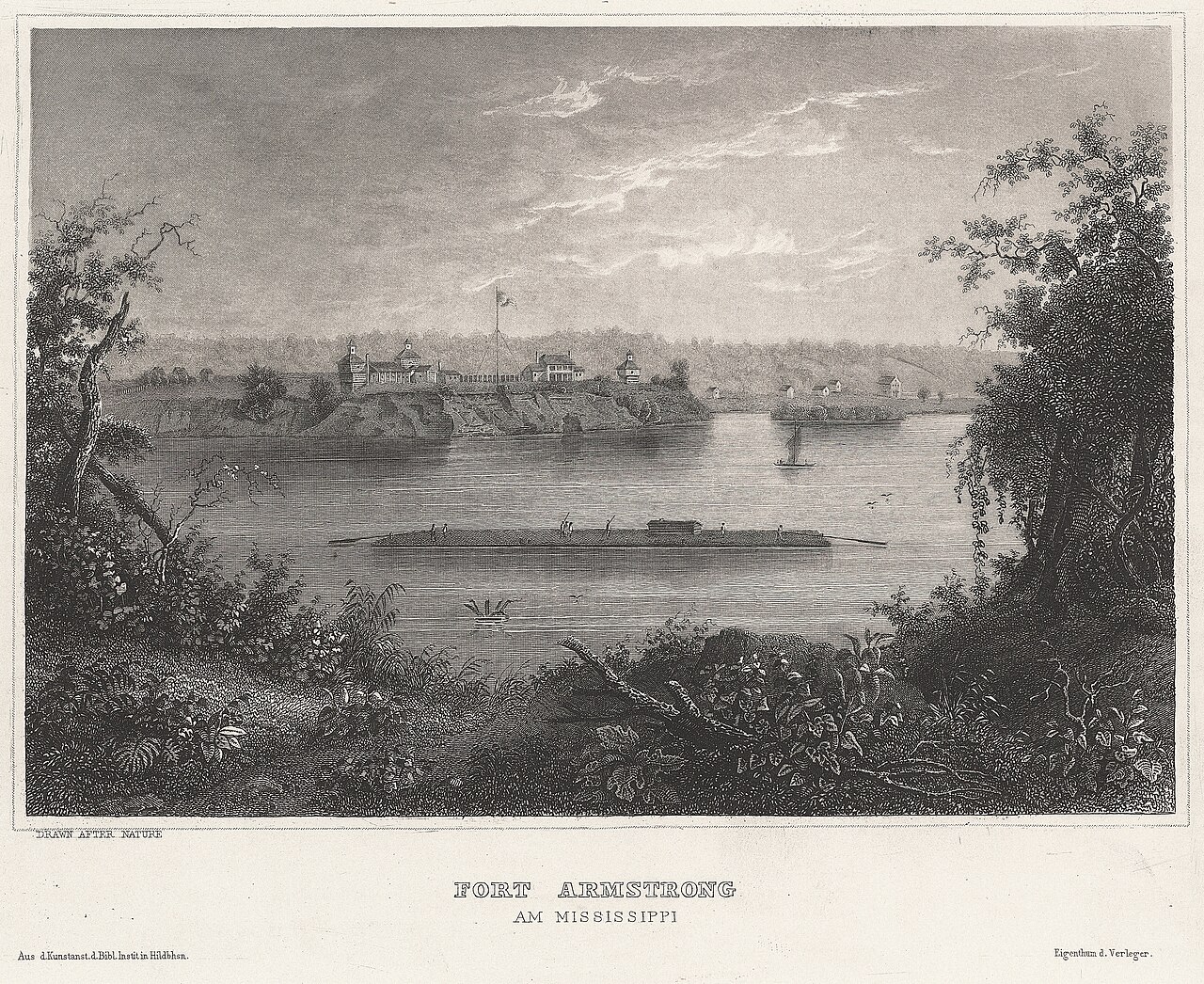
Fort Armstrong was a significant military bastioned fortress constructed in the early 19th century on Rock Island in the Mississippi River, near the present-day Quad Cities area spanning Illinois and Iowa. Built between 1816 and 1817, it formed a crucial part of the United States' western frontier defenses established in the aftermath of the War of 1812. Its strategic location at the foot of Rock Island placed it just five miles from the main village of the Sauk and Meskwaki (Fox) tribes along the Rock River in Illinois, underscoring its role in controlling and monitoring Native American activity in the region. Architectural design and construction The fort was constructed primarily of stone and timber, encompassing a square layout approximately 300 feet on each side. It featured three large blockhouses positioned prominently at its corners, designed to provide overlapping fields of fire and enhanced defensive capabilities. These blockhouses were robust, multi-story wooden structures with firing ports, typical of frontier military architecture of the period. The bastioned design allowed defenders to cover the walls with enfilading fire, a common feature in early 19th-century American fortifications aiming to deter attacks. Construction began in May 1816 and was completed by the following year, reflecting the urgency and importance placed on securing the western frontier. The fort's layout included defensive walls, barracks for troops, storage facilities, and other military buildings necessary to support a garrisoned force. Military role and historical significance Fort Armstrong served as a key military headquarters during the Black Hawk War of 1832, a conflict between the United States and Native American tribes led by the Sauk leader Black Hawk. The fort's garrison typically consisted of two companies of United States Army regulars, tasked with maintaining peace and protecting settlers in the region. Its presence was instrumental in the U.S. government's efforts to pacify Native American resistance and assert control over Illinois and surrounding territories. After the Black Hawk War, as the perceived threat from Native American tribes diminished due to forced relocations and treaties, the fort's strategic importance waned. By 1836, the U.S. Army abandoned Fort Armstrong, reflecting the shifting frontier and the reduced need for such a military installation in the area. Legacy and current status While Fort Armstrong no longer stands as it did in the 19th century, its historical footprint remains significant for understanding early American frontier defense strategies and Native American relations. The fort's site on Rock Island is part of the broader historical landscape of the Quad Cities region, which today includes parks, museums, and heritage sites commemorating this period. Replicas of the fort's blockhouses have been constructed to give visitors a sense of the original fortifications and military life during its operational years. These reconstructions serve educational purposes and help preserve the memory of Fort Armstrong's role in American history. Geographical and cultural context Situated on Rock Island, the fort was strategically placed to control navigation along the Mississippi River and to monitor the nearby Native American villages. The location allowed the U.S. Army to project power into the western frontier and to secure vital transportation and communication routes. The fort's proximity to the Sauk and Meskwaki villages highlights the tension and conflict inherent in the U.S. expansionist policies of the era. Fort Armstrong was both a military stronghold and a symbol of the changing dynamics between Native American tribes and the growing United States.

Modern (19th–20th c.)
Details
128.4 km

Castle of Palmyra

Palmyra, United States of America

The Castle of Palmyra in Illinois is a unique modern castle vacation rental located between Hettick and Palmyra, approximately 80 minutes from St. Louis. Built in 2004, this impressive estate offers a blend of contemporary luxury and castle-inspired architectural elements, making it a distinctive destination for visitors seeking a peaceful retreat with extensive amenities. Architectural design and features This modern castle spans nearly 9000 square feet of living space and includes five bedrooms and seven bathrooms. The design incorporates wood and stone floors throughout, enhancing the rustic yet elegant ambiance. The castle features five wood-burning fireplaces, providing warmth and a cozy atmosphere in multiple rooms. Accessibility is a key feature, with an elevator serving three floors, ensuring convenience for guests. The professional kitchen is equipped for large-scale cooking, ideal for family gatherings or events. The castle boasts over 2000 square feet of decks, including two outdoor grills on the first floor, perfect for hosting barbecues and enjoying the surrounding natural beauty. Grounds and outdoor amenities Set on a 40-acre forested estate, the property includes a fully stocked private lake with a sandy beach area for swimming. Guests can relax on the beach or take a ride on the pontoon boat provided. A suspension bridge adds a charming architectural feature to the grounds, enhancing the scenic hiking trails available for rock hunting, nature walks, and exploration. The estate also features a private observatory equipped with a refractor telescope, offering star gazing opportunities in a tranquil setting. Nearby attractions include Mahan's Arboretum and Terry Park's 9-hole golf course, providing additional recreational options. Visitor experience and accommodations The Castle of Palmyra is designed to offer peace and tranquility, making it an ideal getaway for families, groups, or anyone seeking a unique lodging experience. The combination of modern amenities with castle-inspired elements creates a memorable stay. Cable and internet services are provided, ensuring guests remain connected if desired. Outdoor features such as the fire pit enhance the ambiance for evening gatherings, while the expansive decks allow for enjoying the natural surroundings. The blend of luxury, nature, and castle aesthetics makes this property a standout destination in Illinois. Location and accessibility Located between the small towns of Hettick and Palmyra, the castle is conveniently accessible from St. Louis, making it a feasible weekend retreat or longer vacation spot. The rural setting offers privacy and a connection to nature while still being within driving distance of urban amenities.

Contemporary (20th–21st c.)
Details