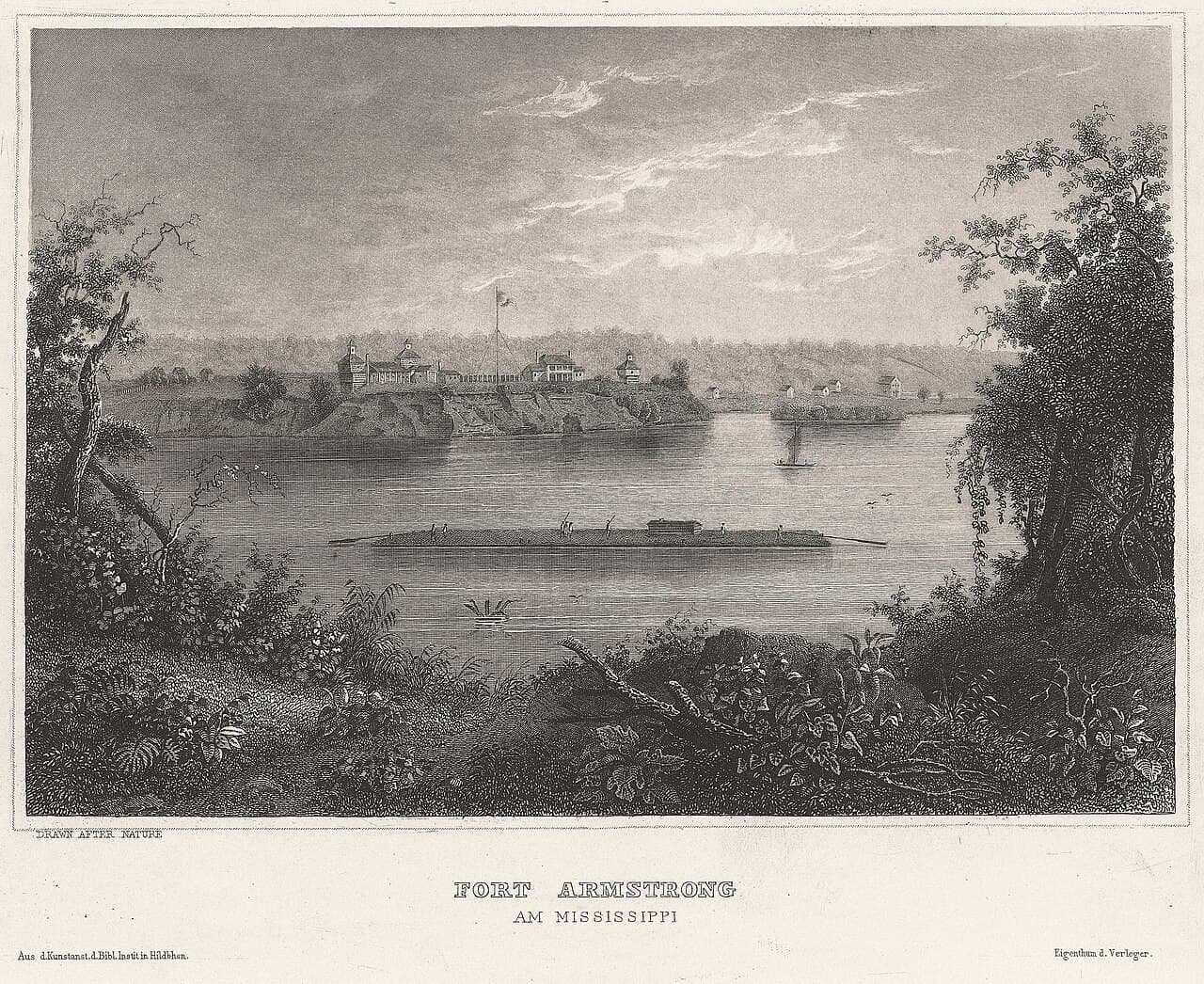
Fort Armstrong
Fort Armstrong was a significant military bastioned fortress constructed in the early 19th century on Rock Island in the Mississippi River, near the present-day Quad Cities area spanning Illinois and Iowa. Built between 1816 and 1817, it formed a crucial part of the United States' western frontier defenses established in the aftermath of the War of 1812. Its strategic location at the foot of Rock Island placed it just five miles from the main village of the Sauk and Meskwaki (Fox) tribes along the Rock River in Illinois, underscoring its role in controlling and monitoring Native American activity in the region.
Architectural design and construction
The fort was constructed primarily of stone and timber, encompassing a square layout approximately 300 feet on each side. It featured three large blockhouses positioned prominently at its corners, designed to provide overlapping fields of fire and enhanced defensive capabilities. These blockhouses were robust, multi-story wooden structures with firing ports, typical of frontier military architecture of the period. The bastioned design allowed defenders to cover the walls with enfilading fire, a common feature in early 19th-century American fortifications aiming to deter attacks.
Construction began in May 1816 and was completed by the following year, reflecting the urgency and importance placed on securing the western frontier. The fort's layout included defensive walls, barracks for troops, storage facilities, and other military buildings necessary to support a garrisoned force.
Military role and historical significance
Fort Armstrong served as a key military headquarters during the Black Hawk War of 1832, a conflict between the United States and Native American tribes led by the Sauk leader Black Hawk. The fort's garrison typically consisted of two companies of United States Army regulars, tasked with maintaining peace and protecting settlers in the region. Its presence was instrumental in the U.S. government's efforts to pacify Native American resistance and assert control over Illinois and surrounding territories.
After the Black Hawk War, as the perceived threat from Native American tribes diminished due to forced relocations and treaties, the fort's strategic importance waned. By 1836, the U.S. Army abandoned Fort Armstrong, reflecting the shifting frontier and the reduced need for such a military installation in the area.
Legacy and current status
While Fort Armstrong no longer stands as it did in the 19th century, its historical footprint remains significant for understanding early American frontier defense strategies and Native American relations. The fort's site on Rock Island is part of the broader historical landscape of the Quad Cities region, which today includes parks, museums, and heritage sites commemorating this period.
Replicas of the fort's blockhouses have been constructed to give visitors a sense of the original fortifications and military life during its operational years. These reconstructions serve educational purposes and help preserve the memory of Fort Armstrong's role in American history.
Geographical and cultural context
Situated on Rock Island, the fort was strategically placed to control navigation along the Mississippi River and to monitor the nearby Native American villages. The location allowed the U.S. Army to project power into the western frontier and to secure vital transportation and communication routes.
The fort's proximity to the Sauk and Meskwaki villages highlights the tension and conflict inherent in the U.S. expansionist policies of the era. Fort Armstrong was both a military stronghold and a symbol of the changing dynamics between Native American tribes and the growing United States.
Frequently asked questions (FAQ)
- What is the historical significance of Fort Armstrong?
- Fort Armstrong was constructed in the mid-19th century as part of the United States' coastal defense strategy. It played a critical role during various conflicts, including the Civil War, and is a notable example of military architecture from that era.
- When was Fort Armstrong built?
- Fort Armstrong was built between 1847 and 1851. It was designed to protect the harbor and nearby settlements from naval attacks, showcasing the military's response to growing tensions in the region.
- What are the opening hours for visiting Fort Armstrong?
- Fort Armstrong is open to visitors from 9 AM to 5 PM, Wednesday through Sunday. It's recommended to check the official website for any seasonal changes in hours or special closures.
- Can I take guided tours of Fort Armstrong?
- Yes, guided tours are available at Fort Armstrong, providing in-depth insights into its history and architecture. Tours typically run every hour and are led by knowledgeable staff who can answer any questions you may have.
- Is Fort Armstrong accessible for individuals with disabilities?
- Yes, Fort Armstrong is committed to accessibility, with ramps and pathways that accommodate visitors with mobility challenges. The staff is also trained to assist guests as needed to ensure a comfortable experience.
- What is the best time to visit Fort Armstrong?
- The best time to visit Fort Armstrong is during the spring and fall when the weather is mild and comfortable for outdoor exploration. Summer can be hot, while winter may bring some chilly conditions, so plan accordingly.
- What are the ticket prices for visiting Fort Armstrong?
- Admission to Fort Armstrong is typically free, but special events or guided tours may have a nominal fee. Check the official site for the latest information on any charges that may apply during your visit.
- Are there any nearby attractions to visit while at Fort Armstrong?
- Yes, Fort Armstrong is located near several attractions, including historical museums and scenic parks. Visitors often enjoy exploring the local area, which offers a mix of history and natural beauty.
Photo gallery

Photo by Meyer’s Universum, oder Abbildung und Beschreibung des Sehenswerthesten und Merkwürdigsten der Natur und Kunst auf der ganzen Erde. 20. BandBibliographisches Institut, Hildburghausen•Public domain
Information
Loading map...
Visitor reviews
No reviews yet. Been here? Write the first review and help other travelers!
Write the first reviewVisited this castle? Share your experience
Your review helps other travelers and adds first-hand knowledge to our encyclopedia.


