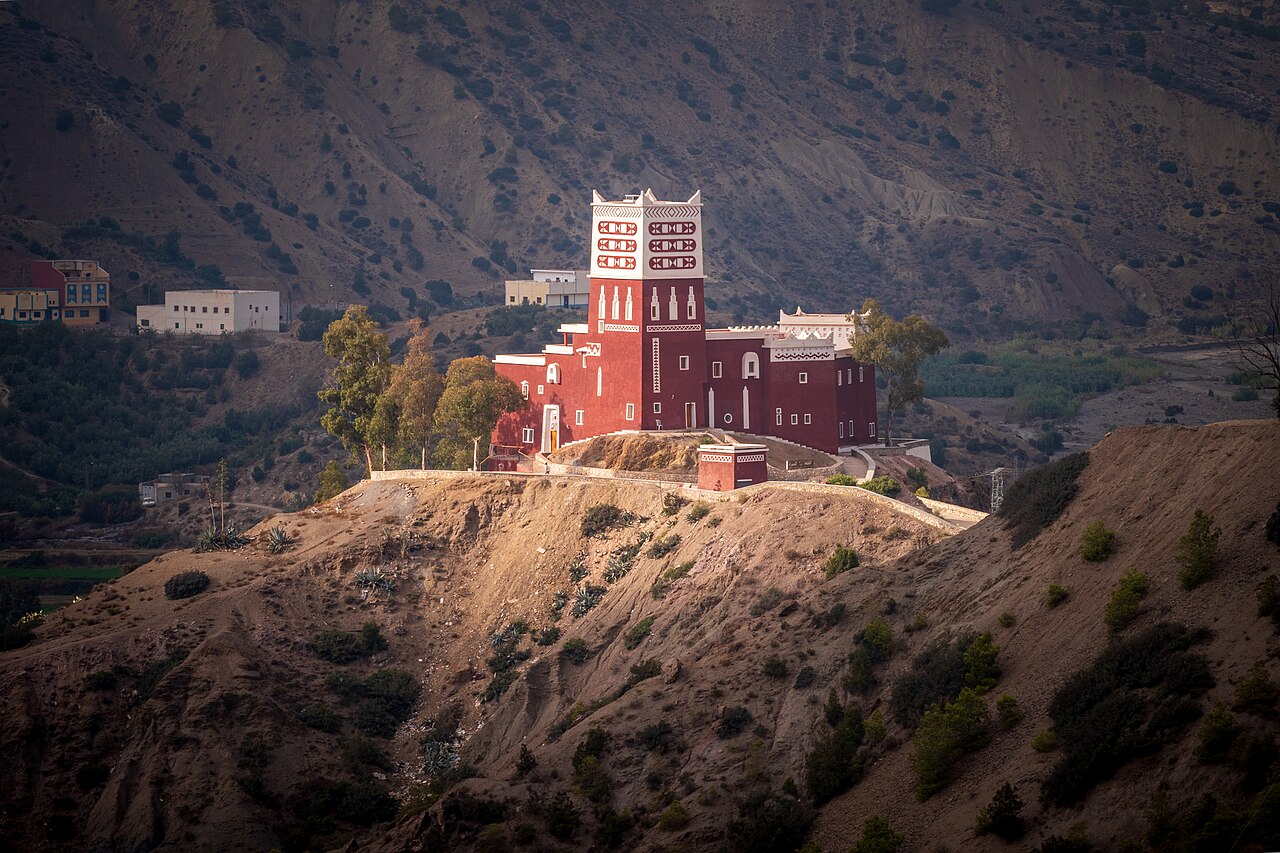
Tazouda Castle — Morocco castle

Tazouda Castle

Tazouda Castle in Morocco
Late Medieval (14th–15th c.)
Ruins

Tazouda Castle is a notable hill castle located in Morocco, distinguished by its strategic position and historical significance. Although the exact city location remains unclear, the castle is recognized for its role in the region's medieval defensive network. The castle's elevated position on a hill allowed it to serve as a vantage point for surveillance and protection against invaders.

Historical context and significance

The castle dates back to the medieval period, serving as a military stronghold during times of conflict in the region. Its construction reflects the need for fortified structures in Morocco's landscape, where control over trade routes and territorial defense was crucial. The castle played a part in the broader network of fortifications that helped secure the area against various threats.

Architectural features

Tazouda Castle exemplifies typical features of a hill castle, including robust defensive walls, battlements, and watchtowers designed to maximize visibility and defense. The castle's layout likely included a central courtyard, living quarters, and storage facilities, although detailed archaeological studies would be necessary to confirm the specifics.

Defensive structures

The castle's fortifications were designed to withstand sieges and attacks. Thick stone walls and elevated towers allowed defenders to monitor and repel enemies effectively. The location on a hill provided natural defense advantages, making direct assaults more challenging for attackers.

Construction materials and techniques

The builders of Tazouda Castle likely used locally sourced stone and traditional masonry techniques common in medieval Moroccan architecture. These materials ensured durability and resilience against both natural elements and military threats.

Cultural and heritage importance

As part of Morocco's historical landscape, Tazouda Castle contributes to understanding the region's medieval military architecture and social organization. It reflects the strategic priorities of its time and offers insights into the methods of defense employed by local rulers.

Current condition and preservation

The castle's current state is not extensively documented, but as a hill castle with medieval origins, it may exist as ruins or partially preserved remains. Preservation efforts, if any, would focus on maintaining the structural integrity of the walls and key architectural elements to safeguard its historical value.

Visiting information

Due to the uncertain exact location and limited public information, visiting Tazouda Castle may require special arrangements or guidance from local authorities or heritage organizations. Visitors interested in medieval Moroccan castles might find it worthwhile to explore this site within the broader context of Morocco's fortified heritage.

Frequently asked questions

  • What is the historical period of Tazouda Castle? It dates back to the medieval period, reflecting the military architecture of that era in Morocco.
  • Where is Tazouda Castle located? The exact city location is unknown, but it is situated in Morocco on a hill, typical of strategic defensive sites.
  • Can visitors tour Tazouda Castle? Due to limited information and unclear location, tours may not be readily available; contacting local heritage bodies is recommended.
  • What architectural style does the castle represent? It embodies medieval military architecture common to hill castles in the region.
  • Is the castle well preserved? The condition is likely to be ruins or partially preserved, typical for castles of its age and location.

Frequently asked questions (FAQ)

How do I get to Tazouda Castle?
Tazouda Castle is located in the picturesque region of Morocco, easily accessible by car or local transport from nearby cities. Visitors can take a scenic drive through the landscape, or opt for guided tours that include transportation to enhance their experience.
What is the historical significance of Tazouda Castle?
Tazouda Castle dates back to the 16th century and played a crucial role in the defense against invasions in the region. Its rich history is intertwined with local legends and the cultural heritage of Morocco, making it a fascinating site for history enthusiasts.
When was Tazouda Castle built?
Tazouda Castle was constructed in the late 1500s, during a period of political upheaval and territorial strife in Morocco. The castle served as a strategic fortress, showcasing the architectural styles and military innovations of its time.
Can I visit Tazouda Castle year-round?
Yes, Tazouda Castle is open to visitors throughout the year, providing an opportunity to explore its historical architecture and stunning views. However, it's advisable to check for any local holidays or events that may affect access.
Why is Tazouda Castle important for architecture lovers?
Tazouda Castle features a unique blend of Berber and Islamic architectural elements, reflecting the cultural influences of the era. Its intricate designs and defensive structures make it a significant study for those interested in historical architecture.
Is it possible to take guided tours of Tazouda Castle?
Yes, guided tours are available and highly recommended for a comprehensive understanding of the castle's history and significance. Knowledgeable guides lead visitors through the site, sharing fascinating stories and insights that enrich the experience.
What are the opening hours for Tazouda Castle?
Tazouda Castle typically opens at 9 AM and closes at 6 PM daily, though hours may vary slightly based on the season. It's a good idea to arrive early to enjoy the site and avoid crowds.
What are the ticket prices for visiting Tazouda Castle?
Ticket prices for Tazouda Castle are generally affordable, with discounts available for students and children. Entry fees help maintain the site and support preservation efforts, allowing future generations to enjoy its historical significance.
What is the best time to visit Tazouda Castle?
The best time to visit Tazouda Castle is during the spring and fall when the weather is mild and pleasant for outdoor exploration. These seasons also provide stunning natural backdrops for photography enthusiasts.
Are there any nearby attractions to visit after Tazouda Castle?
Yes, visitors can explore nearby attractions such as the scenic Atlas Mountains and traditional Berber villages. Additionally, the vibrant markets and cultural sites in surrounding towns offer a rich Moroccan experience to complement your visit to the castle.

Photo gallery

Tazouda Castle
Click to view

Photo by Houssain tork•CC BY-SA 4.0

1 photo • Click any image to view in full screen

Information

Hill Castle

Loading map...

Visitor reviews

No reviews yet. Been here? Write the first review and help other travelers!

Write the first review

Visited this castle? Share your experience

Your review helps other travelers and adds first-hand knowledge to our encyclopedia.
Write a review

(5/5)

0/2000 characters

Your review will be visible after admin approval

Nearby castles

12.6 km
Puerta de Santa Ana, Melilla — Spain castle

Puerta de Santa Ana, Melilla

Melilla, Spain

Puerta de Santa Ana is a prominent bastioned fortress located in the Spanish autonomous city of Melilla, on the northwest coast of Africa. This fortress is a key element of Melilla's extensive defensive system, designed to protect the city against naval and land attacks. Its strategic position near the coast allowed it to serve as a vital military gateway and a stronghold during various periods of conflict. Historical context and significance The fortress of Puerta de Santa Ana was constructed as part of Melilla's fortifications during the period when the city was a crucial military outpost for Spain. Melilla itself has a long history as a fortified city, with its defenses evolving over centuries to respond to changing military technologies and threats. The bastioned design of Puerta de Santa Ana reflects the military architectural innovations of the early modern period, particularly the 16th to 18th centuries, when bastioned fortifications became widespread across Europe and its territories to withstand cannon fire and sieges. Melilla's fortifications, including Puerta de Santa Ana, played significant roles in defending the city from attacks by local forces and rival powers. The fortress was part of a network of walls, bastions, and gates that controlled access to the city and safeguarded its inhabitants and strategic assets. Architectural features and design Puerta de Santa Ana exemplifies the characteristics of a bastioned fortress, featuring angular bastions projecting from the main walls to provide overlapping fields of fire. This design allowed defenders to cover all approaches with artillery and small arms, minimizing blind spots and making direct assaults costly and difficult. The fortress includes robust stone walls, thick enough to absorb cannon fire, and a gate complex that controlled entry and exit. The bastions are connected by curtain walls, forming a defensive perimeter that integrates with Melilla's broader fortification system. Within the fortress, there were likely chambers for guards, storage areas for ammunition and supplies, and platforms for artillery. The layout would have been optimized for both defense and control of movement, with narrow passageways and strategic vantage points. Melilla's military architecture and coastal defense Puerta de Santa Ana is part of Melilla's extensive military architecture, which includes multiple bastions, walls, and other fortifications designed to protect the city from maritime and terrestrial threats. The city's coastal location made it vulnerable to naval attacks, and its fortifications were adapted to counter these risks effectively. The bastioned fortress system in Melilla reflects broader trends in military engineering during the Renaissance and early modern periods, emphasizing angled bastions, thick walls, and integrated artillery positions. These features allowed Melilla to maintain its strategic importance as a Spanish enclave on the African coast. Current condition and cultural importance Today, Puerta de Santa Ana remains a significant historical monument in Melilla. While some parts of the fortress may have undergone restoration or conservation efforts, it stands as a well-preserved example of bastioned military architecture. The fortress is a cultural heritage site, attracting visitors interested in military history and the unique geopolitical context of Melilla. Its preservation contributes to understanding the evolution of fortification design and the historical defense strategies employed by Spain in its overseas territories. Visiting puertade santa ana Visitors to Melilla can explore Puerta de Santa Ana as part of the city's rich historical landscape. The fortress offers insights into the military architecture of the bastioned style and the historical significance of Melilla as a fortified city. Guided tours and informational displays may be available to enhance the visitor experience, providing context about the fortress's role and construction.

Renaissance (15th–17th c.)
Details
12.7 km
Fuerte de Victoria Grande — Spain castle

Fuerte de Victoria Grande

, Spain

Fuerte de Victoria Grande is an 18th-century hill castle located in Spain, representing a significant example of post-Renaissance military architecture. Built during a period marked by evolving defensive needs and artillery advancements, this fortress was strategically positioned on elevated terrain to maximize its defensive capabilities and surveillance over the surrounding landscape.Historical context and constructionThe fortress was constructed in the 18th century, a time when Spain was reinforcing its coastal and inland defenses against potential invasions and conflicts stemming from European rivalries. The choice of a hilltop location was deliberate, providing natural advantages such as enhanced visibility and difficulty of assault for enemies. This period saw military architecture transition from medieval fortifications to designs better suited to withstand cannon fire and artillery bombardments.Architectural features and designFuerte de Victoria Grande exhibits typical characteristics of post-Renaissance fortifications, including thick stone walls designed to absorb artillery impact and angular bastions that allowed defenders to cover multiple approaches with overlapping fields of fire. The fortress likely includes a combination of curtain walls, bastions, and possibly a dry moat or natural defensive slopes enhancing its protection.The fortress's layout would have been influenced by the trace italienne style prevalent in the 17th and 18th centuries, emphasizing star-shaped or polygonal plans that minimized blind spots and maximized defensive firepower. Defensive structures such as embrasures for cannons and musketry loopholes would have been incorporated to enable active defense against attackers.Materials and construction techniquesThe construction predominantly used local stone, chosen for its durability and availability. Masonry techniques of the time ensured robust walls capable of withstanding prolonged sieges and artillery bombardment. The fortress's elevated position also required careful engineering to stabilize the structure on the hill's slopes.Military significance and useDuring the 18th century, Fuerte de Victoria Grande played a role in regional defense strategies, guarding important routes or coastal areas depending on its precise location within Spain. Its elevated position allowed for early warning of approaching enemies and provided a stronghold for troops during conflicts. The fortress's design reflects the military doctrines of the time, which prioritized defense against artillery and coordinated fields of fire.Preservation and current conditionThe fortress remains a notable example of post-Renaissance hill castle architecture. Its condition varies depending on conservation efforts, but it is generally recognized as a well-preserved or partially preserved structure, retaining significant portions of its original walls and defensive features. The site offers insight into 18th-century military engineering and the strategic importance of hilltop fortifications in Spain's defense network.Visiting and cultural importanceVisitors to Fuerte de Victoria Grande can explore its historic walls and vantage points, gaining appreciation for its architectural and military significance. The fortress contributes to Spain's cultural heritage by illustrating the evolution of fortification design in response to changing warfare technologies. It remains a point of interest for historians, architects, and tourists interested in military history and castle architecture.

Post-Renaissance (17th–18th c.)
Details
79.9 km
Kelaat Arbaa Taourirt — Morocco castle

Kelaat Arbaa Taourirt

, Morocco

Kelaat Arbaa Taourirt is a historic hill castle located in Morocco, notable for its strategic position and traditional Moroccan military architecture. Though the exact city location is not definitively recorded, the castle exemplifies the defensive structures typical of the region's fortified sites. Historical significance and strategic role The castle's name, Kelaat Arbaa Taourirt, translates roughly to "Fortress of the Four Hills," reflecting its placement on elevated terrain that provided a commanding view of the surrounding landscape. This vantage point was essential for monitoring and controlling movement across the region, especially during periods of tribal conflicts and external threats. Constructed primarily during the High Medieval period, the castle served as both a military stronghold and a refuge for local populations. Its location on a hill allowed defenders to utilize natural topography in their defense strategies, combining man-made fortifications with the rugged terrain. Architectural features and construction Kelaat Arbaa Taourirt showcases key elements of traditional Moroccan fortress architecture. The castle is built with thick mudbrick walls reinforced with stone, designed to withstand sieges and harsh weather conditions. The walls are punctuated by defensive towers at corners and along the curtain walls, providing vantage points for archers and lookouts. The entrance is typically fortified with a strong gatehouse and may include a bent entrance or angled passage to slow attackers. Inside, the castle likely contains a central courtyard, surrounded by living quarters, storage rooms, and possibly a cistern for water storage, essential for withstanding sieges. Defensive design and layout The layout of Kelaat Arbaa Taourirt reflects a practical approach to defense, with walls adapted to the contours of the hill. The castle's design minimizes blind spots and maximizes the defenders' ability to repel attackers. The use of natural rock formations as part of the defensive perimeter is a notable feature, integrating the fortress seamlessly into its environment. Cultural and regional context This castle is part of a broader tradition of fortified sites in Morocco, which served as centers of power for local rulers and tribal leaders. Such fortresses were crucial in controlling trade routes and protecting communities from raids. The architecture of Kelaat Arbaa Taourirt reflects the blend of Berber and Arab influences characteristic of Moroccan military construction. While not as extensively restored or studied as some other Moroccan castles, Kelaat Arbaa Taourirt remains an important example of the region's historical fortifications. Its preservation provides insight into the defensive strategies and architectural techniques used in Morocco during the medieval period. Current condition and preservation The castle is classified as a hill castle and is currently in a partially preserved state. Although some sections of the walls and towers remain intact, other parts have suffered from erosion and neglect over time. Efforts to maintain and protect the site are limited, reflecting challenges common to many historic fortresses in rural Morocco. Visitors to the site can observe the remains of the castle's defensive structures and appreciate its commanding position in the landscape. The castle's ruins offer valuable opportunities for archaeological study and cultural tourism, contributing to a greater understanding of Morocco's medieval heritage. Visiting information and accessibility Access to Kelaat Arbaa Taourirt may be challenging due to its hilltop location and limited infrastructure. Visitors interested in exploring the site should prepare for a hike and ensure they have appropriate guidance or local knowledge. There are no formal visitor facilities or ticketing systems currently in place. The best time to visit is during the cooler months to avoid the intense heat of the Moroccan summer. While the castle is not widely promoted as a tourist destination, it offers a unique glimpse into Morocco's fortified past for those willing to venture off the beaten path.

High Medieval (11th–13th c.)
Details