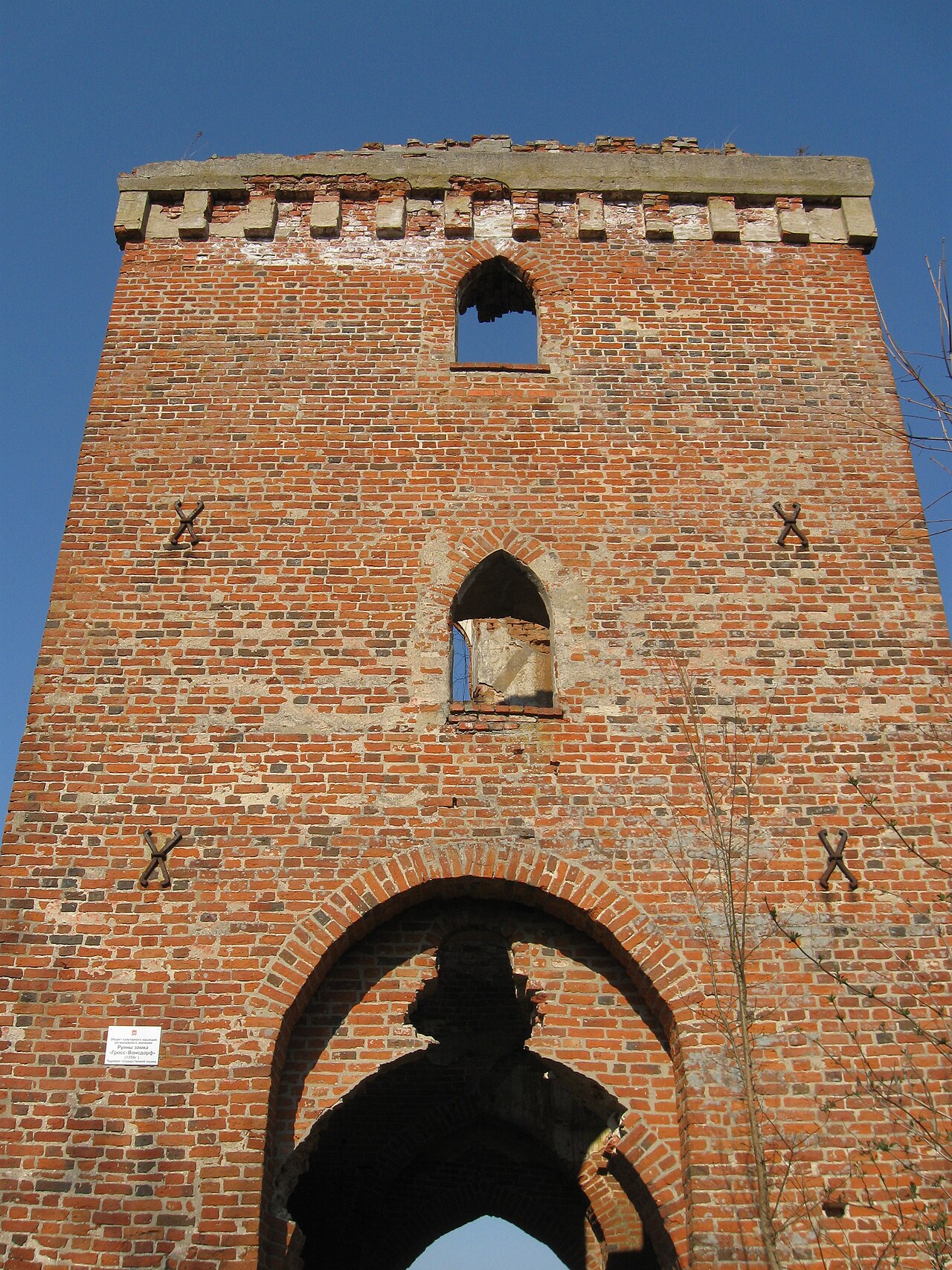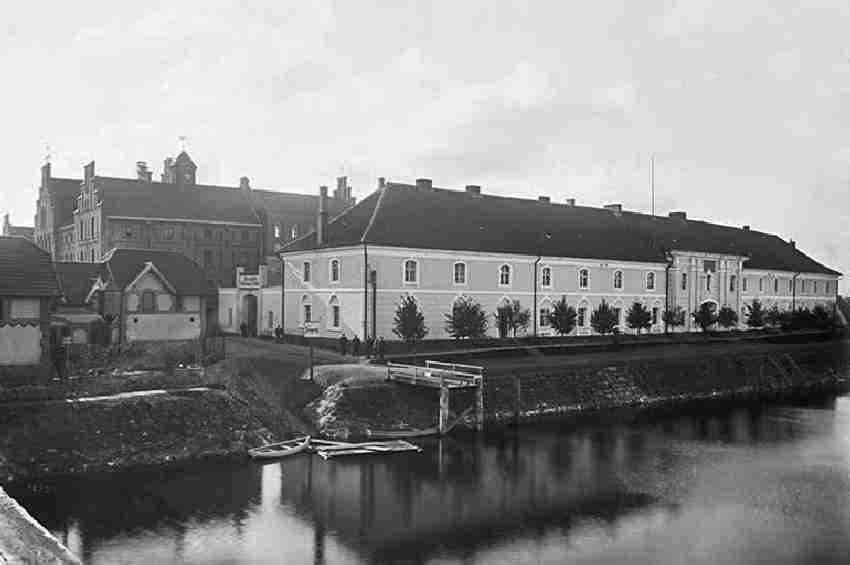
Tapiau Castle Ruins
Tapiau Castle, located in the town of Gvardeysk in the Kaliningrad region of Russia, stands as a significant example of medieval military architecture with a complex history spanning several centuries. Originally constructed by the Teutonic Knights during the High Medieval period, this castle evolved from a wooden fortification into a substantial stone Ordensburg, playing a pivotal role in the region's military, religious, and administrative affairs.
The castle's origins trace back to the late 13th century, when the Teutonic Order, following the Prussian Crusade, established a wooden fort between the Deime and Pregolya rivers from 1283 to 1290. This initial fortification was strategically placed to defend the Samland peninsula against the Nadrovians and Scalovians, indigenous Baltic tribes resisting the Order's expansion. Around 1351, the wooden structure was replaced by the stone Tapiau Castle, marking a transition to a more permanent and defensible stronghold typical of the Order's architectural ambitions in the Baltic region.
Medieval construction and strategic importance
The stone castle was constructed between 1347 and 1359, during a period when the Teutonic Order was consolidating its power in Prussia. Situated on a hill castle type site—a low peninsula naturally protected by the Pregolya and Deime rivers and surrounded on three sides by marshland—the location offered formidable natural defenses. The four-winged stone castle was designed as a military and administrative center, featuring a gatehouse, vaulted halls, living quarters, and defensive fortifications such as a portcullis and thick stone walls.
The castle served as the seat of a local commandery (Komturei) until the 1330s, after which it was integrated into the larger Königsberg Komturei. It was a key military base during campaigns against Lithuania in the 14th century. One of the castle's most notable historical events was the baptism of Vytautas, the future Grand Duke of Lithuania, in 1385 after his escape from Krėvė prison. This event underscored the castle's role not only as a military fortress but also as a site of political and religious significance in the Baltic region.
Architectural features and layout
The surviving structure of Tapiau Castle includes the northwestern wing with its original gatehouse and several chambers. The main hall, vaulted with a barrel vault, likely served as the lord's residence, characterized by its square plan and robust construction. Adjacent rooms were used as living quarters for the Komtur's household, including a refectory or communal dining room.
The southeastern wing's basement retains its original ribbed vaults supported by octagonal granite pillars. Some northern rooms feature decorative star vaults with carved corbels shaped like animal heads, a stylistic detail comparable to the Marshal's building of the nearby Königsberg Castle. Above the main entrance, the niche for a portcullis remains visible, illustrating the castle's defensive capabilities.
Historical transformations and later uses
Throughout its history, Tapiau Castle underwent significant changes reflecting the shifting political landscape. During the Thirteen Years’ War (1454–1466), the castle was captured by the Prussian Confederation but was retaken by the Teutonic Order after a siege. In 1474, the castle's dungeons held Sambian Bishop Dietrich von Kuba, who died imprisoned there by order of Grand Master Heinrich von Richtenberg.
After the dissolution of the Teutonic Order's monastic state in 1525, the castle became part of the Duchy of Prussia. Subsequent centuries saw the castle adapted for residential and administrative functions. In the 18th century, under King Frederick William II of Prussia, the castle was converted into a poorhouse and correctional facility, resulting in the demolition of three of the original four wings and the dismantling of the outer bailey (foreburg).
From the 19th century onward, Tapiau Castle functioned primarily as a prison. In 1879, the remaining medieval wing was expanded vertically with two neo-Gothic floors, including a prison chapel. However, these additions were destroyed by fire during World War I and removed during restoration efforts in 1917, which reinstated the castle's traditional four-sided tiled roof and medieval silhouette.
20th-century history and preservation efforts
During World War I, the castle suffered damage from Russian artillery. After the war, it continued as a prison under the Weimar Republic. Following Soviet occupation in 1945, the castle was repurposed as a detention center for suspected war criminals and later as a labor colony for juveniles. From 1947, it operated as a transit prison and correctional colony, housing first-time offenders under Soviet and Russian administration.
By 2014, the prison held approximately 460 inmates. In recent years, efforts have been made to relocate the prison and preserve the historic castle. The property was transferred to local government and a regional museum by late 2021. Restoration work began in 2022, focusing on removing Soviet-era buildings, conserving the medieval fabric, and converting the foreburg into exhibition spaces. Archaeological discoveries include geometric glazed brick decorations beneath plaster walls, shedding light on the castle's original aesthetic.
Architectural significance and cultural heritage
Tapiau Castle exemplifies the architectural evolution of a Teutonic Ordensburg from a wooden fortress to a stone stronghold. Its medieval defensive features, including the gatehouse, vaulted halls, and portcullis niche, demonstrate the military engineering of the 14th century. The castle's later adaptations for residential, poorhouse, and prison functions illustrate the changing uses of medieval fortifications in modern times.
The castle chapel's association with the baptism of Vytautas connects the site to significant regional religious history. The surviving architectural details, such as the star vaults with animal-headed corbels, link Tapiau to broader Gothic architectural trends in the Baltic region.
Current restoration and conservation efforts aim to preserve this layered history, emphasizing the castle's role as a cultural landmark in the Kaliningrad region. The removal of non-historic Soviet structures has allowed for a clearer understanding of the castle's original form and function, making Tapiau Castle an important subject for medieval studies and heritage tourism.
Frequently asked questions (FAQ)
- How do I get to Tapiau Castle Ruins?
- You can reach Tapiau Castle Ruins by taking a bus or taxi from Gvardeysk city center. The castle is located a short distance from the main road, making it accessible for visitors.
- What is the historical significance of Tapiau Castle?
- Tapiau Castle, originally built in the 13th century, served as a fortress and residence for the Teutonic Knights. Its ruins today offer a glimpse into the medieval architecture and the strategic importance of the castle during its prime.
- When was Tapiau Castle built?
- Construction of Tapiau Castle began in the mid-13th century, with significant expansions and modifications made in the following centuries. The castle played a vital role in regional defense until its decline in the 17th century.
- Can I explore the castle ruins freely?
- Yes, visitors can freely explore the ruins of Tapiau Castle. However, it is recommended to be cautious as some areas may be unstable or difficult to navigate.
- Why is Tapiau Castle a popular tourist destination?
- Tapiau Castle is popular for its rich history and stunning architecture, which attracts history enthusiasts and photographers alike. The scenic views and tranquil surroundings also make it a perfect spot for a peaceful visit.
- Is it possible to visit Tapiau Castle year-round?
- Yes, Tapiau Castle can be visited year-round, though access may be limited during harsh winter conditions. The best time to visit is during the spring and summer months when the weather is more favorable.
- What are the opening hours for Tapiau Castle Ruins?
- Tapiau Castle Ruins are generally open to the public from dawn until dusk. It is advisable to check local listings for any specific seasonal changes in opening hours.
- Are there any ticket prices to visit Tapiau Castle?
- Visiting the ruins of Tapiau Castle is typically free of charge. However, guided tours may have a fee, and donations to help maintain the site are always appreciated.
- What nearby attractions can I visit while at Tapiau Castle?
- While visiting Tapiau Castle, you can explore the charming town of Gvardeysk, as well as nearby natural parks and scenic walking trails. The region is rich in history, with other historical sites within a short drive.
Photo gallery

Information
Website
Visit websiteSources & official resources
Verify the information above using these authoritative references.
Loading map...
Visitor reviews
No reviews yet. Been here? Write the first review and help other travelers!
Write the first reviewVisited this castle? Share your experience
Your review helps other travelers and adds first-hand knowledge to our encyclopedia.