Talietumu — Wallis and Futuna castle

Talietumu

Talietumu archaeological site in Wallis and Futuna
Late Medieval (14th–15th c.)
Ruins

Talietumu, also referred to as Kolo Nui, is a significant archaeological site located on the island of Wallis in the territory of Wallis and Futuna, situated in the southwestern Pacific Ocean. This site is renowned for its well-preserved remains of a fortified settlement dating back to the 15th century, during the late medieval period.

Historical context and significance

The fortress at Talietumu was constructed as a defensive stronghold by the indigenous Polynesian inhabitants of the island. It served as a critical center for local power and protection against rival groups. The site reflects the complex social and political structures of the island communities prior to European contact.

Talietumu is one of the few remaining examples of traditional fortifications in the region, offering valuable insight into the architectural and military strategies employed by Pacific island societies during the late medieval era.

Architectural features of Talietumu

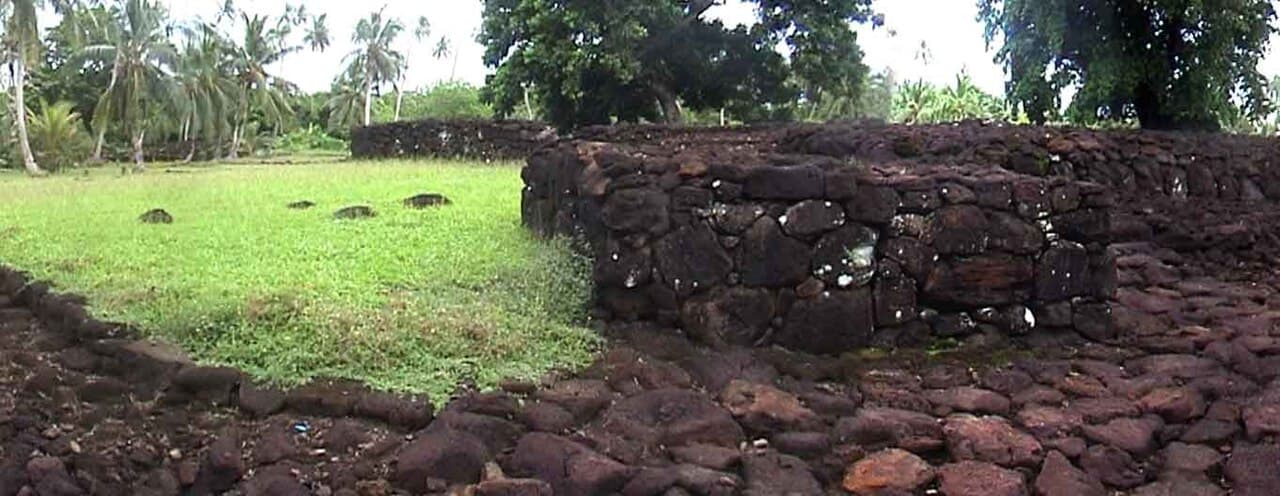
The site consists primarily of stone walls arranged in a roughly circular pattern, enclosing an area that once housed residential and communal buildings. The walls are constructed from large basalt blocks, skillfully fitted without mortar, demonstrating advanced masonry techniques.

The central part of the fortress includes a raised platform or marae, which likely functioned as a ceremonial or religious space. Surrounding this were various smaller structures, possibly used for living quarters, storage, and defense.

The fortress walls feature battlements and defensive openings, indicating their role in protecting inhabitants from attacks. The strategic location of Talietumu on elevated terrain provided natural defense advantages and visibility over the surrounding landscape.

Archaeological research and preservation

Excavations and studies at Talietumu have revealed artifacts such as pottery shards, tools, and remains of food, which help reconstruct the daily life and culture of its former inhabitants. The site is a valuable source for understanding the indigenous history of Wallis and Futuna.

Currently, Talietumu is classified as archaeological ruins and is protected as a cultural heritage site. Efforts have been made to preserve the stone structures and prevent further deterioration, though the site remains exposed to natural elements.

Visiting Talietumu

Visitors to Wallis and Futuna can explore Talietumu to experience a rare glimpse into the island's prehistoric fortifications. The site offers an educational opportunity to learn about Polynesian architecture and history in a unique Pacific setting.

Access to the site is generally open, but visitors should respect the preservation guidelines to help maintain this important cultural landmark.

Frequently asked questions (FAQ)

How do I get to Talietumu Castle?
To reach Talietumu Castle, visitors can take a short boat ride from the main islands of Wallis and Futuna. Once you arrive, local guides are available to help you navigate the area and provide insights about the castle's history.
What is the historical significance of Talietumu Castle?
Talietumu Castle holds great historical significance as it is a symbol of the region's rich cultural heritage and history. It served as a fortress for local leaders and played a crucial role in the defense and governance of the islands.
When was Talietumu Castle built?
Talietumu Castle was constructed in the early 19th century, reflecting the architectural styles and defensive needs of that era. Its design showcases the unique blend of traditional Polynesian and European influences that characterize the region's history.
Can I take guided tours of Talietumu Castle?
Yes, guided tours of Talietumu Castle are available and highly recommended for visitors looking to learn more about its history and architecture. Knowledgeable guides will share fascinating stories and insights during the tour.
Why is Talietumu Castle considered an architectural marvel?
Talietumu Castle is considered an architectural marvel due to its unique construction techniques and the strategic location chosen for its defense. The use of local materials combined with traditional building methods exemplifies the ingenuity of the islanders.
Is it possible to visit Talietumu Castle year-round?
Yes, Talietumu Castle is open for visitors year-round, although the best time to visit is during the dry season from May to October. This period offers more favorable weather conditions for exploring the castle and surrounding areas.
What are the opening hours for Talietumu Castle?
Talietumu Castle is open daily from 9 AM to 5 PM, allowing ample time for visitors to explore its grounds. It is advisable to check for any special holiday hours or events that may affect accessibility.
Are there any nearby attractions to Talietumu Castle?
Yes, several nearby attractions complement a visit to Talietumu Castle, including beautiful beaches and local cultural sites. Visitors can also engage in water sports or enjoy traditional island cuisine in the nearby villages.
What are the ticket prices for visiting Talietumu Castle?
Ticket prices for Talietumu Castle are quite affordable, typically ranging from $5 to $10 for adults, with discounts available for children and seniors. It is a small fee that contributes to the maintenance and preservation of this historical site.

Photo gallery

Talietumu
Click to view

Photo by Tauʻolunga•CC BY-SA 2.5

1 photo • Click any image to view in full screen

Information

Archaeological Site / Ruins

Loading map...

Visitor reviews

No reviews yet. Been here? Write the first review and help other travelers!

Write the first review

Visited this castle? Share your experience

Your review helps other travelers and adds first-hand knowledge to our encyclopedia.
Write a review

(5/5)

0/2000 characters

Your review will be visible after admin approval

Nearby castles

2131.8 km
Fort Teremba — France castle

Fort Teremba

Moindou, France

Fort Teremba is a 19th-century bastioned fortress located near Moindou in New Caledonia, a French territory in the South Pacific. Originally constructed as a prison and military fortification, it played a significant role in the colonial administration and control of the region during the modern period. The fort was strategically positioned to overlook Teremba Bay (Uarai Bay), opposite the mouth of the La Foa River, approximately 124 kilometres north of Noumea, the capital of New Caledonia. Historical context and construction The fort was established primarily to house prisoners and the supervisory staff responsible for overseeing them. The prisoners were employed in constructing a vital road network connecting Canala, Bourail, and Boulouparis, which facilitated transportation and colonial expansion in the region. The construction of Fort Teremba reflects the broader French colonial strategy of using penal labor to develop infrastructure in overseas territories during the 19th century. Architectural features and fortifications As a bastioned fortress, Fort Teremba was designed with defensive features typical of the period, including angled bastions that allowed for overlapping fields of fire to protect against attacks. The fort's layout included strong walls and fortified gates to secure the prison complex and military installations. Its location overlooking Teremba Bay provided a natural defensive advantage, enabling surveillance of maritime approaches and control over the surrounding area. Defensive enhancements after the Kanak revolt Following the 1878 Kanak revolt, during which the indigenous Kanak people besieged the prison, Fort Teremba was further strengthened. This included reinforcement of the fortifications to withstand future uprisings and to maintain colonial authority. The revolt highlighted the tensions between the colonial administration and the Kanak population, making the fort a focal point of military and penal control. Operational history and closure Fort Teremba functioned as a prison and military post throughout the late 19th century. It housed prisoners who contributed to the development of the region's infrastructure under strict supervision. The fort's operational period ended in 1898 when it was officially closed. After its closure, the site remained an important historical landmark reflecting the colonial past of New Caledonia. Legacy and current status Today, Fort Teremba stands as a preserved historical site that offers insight into the colonial history and penal practices of 19th-century New Caledonia. Its bastioned design and strategic location make it an important example of military architecture adapted to the unique geographic and political context of the South Pacific. Visitors to the site can explore the remains of the fortifications and learn about the complex interactions between the French colonial authorities and the indigenous Kanak people.

Modern (19th–20th c.)
Details
3230.8 km
Fort Buckley — New Zealand castle

Fort Buckley

, New Zealand

Fort Buckley is a 19th-century bastioned fortress located in Wellington, New Zealand, strategically positioned to oversee and defend the entrance to Wellington Harbour. Constructed in 1885, the fort was part of New Zealand's coastal defense system during a period of heightened concern about potential foreign naval threats. Its location on the slopes of Kaiwharawhara provided commanding views over the harbor and the city, making it a critical point for the protection of the capital. Historical context and construction The construction of Fort Buckley came during the late 19th century when New Zealand was expanding its coastal defenses in response to global naval power shifts and fears of invasion. The fort was named after Patrick Buckley, a notable Irish New Zealand soldier, lawyer, and politician, reflecting the practice of honoring prominent figures in military and public service. Designed as a bastioned fortress, Fort Buckley incorporated defensive features typical of the period, including gun-pits and rifled muzzle-loading artillery. The fort originally housed two 64-pounder rifled muzzle-loading (RML) guns, which had an effective range of approximately three kilometres, enabling the fort to engage enemy ships attempting to enter Wellington Harbour. Architectural features and armaments The fort's design included concrete gun-pits built into the hillside, which provided protection and stability for the artillery pieces. The layout allowed for overlapping fields of fire, a key characteristic of bastioned fortifications, which enhanced defensive capabilities against naval attacks. During its operational period, the fort's armaments were state-of-the-art for coastal defense, with the rifled 64-pounder guns offering improved accuracy and range compared to earlier smoothbore cannons. These guns were muzzle-loading, requiring crews to load powder and shot from the front of the barrel, a standard technology of the era before breech-loading artillery became widespread. World War II modifications In the course of World War II, Fort Buckley saw further military use when an anti-aircraft gun was installed on the site of the former caretaker's cottage, situated on the slopes above the original gun-pits. This addition reflected the evolving nature of military threats, with aerial attacks becoming a significant concern. Although the original anti-aircraft gun no longer remains, the concrete foundation of the caretaker's cottage is still visible today. Preservation and current status Today, Fort Buckley is recognized as a Category 1 Historic Place by Heritage New Zealand, indicating its national historical significance. The physical remains primarily consist of the concrete foundations of the two RML gun-pits, which offer tangible links to the site's military past. The anti-aircraft gun's location is less obvious but marked by the caretaker's cottage foundation. The land encompassing Fort Buckley is owned by the Wellington City Council and has been designated a public reserve since 2010. The site is accessible via a well-maintained gravel path from Barnard Street in Wadestown, with clear signage and fencing to protect the historic features. Vegetation management has been an ongoing effort, as the area has experienced several scrub fires and natural overgrowth. The Highland Park Progressive Association (HPPA), a local residents' group, actively maintains and enhances the site in partnership with the city council. Their efforts include clearing paths, installing interpretive signage, and providing educational pamphlets detailing the fort's history. Community engagement and activities Fort Buckley now serves not only as a historical landmark but also as a community space. The HPPA organizes social activities such as family picnics, geocaching, and guided walks along the tracks. In 2014, a large picnic table was installed on the former caretaker's cottage foundation, further encouraging public use and enjoyment of the site. Future prospects and heritage significance One of the long-term goals for Fort Buckley is to enhance its historical interpretation by either locating the original 64-pounder guns, which are believed to be buried in Palmerston North, or commissioning replica iron guns to be cast and placed in the existing gun-pits. Such additions would provide visitors with a more immersive understanding of the fort's operational history. Fort Buckley's designation as a Category 1 Historic Place underscores its importance in New Zealand's military heritage. It stands as a rare example of a bastioned fortress from the modern period of coastal defense architecture, illustrating the transition from 19th-century artillery fortifications to adaptations made during the 20th century's global conflicts.

Modern (19th–20th c.)
Details
3239.4 km

The Castle on Hawkin's Hill

Wellington, New Zealand

The castle on Hawkin's Hill is a distinctive modern landmark perched atop a hill in the Greater Wellington region of New Zealand. Often dubbed the "castle in the clouds," this unique structure stands isolated amidst native bush at 430 Hawkins Hill Road, offering commanding views over the city of Wellington and its surrounding landscapes. Unlike traditional medieval castles, this site has a contemporary origin and history closely tied to New Zealand's aviation and local entrepreneurial ventures. Origins as an airways radar bunker The site originally housed a decommissioned Airways Corporation radar bunker, part of New Zealand's civil aviation infrastructure. The radar installation was strategically positioned on Hawkins Hill to maximize coverage and ensure safe air traffic control over the capital region. When the radar station was decommissioned, the site was left unused until it was purchased in 1998 by Brian Willman. Willman's initial vision was to transform the site into a conference center capitalizing on the panoramic views and secluded location. Over time, the property evolved beyond its original purpose, becoming a private retreat and a unique venue for business gatherings. Transformation into a unique modern castle While not a castle in the traditional architectural sense, the property earned its nickname due to its imposing presence on the hill and its somewhat fortress-like appearance. The building incorporates elements of rugged modern construction, blending with the natural bush surroundings and the remnants of the radar infrastructure. The site features a combination of concrete structures, observation points, and enclosed spaces that evoke a sense of fortification. The elevated position and isolation contribute to the castle-like ambiance, making it a notable landmark visible from various points around Wellington. Woofington's luxury dog hotel and local lore In 2016, Brian Willman repurposed the castle site to open Woofington's, a luxury dog hotel aimed at providing high-end care for pets. This venture attracted a niche clientele and added a new chapter to the site's evolving story. However, the property became the subject of local intrigue due to a series of unfortunate and mysterious events. In 2018, the manager of Woofington's went missing and was later found deceased under circumstances that sparked community speculation. The following years saw a burglary and arrest in 2019, and a police raid in 2020, further deepening the castle's mystique and reputation among Wellington residents. Woofington's is no longer operational, but the site remains a point of interest for locals and visitors alike. Current status and visitor experience Today, the castle on Hawkin's Hill is a popular visual landmark for hikers and outdoor enthusiasts exploring the Hawkin's Ridge Trail. The trail offers scenic views and passes near the castle, allowing visitors to appreciate the structure from various vantage points. The surrounding area is known for its eclectic mix of sights, including the distinctive Hawkins Hill Radar Dome, roaming ostriches, and nearby windmills, all contributing to the unique character of this Wellington hillside. While the castle itself is privately owned and not open for public tours, its presence enriches the local landscape and adds a layer of modern cultural heritage to the region. Architectural and cultural significance Though not a medieval fortress, the castle on Hawkin's Hill represents an interesting example of adaptive reuse and modern architectural presence in a natural setting. It illustrates how contemporary structures can gain symbolic importance and local legend status, blending functional history with community narratives. The site's evolution from a critical aviation facility to a private conference center and then to a luxury dog hotel reflects changing land use patterns and entrepreneurial creativity in New Zealand's capital region. Its story is a testament to the diverse ways in which sites can become landmarks beyond traditional historical or architectural definitions, enriching Wellington's cultural tapestry.

Details