Swansea Castle
Swansea Castle stands as a significant medieval Norman fortress located in the heart of Swansea, Wales. Established in 1107 by Henry de Beaumont, the first Earl of Warwick, it served as the administrative centre or caput of the Lordship of Gower. Originally constructed as a timber motte-and-bailey castle, its strategic position overlooking the River Tawe made it a vital stronghold during the Norman consolidation of South Wales.
The castle’s early history was marked by conflict with Welsh forces. In 1116, a Welsh attack partially destroyed the timber outer defences, demonstrating the turbulent nature of the region during the High Medieval period. Later, in 1192, the castle endured a ten-week siege by Rhys ap Gruffydd, Prince of Deheubarth, who sought to wrest control from the Normans but ultimately failed. The castle briefly fell to Welsh forces in 1217 but was restored to English rule by 1220 following a treaty between Llywelyn ap Iorwerth and King Henry III.
Stone reconstruction and architectural evolution
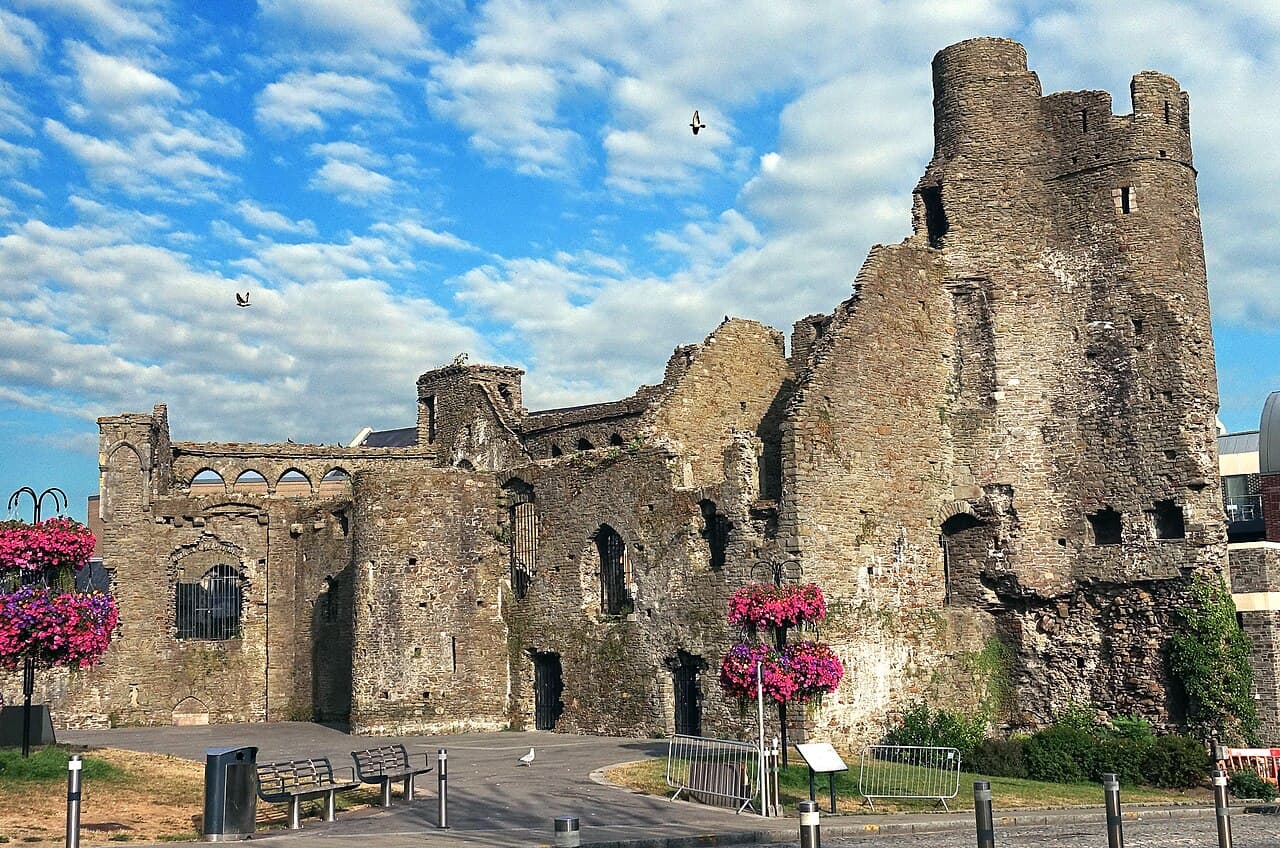
Between 1221 and 1284, Swansea Castle underwent a major transformation from timber to stone. This phase included the construction of a fortified inner enclosure with at least one tower and the expansion of a large outer bailey. The surviving stone walls, particularly the outer bailey walls on the southeast corner, date from the late 13th or early 14th century. These walls feature an elegant series of arcades along the wall-head, a decorative architectural element comparable to those found in the palatial residences of the Bishop of Saint David’s.
The south face of the outer bailey ends with a tall garderobe tower, a medieval latrine projecting from the wall, illustrating the castle’s practical design considerations. Beneath the castle, there are five vaulted basement rooms with tunnel-like ceilings, built in the medieval stone style, though their exact functions remain unclear.
Military and administrative role
By the 14th century, Swansea Castle had lost much of its military importance as the region stabilized under English control. It continued to serve as an administrative centre and a symbol of Norman authority in the area. The castle may have played a role during the Welsh uprising led by Owain Glyndŵr in the early 15th century, though records do not confirm any capture or significant damage during this period.
Architectural adaptations during the late medieval period include the addition of a two-storey residential block containing a great hall and private chambers. A small round tower with defensive gunports was likely added during the Wars of the Roses in the 15th century, reflecting evolving military technology. The northeast tower functioned as a prison and debtors’ tower until 1858, indicating the castle’s continued civic role.
Post-medieval decline and adaptive reuse
From the 17th century onwards, Swansea Castle’s military function ceased, and it was adapted for various civic and industrial uses. The square tower was converted into a bottle factory in the 1670s. In 1700, a town hall was constructed within the castle courtyard, while the Great Hall was transformed into a workhouse by the mid-18th century. The town hall was replaced by a post office in the 19th century, and a military drill room took over the workhouse site by 1850.
The nearby River Tawe was straightened and diverted in the 1840s, altering the castle’s immediate landscape. Between 1909 and 1913, the original large motte was demolished to make way for newspaper offices. These offices notably employed the poet Dylan Thomas in the early 1930s. The newspaper buildings were removed in 1976, after which the castle ruins were consolidated and made accessible to the public.
Current remains and heritage status
Today, Swansea Castle exists as ruins primarily consisting of two blocks of stone walls forming an L-shaped section of the outer bailey on the southeast corner. The site covers approximately 4.6 acres (1.9 hectares) and retains important medieval architectural features such as the arcaded parapet and the garderobe tower. The original motte, once one of the largest in Wales at 52 meters across, no longer survives.
The castle is protected as a Scheduled Ancient Monument and has held a Grade I heritage listing since 1952. Managed by Cadw, the Welsh heritage agency, the site was improved in the 2010s with paved courtyards and educational panels for visitors. It serves as a public space that preserves the medieval legacy within Swansea’s modern urban environment.
Architectural significance and comparison
Swansea Castle’s stonework, especially the arcaded parapet, is an example of high medieval castle architecture in Wales, comparable to ecclesiastical palaces of the same era. The combination of defensive and residential structures illustrates the dual military and administrative functions typical of Norman castles in the region. Its evolution from a timber motte-and-bailey to a stone fortress reflects broader trends in castle construction during the High Medieval period.
The castle’s later adaptations for civic use demonstrate the changing role of medieval fortifications in urban settings. Despite much loss, the remaining ruins provide valuable insight into the architectural and social history of medieval Swansea and the wider Gower peninsula.
Frequently asked questions (FAQ)
- How do I visit Swansea Castle?
- Swansea Castle is located in Swansea city centre and is accessible to the public as an open-air ruin. There are no entrance fees, and visitors can explore the site at any time during daylight hours. Informational panels provide historical context on site.
- What remains can I see at Swansea Castle today?
- Today, visitors can see the stone ruins of the outer bailey walls, including the arcaded parapet and the tall garderobe tower. The original motte no longer exists, but the remaining walls showcase medieval defensive and residential architecture.
- When was Swansea Castle built and by whom?
- Swansea Castle was founded in 1107 by Henry de Beaumont as a timber motte-and-bailey castle. It was later rebuilt in stone between 1221 and 1284 to strengthen its defenses and administrative role.
- Why is Swansea Castle historically important?
- Swansea Castle was a key Norman stronghold in South Wales, serving as the administrative centre of the Lordship of Gower. It played a significant role in regional conflicts and exemplifies medieval castle architecture and Norman colonization.
- Is Swansea Castle wheelchair accessible?
- As an open-air ruin with uneven ground and limited pathways, Swansea Castle has limited wheelchair accessibility. Visitors with mobility concerns should contact local tourist information for advice before visiting.
- What is the best time to visit Swansea Castle?
- The castle can be visited year-round during daylight hours. Spring and summer months offer better weather and longer daylight for exploring the ruins and surrounding city centre.
Photo gallery

Information
Sources & official resources
Verify the information above using these authoritative references.
Loading map...
Visitor reviews
No reviews yet. Been here? Write the first review and help other travelers!
Write the first reviewVisited this castle? Share your experience
Your review helps other travelers and adds first-hand knowledge to our encyclopedia.