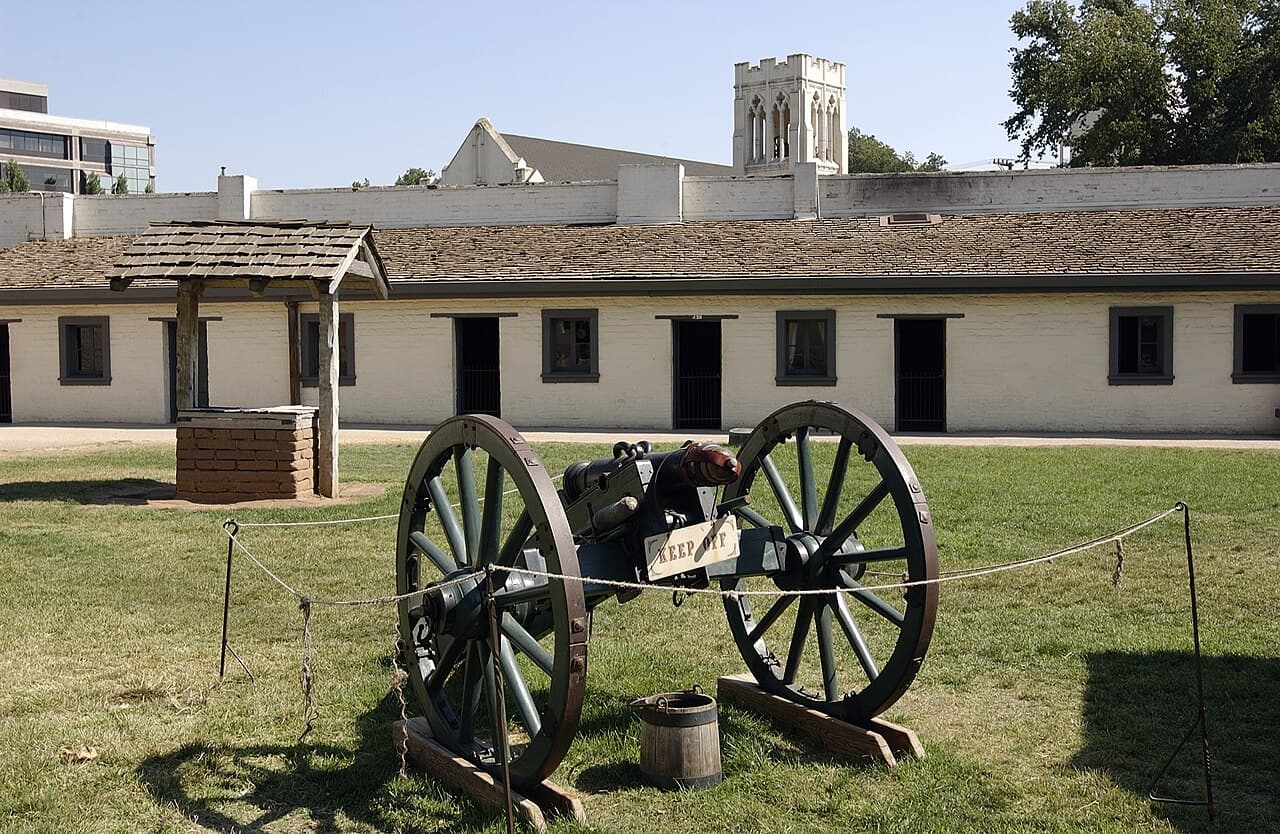
Sutter's Fort
Sutter's Fort stands as a significant historical site in the early development of California during the 19th century. Originally established as part of a larger colonial enterprise known as New Helvetia (New Switzerland) by John Sutter in 1839, the fort itself began construction in 1841. This adobe fortification was the first non-Indigenous settlement in the California Central Valley, playing a crucial role in the region's agricultural and trade activities during the Mexican Alta California period.
Historical context and foundation
The founding of Sutter's Fort occurred amid a period of territorial shifts and cultural encounters in California. John Sutter, a Swiss immigrant, envisioned New Helvetia as a utopian agricultural colony, aiming to establish a self-sufficient community. The fort was designed as a fortified compound to protect settlers and serve as a center for trade and agriculture. Its location was strategic, near the convergence of important trails such as the California Trail and the Siskiyou Trail, making it a vital waystation for travelers and migrants moving westward.
Construction and architecture
The fort's construction began in 1841, primarily using adobe bricks, a common building material in the region due to its availability and insulating properties. The structure was designed as a bastioned fortress, featuring defensive walls with bastions at the corners to allow for protection against potential attacks. The fort included living quarters, storage rooms, workshops, and stables arranged around a central courtyard, typical of frontier forts of the era.
Role in California's early development
Sutter's Fort quickly became a focal point for the emerging non-Indigenous population in the Central Valley. It served as a hub for agricultural production, utilizing Indigenous labor under conditions that have since been recognized as exploitative and harsh. The fort's agricultural output supported both the local community and travelers passing through the region.
The fort gained historical prominence due to its association with several key events. It was near the site where the Donner Party passed during their ill-fated journey west. More notably, the discovery of gold at Sutter's Mill in 1848, located nearby on Sutter's property, sparked the California Gold Rush, dramatically transforming the region's economy and demographics.
Impact on indigenous populations
The establishment and operation of Sutter's Fort had profound effects on local Indigenous communities. Indigenous laborers were employed under conditions resembling feudal servitude, and many suffered mistreatment. This aspect of the fort's history is critical to understanding the broader impacts of colonization in California.
Transition and legacy
Following the American annexation of California after the Mexican-American War, Sutter's Fort transitioned from a private colonial enterprise to a historical landmark. The surrounding area developed into the city of Sacramento, which grew out of the settlement around the fort. The fort itself fell into disrepair over time but was later restored to reflect its original 19th-century appearance.
Preservation and modern significance
Today, Sutter's Fort is preserved as a California State Historic Park, administered by the California Department of Parks and Recreation. The adobe structure has been carefully restored, allowing visitors to explore the fort's original layout and gain insight into early California history. It was designated a National Historic Landmark in 1961, recognizing its cultural and historical importance.
The site offers educational programs and reenactments that highlight the daily life of settlers and Indigenous peoples during the fort's operational period. Its location near Sacramento makes it accessible for those interested in the formative years of California's statehood and the complex interactions between cultures during the 19th century.
Frequently asked questions (FAQ)
- What is the historical significance of Sutter's Fort?
- Sutter's Fort was the first non-Indigenous settlement in California's Central Valley and played a key role in agriculture, trade, and westward migration during the 19th century. It is also linked to the California Gold Rush and early Sacramento development.
- How can I visit Sutter's Fort today?
- Sutter's Fort is a California State Historic Park open to the public. It offers tours, educational programs, and reenactments. The fort is located at 2701 L Street, Sacramento, and is accessible by car or public transport.
- When was Sutter's Fort built and what materials were used?
- Construction of Sutter's Fort began in 1841 using adobe bricks, a traditional building material in the region, designed as a bastioned fortress with defensive walls and bastions.
- What was the role of Indigenous people at Sutter's Fort?
- Indigenous laborers worked under difficult and often exploitative conditions at Sutter's Fort, contributing to agricultural production and maintenance of the settlement during its early years.
- Why is Sutter's Fort associated with the California Gold Rush?
- The discovery of gold at nearby Sutter's Mill in 1848, on land owned by John Sutter, sparked the California Gold Rush, linking the fort to this transformative event in American history.
Photo gallery

Information
Address
2701 L Street, Sacramento, CA 95816
Loading map...
Visitor reviews
No reviews yet. Been here? Write the first review and help other travelers!
Write the first reviewVisited this castle? Share your experience
Your review helps other travelers and adds first-hand knowledge to our encyclopedia.


