
Suscinio Castle
Suscinio Castle, also known as Château de Suscinio, stands as a remarkable example of a medieval ducal fortress located on the Rhuys peninsula near Sarzeau in the Morbihan department of France. Originally constructed in the early 13th century, the castle has witnessed centuries of political intrigue, architectural evolution, and historical significance tied to the Duchy of Brittany and later the French crown. Its strategic location near the Atlantic coast, surrounded by dense forests and salt marshes, made it an ideal residence and hunting retreat for the dukes.
The castle's origins date back to 1218 when it was built as an unfortified seigneurial manor for Peter I, Duke of Brittany. This initial structure served primarily as the administrative center of a large agricultural estate. In 1229, Peter's son, John I, initiated the fortification of the manor, transforming it into a defensible castle. Over the following centuries, Suscinio underwent significant expansions and enhancements, particularly under the Montfort dynasty, which ruled Brittany during a turbulent historical period marked by the Breton War of Succession and ongoing conflicts with France.
Architectural evolution and defensive features
The castle as it stands today reflects the culmination of these medieval building campaigns, primarily from the 13th to the 15th centuries. It is classified as a water castle, surrounded by broad, water-filled moats that reach depths of three to four meters, encircling the entire fortress. The irregular quadrilateral enclosure is fortified by seven towers, six of which are circular with characteristic pointed conical roofs, providing elevated vantage points and defensive strength. The seventh tower is square and reinforces the western curtain wall, adding architectural variety.
The curtain walls or enceinte are topped with distinctive Breton-style machicolations, a defensive feature consisting of projecting stone corbels arranged in stepped pyramids. These allowed defenders to repel attackers by dropping projectiles or boiling substances directly down the walls. The main entrance is guarded by two massive round towers flanking a gate that originally featured a drawbridge crossing the moat. Later restoration introduced a fixed stone bridge. Four watch posts near the entrance provided additional surveillance and defense.
In the late 16th century, reflecting the evolution of military technology, two artillery bastions were added on the southern side under the direction of the Duke of Mercœur. These bastions were designed to mount cannons and withstand artillery fire, marking a transition from medieval to early modern fortification styles.
Residential buildings and internal layout
Within the castle's walls lie two main residential buildings, or logis, constructed of rubble granite and facing each other across a spacious courtyard. The northern logis, revealed through archaeological excavation, contains a complex ground-floor arrangement including kitchens and storage areas dating from the late 13th century. This building connects to an eastern ducal residence featuring a ceremonial hall, kitchen service hatch, the duke's bedroom adjacent to a dressing chamber, heated rooms, and a small oratory opening onto the northern tower.
The western logis, accessible to visitors today, completes the enclosed residential space, illustrating the castle's dual function as a fortress and noble home. The castle's interiors include rooms such as the banquet hall, duke's withdrawal room, duchess's wardrobe, and functional spaces like ovens. Archaeological finds displayed within the castle provide insights into medieval daily life and ducal history.
Historical significance and notable occupants
Suscinio Castle played a pivotal role in the history of Brittany and beyond. After its initial construction, it was enlarged and fortified notably under Duke John IV following its capture by Bertrand du Guesclin, a Breton knight and Constable of France. The castle was further consolidated by Duke John V in the 15th century, who added the prominent Tour Neuve (New Tower).
From 1471 to 1483, during the Wars of the Roses, Suscinio served as a refuge for Jasper Tudor, Henry Tudor (later King Henry VII of England), and their Lancastrian supporters. They lived under the protection of Duke Francis II of Brittany before fleeing to France following betrayal. This period underscores the castle's role in international dynastic politics.
In the early 16th century, the castle passed to the French crown under King Francis I, who gifted it to one of his mistresses. The castle's importance waned thereafter, and it gradually fell into disuse. During the French Revolution, the castle was sold as national property and used as a stone quarry, accelerating its decline into ruin.
Restoration and modern status
In 1852, Vicomte Jules de Francheville acquired the castle and undertook initial consolidation efforts. Since 1965, ownership transferred to the Departmental Council of Morbihan, which has overseen extensive restoration projects aimed at preserving the castle's structural integrity and historical character. These works include stabilizing walls and towers, restoring moats and drawbridges, and reconstructing lost architectural elements.
Archaeological excavations have revealed important details about the castle's construction phases, internal layout, and the lifestyle of its noble inhabitants. The nearby Saint-Nicolas chapel, once richly decorated with a unique tiled floor featuring the medieval alphabet, has been partially restored and its artifacts are displayed within the castle.
Today, Suscinio Castle stands as a well-preserved example of a late medieval fortress that uniquely retains its defensive features alongside residential comforts. It offers visitors a comprehensive glimpse into the architectural, military, and cultural history of the Breton dukes and their legacy.
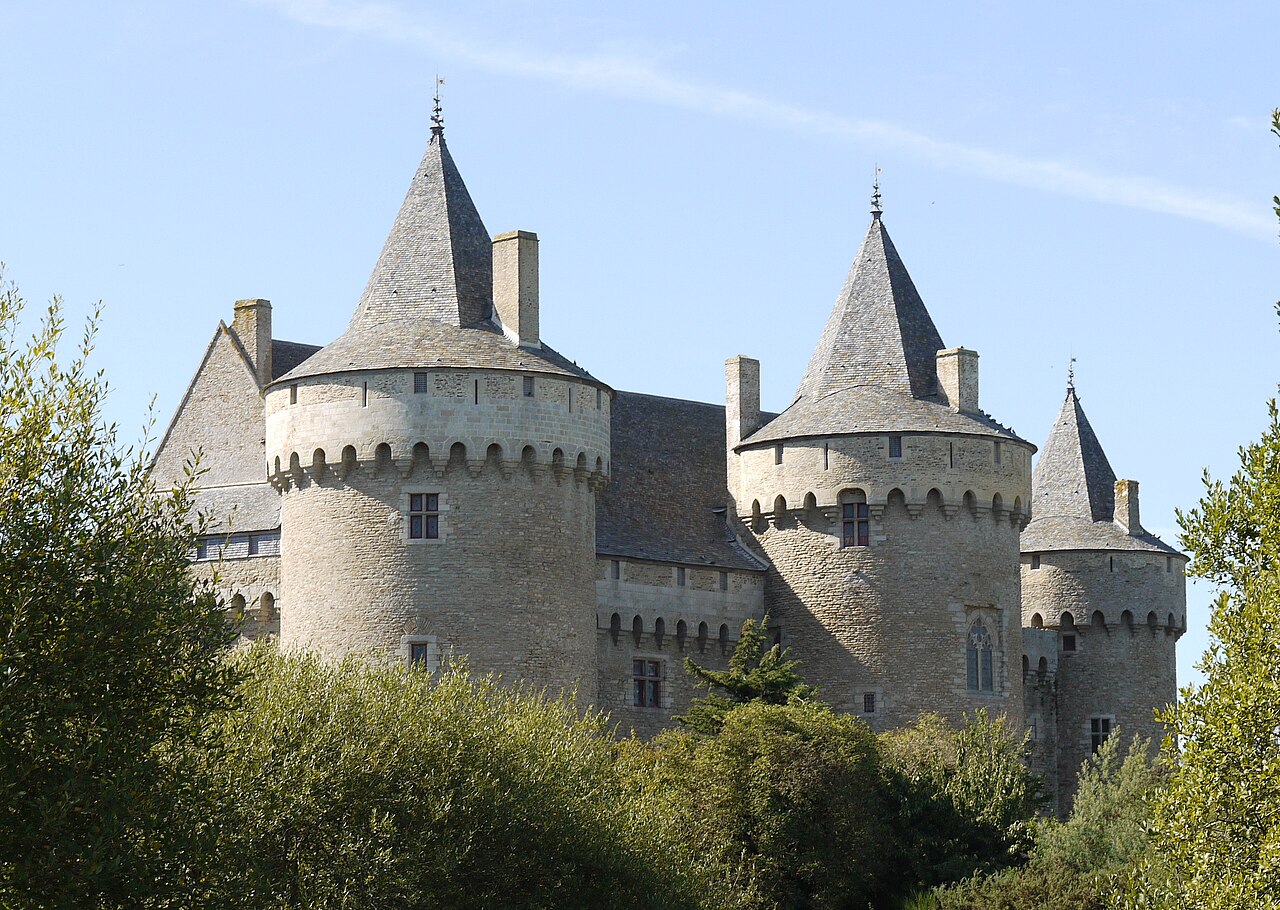
Photo by Pline • CC BY-SA 3.0
Architectural highlights and visitor experience
Visitors to Suscinio Castle can explore its imposing curtain walls, climb the towers for panoramic views, and walk along the restored moats and drawbridge. The castle's interiors showcase medieval living spaces, including the banquet hall and private chambers, enriched by informative panels and displays of archaeological finds.
The castle's setting near the Atlantic coast and its surrounding natural landscape of forests and marshes enhance the historical ambiance, reflecting its original purpose as a hunting and leisure retreat. The adjacent dovecote and the remains of the ducal chapel add further depth to the site's historical narrative.
Suscinio Castle is accessible to the public for a fee, with ongoing restoration ensuring that this iconic monument continues to be a vital link to Brittany's medieval past and a significant cultural heritage site in France.
Frequently asked questions (FAQ)
- What is the historical significance of Suscinio Castle?
- Suscinio Castle, built in the 13th century, is a remarkable example of medieval architecture in Brittany, France. It served as a residence for the Dukes of Brittany and played a vital role in regional power dynamics during its time.
- When was Suscinio Castle constructed?
- Construction of Suscinio Castle began in the early 13th century, with significant expansions and modifications occurring over the years. The castle was primarily completed by the end of the 15th century, showcasing the evolution of architectural styles through its history.
- Can I visit Suscinio Castle year-round?
- Yes, Suscinio Castle is open to visitors throughout the year, although opening hours may vary by season. It is advisable to check the official website for the most current visiting hours before planning your trip.
- What are the ticket prices for Suscinio Castle?
- Ticket prices for Suscinio Castle are typically around €7 for adults and €4 for children aged 7 to 18. Discounts may be available for families and groups, so be sure to inquire when purchasing your tickets.
- Is Suscinio Castle accessible for visitors with disabilities?
- Yes, Suscinio Castle has made provisions to ensure accessibility for visitors with disabilities. Ramps and designated pathways are available to facilitate access to key areas of the castle.
- When is the best time to visit Suscinio Castle?
- The best time to visit Suscinio Castle is during the spring and early autumn months when the weather is mild and pleasant. Additionally, these seasons typically see fewer crowds, allowing for a more enjoyable experience.
- What nearby attractions can I explore after visiting Suscinio Castle?
- After visiting Suscinio Castle, you can explore the stunning beaches of Sarzeau or take a stroll through the picturesque countryside. The Gulf of Morbihan, known for its beautiful islands and nature reserves, is also a short drive away.
- What architectural features should I look for at Suscinio Castle?
- Visitors should take note of the castle's impressive fortified walls, majestic towers, and intricate stone carvings. The blend of Gothic and Renaissance architectural styles is particularly noteworthy, reflecting the castle's rich history.
- How do I get to Suscinio Castle from Sarzeau?
- Suscinio Castle is conveniently located just a short drive from the town of Sarzeau. Visitors can reach the castle by car, bike, or even on foot, as there are well-marked paths leading to this historical site.
Photo gallery

Information
Sources & official resources
Verify the information above using these authoritative references.
Loading map...
Visitor reviews
No reviews yet. Been here? Write the first review and help other travelers!
Write the first reviewVisited this castle? Share your experience
Your review helps other travelers and adds first-hand knowledge to our encyclopedia.