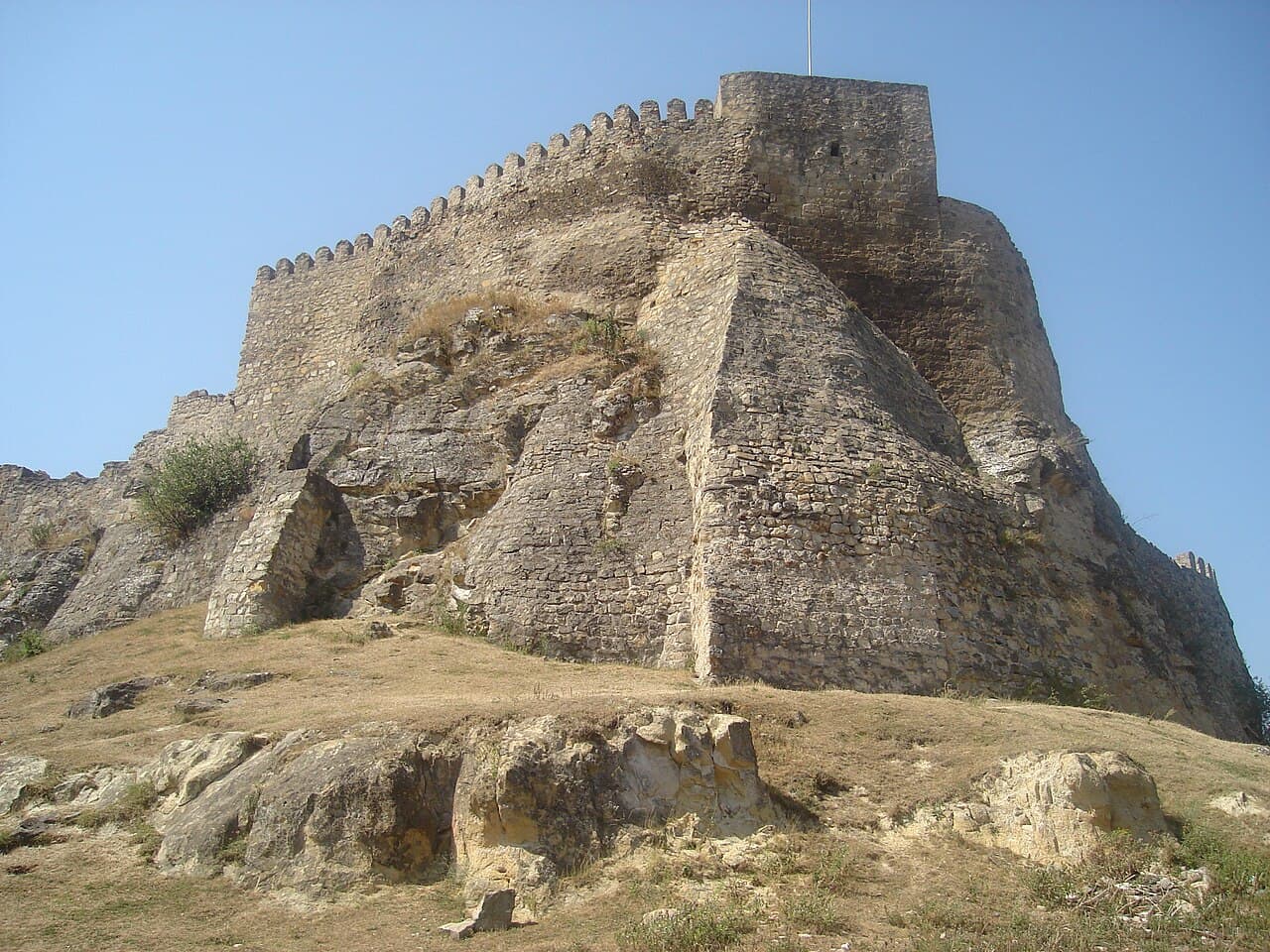
Surami Castle — Georgia castle

Surami Castle

Surami Castle: medieval bastioned fortress in Georgia
Surami, Shida Kartli, Georgia
High Medieval (11th–13th c.)
Ruins

Surami Castle stands prominently in the town of Surami, located within the Khashuri municipality in Georgia's Shida Kartli region. This medieval bastioned fortress occupies a commanding position atop a large rock at the heart of the town, strategically overseeing the entrance to the Borjomi Gorge and controlling the vital road connecting eastern and western Georgia.

Historical background and strategic importance

The origins of Surami Castle date back to the 12th or 13th century, a period when the town was heavily fortified to protect this crucial transit corridor. From the 1170s until the late 14th century, the fortress served as a hereditary fiefdom of the Eristavis (dukes) of Kartli, a noble dynasty that played a significant role in the region's governance and defense. This era marked the castle's prominence as a military and administrative center.

Following this period, Surami experienced decline but retained its importance as a trading post and military stronghold. The fortress underwent significant reconstruction during the 16th and 17th centuries, reflecting ongoing strategic needs amid regional conflicts involving Persian and Ottoman forces.

Architectural features and fortifications

Surami Castle exemplifies a bastioned fortress design adapted to its rugged terrain. Built on a large rock outcrop, the castle's walls and defensive structures were constructed to maximize natural elevation advantages. The fortress includes thick stone walls, battlements, and towers positioned to provide overlapping fields of fire and surveillance over the surrounding landscape.

The castle's layout reflects typical medieval Georgian military architecture, with a compact plan focused on defense and control of the key mountain pass. The use of bastions allowed defenders to cover approaches effectively, while the elevated position made it difficult for attackers to mount successful sieges.

Military engagements and historical events

Surami Castle's military significance is highlighted by its involvement in several notable conflicts. In 1625, during the period of Iranian Safavid dominance, the fortress was captured and rebuilt by Prince Giorgi Saakadze, a prominent Georgian military commander and politician. This reconstruction reinforced its defensive capabilities amid ongoing regional power struggles.

By 1692, the castle had fallen under Ottoman control, reflecting the shifting balance of power in the Caucasus. After the Ottomans were expelled, Surami became a key base for Georgian rebels resisting Iranian Safavid rule.

During the 1742-1745 rebellion against the Safavid Empire, Surami Castle was the principal bastion of Prince Givi Amilakhvari. The fortress endured a prolonged siege by the Persian army led by Nader Shah, with Georgian allies Teimuraz II of Kakheti and his son Erekle II commanding the besieging forces. Despite repeated attempts, including two efforts to blow up the castle walls, the fortress held firm until Amilakhvari was persuaded to surrender. Following the surrender, Nader Shah ordered the castle's demolition.

Nevertheless, the fortress was soon rebuilt by Georgians and remained in use until 1782. It played a role in the Russo-Turkish War of 1768–1774, serving as a base for Russo-Georgian troops conducting operations against Ottoman forces.

Surami Castle continued to function as a military post after the Russian annexation of Georgia in 1801, but over the course of the 19th century, its military importance diminished, and the fortress gradually fell into ruin.

Later history and current status

By the mid-18th century, Surami was a diverse settlement with approximately 200 households comprising Georgians, Armenians, and Jews, according to historical accounts by Prince Vakhushti. The town retained its status as a lively trading post and became known for its mountain climate.

Today, Surami Castle remains a notable historical monument, freely accessible to visitors. While it is relatively small, the fortress offers insight into the region's medieval military architecture and turbulent history. Its position atop a rocky outcrop provides commanding views of the surrounding landscape and the Borjomi Gorge.

Architectural significance and heritage value

Surami Castle is a representative example of a high medieval bastioned fortress adapted to the challenging terrain of the Caucasus Mountains. Its design showcases the strategic use of natural topography combined with fortified stone construction to create a defensible position controlling vital routes.

The castle's repeated reconstruction and use across centuries reflect the geopolitical importance of the region and the persistent conflicts involving Georgian, Persian, Ottoman, and Russian powers. As such, Surami Castle holds significant cultural and historical value as a symbol of Georgian resilience and military heritage.

Frequently asked questions (FAQ)

How do I get to Surami Castle?
Surami Castle is located in the town of Surami in the Shida Kartli region of Georgia. It is accessible by road from major cities like Tbilisi and Kutaisi, with local transport options available.
What is the best time to visit Surami Castle?
The best time to visit Surami Castle is during late spring to early autumn when the weather is mild and the surrounding landscape is lush and green.
Is Surami Castle open to the public?
Yes, Surami Castle is freely accessible to visitors year-round, allowing exploration of its ruins and panoramic views of the Borjomi Gorge.
What historical events is Surami Castle known for?
Surami Castle is known for its role in resisting sieges during the 1742-1745 rebellion against the Safavid Empire, particularly under Prince Givi Amilakhvari's leadership.
Can I see architectural features like bastions and towers at Surami Castle?
Visitors can observe the remains of Surami Castle's bastioned walls and defensive towers, which illustrate its medieval military architectural style.

Photo gallery

Surami Castle
Click to view

Photo by Kober•Public domain

1 photo • Click any image to view in full screen

Information

Bastioned Fortress

Loading map...

Visitor reviews

No reviews yet. Been here? Write the first review and help other travelers!

Write the first review

Visited this castle? Share your experience

Your review helps other travelers and adds first-hand knowledge to our encyclopedia.

Write a review

(5/5)

0/2000 characters

Your review will be visible after admin approval

Nearby castles

3.6 km

Khashuri Tower

Khashuri, Georgia

Khashuri Tower is a historic circular watchtower located in the heart of Khashuri town, within the Shida Kartli region of Georgia. This tower is a notable example of 18th-century defensive architecture in the region, reflecting the military and strategic needs of its time. The tower's circular form is characteristic of watchtowers designed to provide a wide field of vision for surveillance and early warning purposes. Constructed during the post-Renaissance period, specifically in the 18th century, it served as a lookout point to protect the town and surrounding areas from potential invasions or raids. Architectural features and construction The Khashuri Tower is built primarily from stone, a common material in Georgian fortifications, chosen for its durability and defensive strength. Its circular shape not only enhanced its defensive capabilities by eliminating blind spots but also helped it withstand attacks more effectively than angular structures. The tower's walls are thick, designed to resist siege weaponry and provide shelter for guards stationed within. Although detailed architectural plans or records are scarce, the tower likely included narrow windows or arrow slits, typical of watchtowers, allowing defenders to observe and fire upon approaching enemies while remaining protected. Historical context and significance During the 18th century, the region of Shida Kartli, including Khashuri, was subject to various military pressures due to its strategic location in the South Caucasus. The construction of watchtowers like Khashuri Tower was part of a broader defensive network intended to safeguard local populations and trade routes against incursions by rival factions and invading forces. While specific historical events associated with Khashuri Tower are not well documented, its existence underscores the importance of regional defense strategies in Georgian history during this period. The tower would have been manned by local militia or guards tasked with early detection of threats, contributing to the security and stability of the town. Current condition and access Today, Khashuri Tower remains a prominent landmark in the town center, although it is privately owned and not open to public visits. Its preservation status is partially maintained, but the tower is not fully restored or adapted for tourism. Despite limited access, the tower continues to attract interest from historians, architecture enthusiasts, and visitors intrigued by Georgia's rich heritage of fortifications. Its modest size and simple design reflect the practical military architecture of its time rather than grandiose castle construction. Role in Georgian architectural heritage Khashuri Tower represents an important example of post-Renaissance military architecture in Georgia, illustrating how local defensive structures adapted to the geopolitical realities of the 18th century. It complements other regional fortifications that together narrate the story of Georgian resilience and strategic ingenuity. While it may not possess the scale or fame of larger castles or citadels, Khashuri Tower's survival offers valuable insight into the smaller-scale fortifications that played a crucial role in community defense and control of key transit points.

Post-Renaissance (17th–18th c.)
Details
11.6 km

Akhaldaba Tower

Akhaldaba, Georgia

Akhaldaba Tower is a historic watchtower located in the village of Akhaldaba within the Borjomi municipality of the Samtskhe–Javakheti region in Georgia. This tower stands prominently on the right bank of the Kura River (known locally as the Mtkvari), offering strategic views over the surrounding landscape. Though now in ruins, the tower's circular design reflects its original defensive purpose during the post-Renaissance period, likely constructed in the 18th century. Historical context and strategic importance The Akhaldaba Tower functioned as an outpost connected to the nearby Akhaldaba Castle, which was situated on a mountain south of the village. This positioning allowed the tower to serve as an early warning and surveillance point along the river corridor. During the 17th and 18th centuries, this region was a crossroads for various military and trade routes, making such watchtowers essential for controlling movement and providing defense against potential invaders. While detailed historical records about the tower itself are scarce, its architectural form and location suggest it played a role in the broader defensive network of the area. The tower's proximity to the Kura River would have enabled monitoring of river traffic and communication with other fortifications in the region. Architectural features of Akhaldaba Tower The tower is characterized by its circular plan, a common design for watchtowers aiming to provide a 360-degree field of view. This shape also helped deflect projectiles and reduce blind spots. Constructed primarily from local stone, the tower's walls were likely thick to withstand attacks and provide shelter for the guards stationed there. Though now a ruin, remnants of the tower's masonry reveal the quality of construction typical for Georgian military architecture of the period. The tower would have included narrow slits or embrasures for archers or riflemen to observe and defend against approaching threats. The tower's elevated position on the riverbank also emphasizes its role in surveillance and communication, as signals could be sent to other nearby fortifications or settlements. Relationship with Akhaldaba Castle The nearby Akhaldaba Castle, located on a mountain south of the village, was the primary fortress in the area. The tower likely supported the castle by extending its surveillance reach and acting as a first line of defense. The castle itself would have been a larger complex, possibly including residential quarters, storage facilities, and more substantial fortifications. This network of fortifications reflects the military strategies of the post-Renaissance period in Georgia, where controlling key geographic points such as riverbanks and mountain passes was vital for regional security. Current condition and visiting information Today, Akhaldaba Tower remains a ruined circular watchtower, but it is accessible to visitors interested in Georgian history and architecture. The site offers a picturesque setting on the banks of the Kura River, making it a worthwhile destination for those exploring the Samtskhe–Javakheti region. Visitors can freely explore the ruins, although the tower itself is simple and lacks extensive preservation or restoration efforts. The location provides insight into the strategic military architecture of the 18th century in Georgia and offers views of the surrounding natural landscape. Significance in Georgian heritage Although not as grand or well-known as some Georgian castles and fortresses, Akhaldaba Tower contributes to understanding the network of military outposts that protected key routes and settlements in the region. Its endurance as a ruin highlights the historical layering of defense mechanisms in Georgian history, particularly during the post-Renaissance period. The tower's presence underscores the importance of river control and mountain surveillance in Georgian defensive strategies. It remains a tangible link to the past for the local community and visitors alike.

Post-Renaissance (17th–18th c.)
Details
17.6 km

Mdzovreti Castle

Ortubani, Georgia

Mdzovreti Castle, also known by its alternate names Dzia, Dzaya, or Dzhami, is a historic fortress situated on a mountain east of the village of Ortubani in the Kareli municipality, within the Shida Kartli region of Georgia. This castle occupies a strategic position that has played a significant role throughout its history, particularly during the medieval period of Georgian statehood. Early medieval origins and royal significance First mentioned in the 10th century, Mdzovreti Castle was constructed during the early medieval period, reflecting the military and architectural characteristics of that era. By the 11th and 12th centuries, during the time of the unified Kingdom of Georgia, the castle served as a royal stronghold. Its location and fortifications made it a vital defensive site and a symbol of royal authority in the region. Historical conflicts and reconstructions Siege by ossetians and rebuilding During the reign of David VIII of Georgia (either 1292-1302 or 1308-1311), the castle was briefly captured by Ossetian forces amid internal conflicts. This period of turmoil led to significant military engagements in the area. Subsequently, the castle underwent reconstruction at the beginning of the 14th century, which likely included strengthening of its defensive walls and towers to withstand further assaults. The siege by timur in 1400 One of the most notable events in the castle's history occurred in 1400 when the Mongol warlord Timur (Tamerlane) launched an incursion into Georgian territories. During this campaign, King George VII of Georgia took refuge within Mdzovreti Castle under heavy fighting. Timur laid siege to the fortress for about a week, demonstrating the castle's strategic importance and resilience. Despite the siege, historical accounts suggest that King George VII managed to escape, preserving the continuity of Georgian resistance. Feudal ownership and decline Throughout the medieval period, Mdzovreti Castle was controlled by the prominent Javakhishvili family, a feudal dynasty influential in the region. Their dominance persisted until the end of the 15th century, after which control of the castle passed to the Tsitsishvili family. Over the following centuries, the castle's military significance diminished, and by the 18th or 19th century, it had fallen into ruin. Modern restoration and monastic conversion In the early 21st century, the ruins of Mdzovreti Castle were taken over by a group of monks who began an extensive rebuilding effort. This restoration transformed the castle into a self-sufficient and strict monastery. However, the reconstruction has been carried out according to the monks' own vision and needs, which do not necessarily adhere to historical accuracy or architectural authenticity. Today, the castle-monastery complex can be visited only through a free guided tour, allowing visitors to explore the unique blend of medieval fortress remains and modern monastic adaptations. Notably, the site features a distinctive pond that enhances the serene atmosphere of the location. Architectural features and layout While detailed architectural studies are limited due to the castle's partial reconstruction and modifications, the original Mdzovreti Castle would have included typical early medieval defensive elements such as fortified walls, towers, and possibly a keep or donjon. The mountainous setting provided natural defense, complemented by man-made fortifications to protect against sieges and raids common in the medieval Caucasus region. The current monastery structures incorporate some of these medieval elements but are primarily adapted for religious use, which affects the authenticity of the castle's original architectural style. Cultural and historical significance Mdzovreti Castle holds a significant place in Georgian history as a symbol of royal power, feudal authority, and resistance against foreign invasions. Its association with key historical figures such as David VIII and George VII of Georgia highlights its strategic and political importance during the medieval period. The castle's transformation into a monastery in the 21st century reflects ongoing cultural and religious traditions in Georgia, even as it raises questions about historical preservation and authenticity.

Early Medieval (5th–10th c.)
Details
