Akhaldaba Tower

Akhaldaba Tower in Samtskhe–Javakheti, Georgia
Akhaldaba, Georgia
Post-Renaissance (17th–18th c.)
Ruins

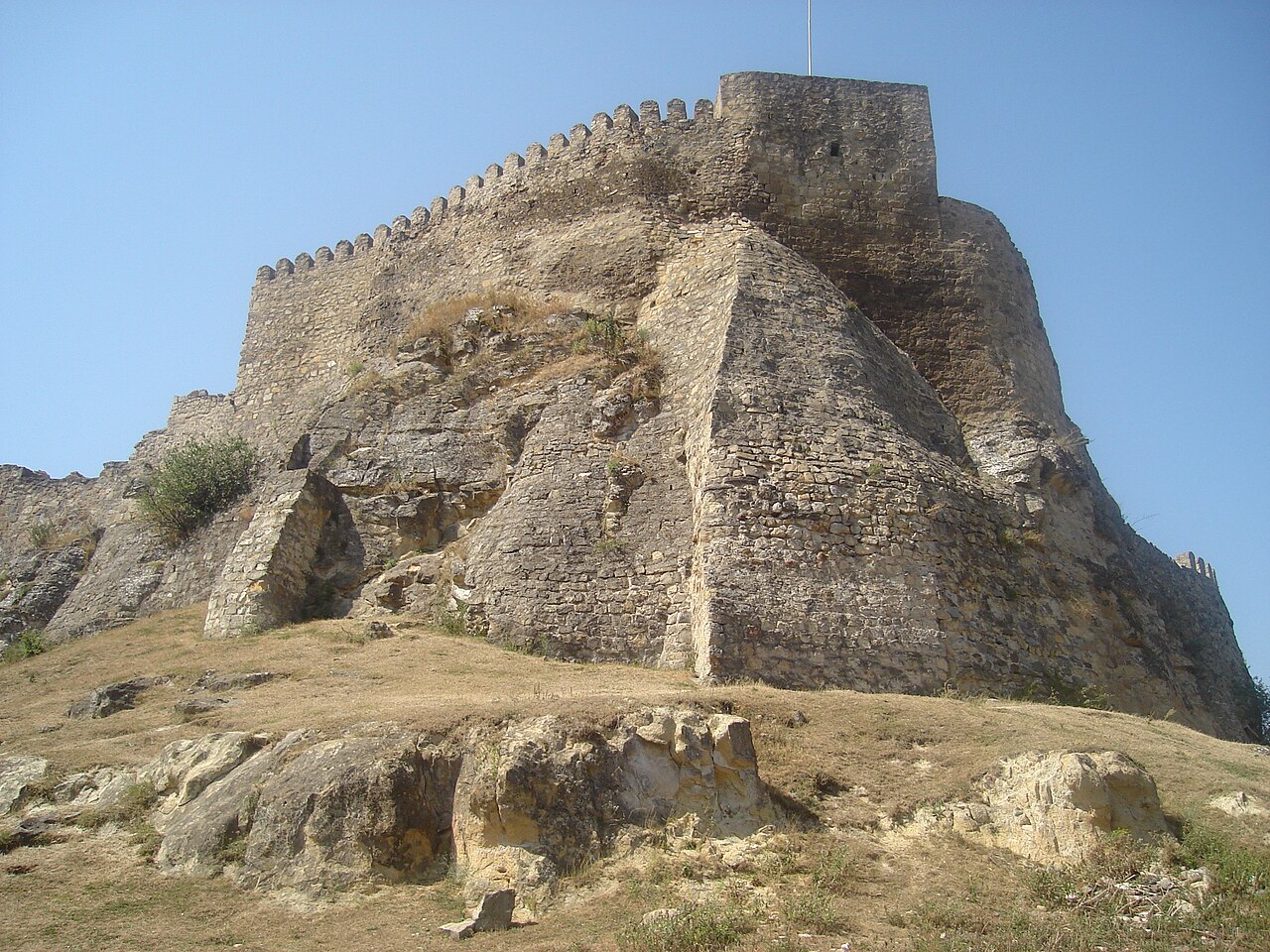
Akhaldaba Tower is a historic watchtower located in the village of Akhaldaba within the Borjomi municipality of the Samtskhe–Javakheti region in Georgia. This tower stands prominently on the right bank of the Kura River (known locally as the Mtkvari), offering strategic views over the surrounding landscape. Though now in ruins, the tower's circular design reflects its original defensive purpose during the post-Renaissance period, likely constructed in the 18th century.

Historical context and strategic importance

The Akhaldaba Tower functioned as an outpost connected to the nearby Akhaldaba Castle, which was situated on a mountain south of the village. This positioning allowed the tower to serve as an early warning and surveillance point along the river corridor. During the 17th and 18th centuries, this region was a crossroads for various military and trade routes, making such watchtowers essential for controlling movement and providing defense against potential invaders.

While detailed historical records about the tower itself are scarce, its architectural form and location suggest it played a role in the broader defensive network of the area. The tower's proximity to the Kura River would have enabled monitoring of river traffic and communication with other fortifications in the region.

Architectural features of Akhaldaba Tower

The tower is characterized by its circular plan, a common design for watchtowers aiming to provide a 360-degree field of view. This shape also helped deflect projectiles and reduce blind spots. Constructed primarily from local stone, the tower's walls were likely thick to withstand attacks and provide shelter for the guards stationed there.

Though now a ruin, remnants of the tower's masonry reveal the quality of construction typical for Georgian military architecture of the period. The tower would have included narrow slits or embrasures for archers or riflemen to observe and defend against approaching threats.

The tower's elevated position on the riverbank also emphasizes its role in surveillance and communication, as signals could be sent to other nearby fortifications or settlements.

Relationship with Akhaldaba Castle

The nearby Akhaldaba Castle, located on a mountain south of the village, was the primary fortress in the area. The tower likely supported the castle by extending its surveillance reach and acting as a first line of defense. The castle itself would have been a larger complex, possibly including residential quarters, storage facilities, and more substantial fortifications.

This network of fortifications reflects the military strategies of the post-Renaissance period in Georgia, where controlling key geographic points such as riverbanks and mountain passes was vital for regional security.

Current condition and visiting information

Today, Akhaldaba Tower remains a ruined circular watchtower, but it is accessible to visitors interested in Georgian history and architecture. The site offers a picturesque setting on the banks of the Kura River, making it a worthwhile destination for those exploring the Samtskhe–Javakheti region.

Visitors can freely explore the ruins, although the tower itself is simple and lacks extensive preservation or restoration efforts. The location provides insight into the strategic military architecture of the 18th century in Georgia and offers views of the surrounding natural landscape.

Significance in Georgian heritage

Although not as grand or well-known as some Georgian castles and fortresses, Akhaldaba Tower contributes to understanding the network of military outposts that protected key routes and settlements in the region. Its endurance as a ruin highlights the historical layering of defense mechanisms in Georgian history, particularly during the post-Renaissance period.

The tower's presence underscores the importance of river control and mountain surveillance in Georgian defensive strategies. It remains a tangible link to the past for the local community and visitors alike.

Frequently asked questions (FAQ)

What is the historical significance of Akhaldaba Tower?
Akhaldaba Tower is a key landmark in Georgia, representing the medieval fortification architecture of the region. It was built to defend against invasions and played a crucial role in the local history of the area. Its structure and design reflect the strategic importance of the location during various historical periods.
When was Akhaldaba Tower built?
Akhaldaba Tower was constructed in the 12th century, during a time when Georgia was experiencing significant political and military developments. The tower stands as a testament to the engineering skills and architectural advancements of that era. Its enduring presence offers insights into the historical context of the time.
How do I get to Akhaldaba Tower?
To reach Akhaldaba Tower, visitors can drive from the nearest major city, Tbilisi, which is about a 2-hour journey. Public transportation options are also available, with buses regularly traveling to Akhaldaba from nearby towns. Once in the village, the tower is accessible by a short walk.
What are the opening hours for Akhaldaba Tower?
Akhaldaba Tower is open to visitors daily from 9:00 AM to 6:00 PM. It is advisable to check for any seasonal changes in hours, especially during holidays or special events. Guided tours may be available at specific times, enhancing the visitor experience.
Can I take photos at Akhaldaba Tower?
Yes, photography is allowed at Akhaldaba Tower, making it a great opportunity for visitors to capture the stunning architecture and surrounding landscape. However, it's important to be respectful of other visitors and the historical site while taking photos. Sharing your experiences online helps promote the beauty of this historical gem.
Is it possible to climb the tower?
Yes, visitors can climb to the top of Akhaldaba Tower for breathtaking views of the surrounding landscape. The climb may involve navigating some steep and narrow stairs, so it's advisable for visitors to be in good health. The panoramic views from the top make the effort worthwhile.
What is the best time to visit Akhaldaba Tower?
The best time to visit Akhaldaba Tower is during the spring and fall months when the weather is mild and pleasant. This season also allows visitors to enjoy the beautiful natural scenery and foliage surrounding the tower. Summer can be hot, while winter may bring snow, which could affect accessibility.
Are there any nearby attractions to visit?
Yes, there are several attractions near Akhaldaba Tower, including the picturesque villages and stunning landscapes of the region. Visitors can explore other historical sites and enjoy local cuisine at nearby restaurants. The area is rich in culture, making it a perfect spot for a day of exploration.
What are the ticket prices for visiting Akhaldaba Tower?
Admission to Akhaldaba Tower is generally affordable, with ticket prices around 5 GEL for adults and discounted rates for students and children. It's a good idea to check for any special promotions or group rates that may be available. The cost provides access to the historical site and its fascinating views.

Information

Water Castle

Loading map...

Visitor reviews

No reviews yet. Been here? Write the first review and help other travelers!

Write the first review

Visited this castle? Share your experience

Your review helps other travelers and adds first-hand knowledge to our encyclopedia.
Write a review

(5/5)

0/2000 characters

Your review will be visible after admin approval

Nearby castles

11.6 km
Surami Castle — Georgia castle

Surami Castle

Surami, Georgia

Surami Castle stands prominently in the town of Surami, located within the Khashuri municipality in Georgia's Shida Kartli region. This medieval bastioned fortress occupies a commanding position atop a large rock at the heart of the town, strategically overseeing the entrance to the Borjomi Gorge and controlling the vital road connecting eastern and western Georgia. Historical background and strategic importance The origins of Surami Castle date back to the 12th or 13th century, a period when the town was heavily fortified to protect this crucial transit corridor. From the 1170s until the late 14th century, the fortress served as a hereditary fiefdom of the Eristavis (dukes) of Kartli, a noble dynasty that played a significant role in the region's governance and defense. This era marked the castle's prominence as a military and administrative center. Following this period, Surami experienced decline but retained its importance as a trading post and military stronghold. The fortress underwent significant reconstruction during the 16th and 17th centuries, reflecting ongoing strategic needs amid regional conflicts involving Persian and Ottoman forces. Architectural features and fortifications Surami Castle exemplifies a bastioned fortress design adapted to its rugged terrain. Built on a large rock outcrop, the castle's walls and defensive structures were constructed to maximize natural elevation advantages. The fortress includes thick stone walls, battlements, and towers positioned to provide overlapping fields of fire and surveillance over the surrounding landscape. The castle's layout reflects typical medieval Georgian military architecture, with a compact plan focused on defense and control of the key mountain pass. The use of bastions allowed defenders to cover approaches effectively, while the elevated position made it difficult for attackers to mount successful sieges. Military engagements and historical events Surami Castle's military significance is highlighted by its involvement in several notable conflicts. In 1625, during the period of Iranian Safavid dominance, the fortress was captured and rebuilt by Prince Giorgi Saakadze, a prominent Georgian military commander and politician. This reconstruction reinforced its defensive capabilities amid ongoing regional power struggles. By 1692, the castle had fallen under Ottoman control, reflecting the shifting balance of power in the Caucasus. After the Ottomans were expelled, Surami became a key base for Georgian rebels resisting Iranian Safavid rule. During the 1742-1745 rebellion against the Safavid Empire, Surami Castle was the principal bastion of Prince Givi Amilakhvari. The fortress endured a prolonged siege by the Persian army led by Nader Shah, with Georgian allies Teimuraz II of Kakheti and his son Erekle II commanding the besieging forces. Despite repeated attempts, including two efforts to blow up the castle walls, the fortress held firm until Amilakhvari was persuaded to surrender. Following the surrender, Nader Shah ordered the castle's demolition. Nevertheless, the fortress was soon rebuilt by Georgians and remained in use until 1782. It played a role in the Russo-Turkish War of 1768–1774, serving as a base for Russo-Georgian troops conducting operations against Ottoman forces. Surami Castle continued to function as a military post after the Russian annexation of Georgia in 1801, but over the course of the 19th century, its military importance diminished, and the fortress gradually fell into ruin. Later history and current status By the mid-18th century, Surami was a diverse settlement with approximately 200 households comprising Georgians, Armenians, and Jews, according to historical accounts by Prince Vakhushti. The town retained its status as a lively trading post and became known for its mountain climate. Today, Surami Castle remains a notable historical monument, freely accessible to visitors. While it is relatively small, the fortress offers insight into the region's medieval military architecture and turbulent history. Its position atop a rocky outcrop provides commanding views of the surrounding landscape and the Borjomi Gorge. Architectural significance and heritage value Surami Castle is a representative example of a high medieval bastioned fortress adapted to the challenging terrain of the Caucasus Mountains. Its design showcases the strategic use of natural topography combined with fortified stone construction to create a defensible position controlling vital routes. The castle's repeated reconstruction and use across centuries reflect the geopolitical importance of the region and the persistent conflicts involving Georgian, Persian, Ottoman, and Russian powers. As such, Surami Castle holds significant cultural and historical value as a symbol of Georgian resilience and military heritage.

High Medieval (11th–13th c.)
Details
12.1 km

Khashuri Tower

Khashuri, Georgia

Khashuri Tower is a historic circular watchtower located in the heart of Khashuri town, within the Shida Kartli region of Georgia. This tower is a notable example of 18th-century defensive architecture in the region, reflecting the military and strategic needs of its time. The tower's circular form is characteristic of watchtowers designed to provide a wide field of vision for surveillance and early warning purposes. Constructed during the post-Renaissance period, specifically in the 18th century, it served as a lookout point to protect the town and surrounding areas from potential invasions or raids. Architectural features and construction The Khashuri Tower is built primarily from stone, a common material in Georgian fortifications, chosen for its durability and defensive strength. Its circular shape not only enhanced its defensive capabilities by eliminating blind spots but also helped it withstand attacks more effectively than angular structures. The tower's walls are thick, designed to resist siege weaponry and provide shelter for guards stationed within. Although detailed architectural plans or records are scarce, the tower likely included narrow windows or arrow slits, typical of watchtowers, allowing defenders to observe and fire upon approaching enemies while remaining protected. Historical context and significance During the 18th century, the region of Shida Kartli, including Khashuri, was subject to various military pressures due to its strategic location in the South Caucasus. The construction of watchtowers like Khashuri Tower was part of a broader defensive network intended to safeguard local populations and trade routes against incursions by rival factions and invading forces. While specific historical events associated with Khashuri Tower are not well documented, its existence underscores the importance of regional defense strategies in Georgian history during this period. The tower would have been manned by local militia or guards tasked with early detection of threats, contributing to the security and stability of the town. Current condition and access Today, Khashuri Tower remains a prominent landmark in the town center, although it is privately owned and not open to public visits. Its preservation status is partially maintained, but the tower is not fully restored or adapted for tourism. Despite limited access, the tower continues to attract interest from historians, architecture enthusiasts, and visitors intrigued by Georgia's rich heritage of fortifications. Its modest size and simple design reflect the practical military architecture of its time rather than grandiose castle construction. Role in Georgian architectural heritage Khashuri Tower represents an important example of post-Renaissance military architecture in Georgia, illustrating how local defensive structures adapted to the geopolitical realities of the 18th century. It complements other regional fortifications that together narrate the story of Georgian resilience and strategic ingenuity. While it may not possess the scale or fame of larger castles or citadels, Khashuri Tower's survival offers valuable insight into the smaller-scale fortifications that played a crucial role in community defense and control of key transit points.

Post-Renaissance (17th–18th c.)
Details
13.4 km

Gogia Castle

Borjomi, Georgia

Gogia Castle is a medieval fortress perched on a mountain overlooking the town of Borjomi in the Samtskhe–Javakheti region of Georgia. This castle's strategic location allowed it to control the vital passage through the gorge of the Kura River (known locally as the Mtkvari), which served as a key route into the Georgian heartland from the south. Though modest in size and now largely in ruins, Gogia Castle remains an important historical landmark reflecting the defensive architecture and feudal history of late medieval Georgia. Historical context and strategic importance The exact date of Gogia Castle's construction remains uncertain, but architectural analysis of its square main tower suggests it dates back to the 14th century or possibly earlier. Its primary function was military defense, acting as a sentinel guarding the southern approaches through the Kura River gorge. This gorge was a critical corridor for trade and military movements, making the castle a vital component in a network of fortifications designed to protect Georgian territories. These fortifications communicated through a system of bonfires to warn of enemy advances, a common medieval early-warning method. Gogia Castle was part of this defensive chain, working in concert with nearby castles such as Petre Castle to monitor and secure the region. Architectural features and layout The castle's most prominent surviving feature is its square main tower, characteristic of late medieval military architecture in Georgia. This tower would have served both as a lookout point and a last line of defense. The castle's position atop a mountain provided natural fortification advantages, with steep slopes limiting access and enhancing its defensive capabilities. While much of the original structure has deteriorated, the ruins still indicate a compact fortress designed to accommodate a small garrison. Defensive walls and ancillary buildings likely surrounded the tower, but these have not survived intact. The castle's design reflects practical military considerations rather than elaborate residential or ceremonial architecture. Ownership and usage through the centuries From the 15th century onward, Gogia Castle was owned by the feudal Avalishvili family, who controlled several fortifications in the region, including the nearby Petre Castle. The castle's name derives from one of the Avalishvili lords, Gogia, whose tenure marked the castle's significance as a local power center. Despite its medieval origins, the castle remained in use well into the 19th century. During this period, it served as a watch post first for Georgian police forces and later for Russian troops, reflecting its enduring strategic value even as military technology and political control evolved. Current condition and visitor information Today, Gogia Castle is a small ruin accessible to visitors without restrictions. The site offers a glimpse into Georgia's medieval defensive network, though it is modest in scale and does not feature extensive preserved structures. Its location provides panoramic views of the surrounding Borjomi landscape and the Kura River gorge. While the castle itself may not appeal to those seeking grand architectural monuments, it holds interest for visitors keen on exploring the historical military heritage of the region and understanding the strategic importance of mountain fortresses in Georgian history.

Late Medieval (14th–15th c.)
Details

