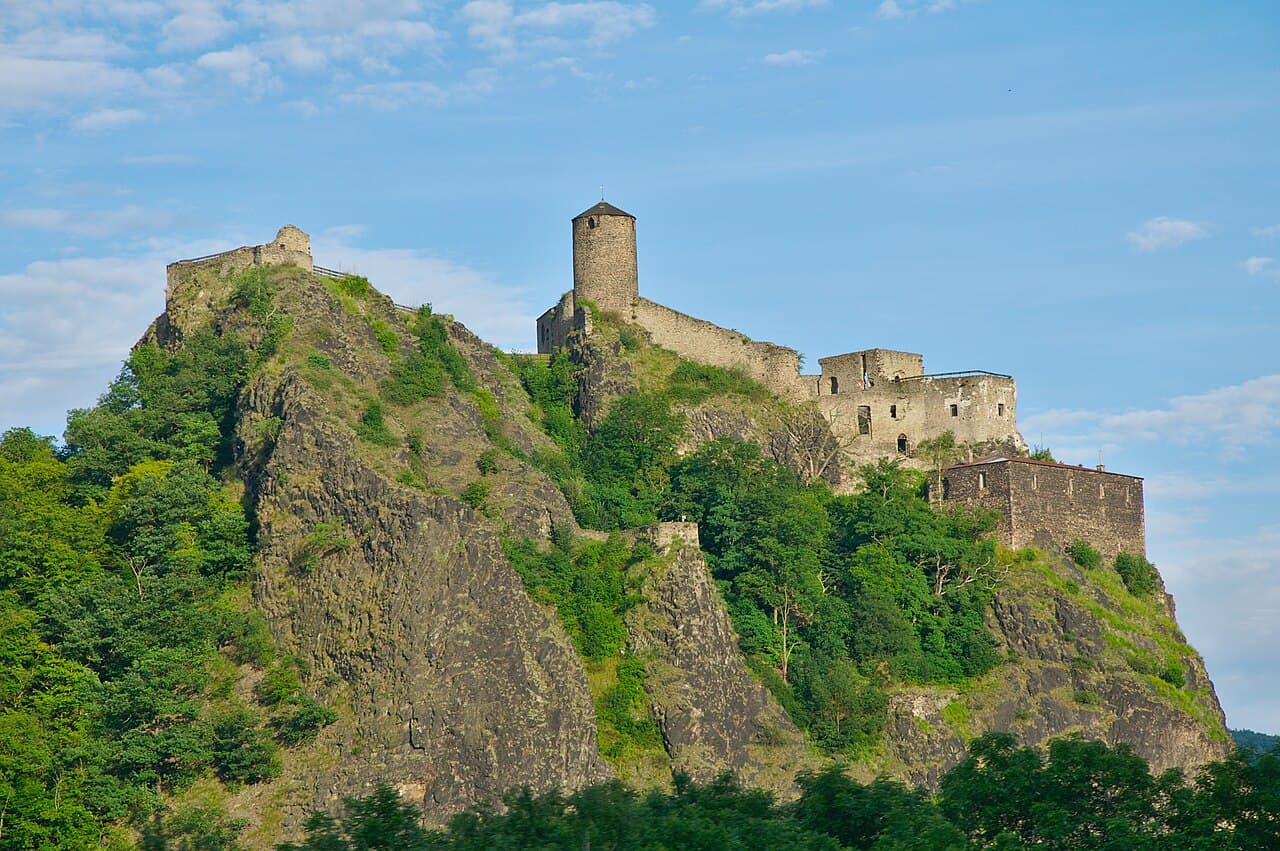
Strekov Castle
Strekov Castle, also known by its German name Schreckenstein, is a striking hill castle perched dramatically atop a steep cliff overlooking the Elbe River near the city of Ústí nad Labem in the Czech Republic. Constructed in 1316 during the late medieval period, the castle was originally built to guard a crucial trade route leading into Germany and to control river traffic, serving both military and administrative functions. Its commanding position nearly 100 meters above the water and its natural defenses provided by the rugged trachyte rock outcrop made it a formidable stronghold in the region.
The castle's foundation was commissioned by King John of Bohemia (Jan Lucemburský), father of the Holy Roman Emperor Charles IV. Early ownership passed to the influential Vartenberk family and later to other noble houses, including the Lobkowicz family, who acquired it in 1563 and maintained ownership for centuries. Throughout its history, Strekov Castle played a significant role in regional conflicts, notably during the Thirty Years' War and the Seven Years' War, enduring multiple occupations and sieges by Imperial, Saxon, Swedish, Austrian, and Prussian forces.
Architectural design and medieval fortifications
Strekov Castle's layout is distinctive, divided into two main sections connected by an arched bridge spanning a natural moat carved into the rock, an unusual feature for a castle built in the early 14th century. The castle's defensive structures include semicircular bastions inspired by French military architecture, which are among the earliest examples of such designs in Bohemia. These bastions reinforced the curtain walls and provided enhanced protection against siege weaponry.
The castle's core features a large round bergfried—a tall defensive tower with a conical wooden-shingled roof—and a smaller round tower guarding the entrance. The bergfried's original access was via a pointed-arch doorway above ground level, a design enhancing its defensibility. The rectangular two-room palace with rounded corners on the western side of the forecourt served as the main residential and administrative building.
Construction materials and stylistic elements
The castle was primarily constructed from locally quarried stone with finely cut masonry, exhibiting Gothic architectural details such as pointed arch windows and ornate late Gothic crossbars. The upper palace structures display a slightly rhomboid outline typical of the late Gothic style, with a pavilion roof also covered in wooden shingles. The castle's integration with the natural rock formations is notable, with parts of the palace built directly on and into the rocky slope.
Historical significance and military role
Initially built to secure the vital Elbe River trade route, Strekov Castle served as a customs collection point and military bastion. It replaced an older fortress near Ústí nad Labem, becoming the primary stronghold in the area. Ownership transitions reflect the shifting political landscape of medieval Bohemia, with the castle passing through various noble families and rulers.
During the Thirty Years' War in the 17th century, the castle was occupied by multiple armies, including Imperial Habsburg, Saxon, and Swedish forces, often suffering damage due to military actions. The Seven Years' War saw further conflict, including a notable siege in 1757 involving Croatian and Prussian troops. These repeated military engagements contributed to the castle's decline and eventual abandonment as a fortress by the late 18th century.
Romantic era and cultural legacy
By the 19th century, Strekov Castle had fallen into ruin but gained renewed fame during the Romantic period as a picturesque ruin attracting artists, poets, and musicians. The castle's dramatic setting above the Elbe inspired figures such as Johann Wolfgang von Goethe, who praised the view as the most beautiful in Central Europe. Composer Richard Wagner is said to have drawn inspiration for his opera Tannhäuser from his visit to the castle. The Czech poet Karel Hynek Mácha also found muse in the castle's romantic decay.
A restaurant established on the castle grounds in 1830 catered to visitors drawn by the castle's evocative atmosphere. The site became a cultural monument and was protected by the state starting in 1953. Following restitution laws after the fall of the Communist regime, ownership returned to the Lobkowicz family in 1992, who continue to preserve the castle as a historic site.
Current condition and preservation efforts
Today, Strekov Castle remains a well-known ruin offering visitors insight into medieval military architecture and noble residence design. The castle's remains include the bergfried, the palace ruins, curtain walls with semicircular bastions, and the distinctive arched bridge over the natural moat. The site is protected as a cultural monument and has undergone restoration efforts since the late 19th century, including significant work in 1911–1912.
The castle's location on a rugged rock formation with near-vertical cliffs and an extensive system of underground cellars adds to its unique character. Visitors can explore the ruins, enjoy panoramic views of the Elbe valley, and appreciate the blend of military functionality and Gothic architectural elegance that characterizes Strekov Castle.
Visitor experience and accessibility
While the castle is largely a ruin, pathways and viewing points allow visitors to safely explore the site and its dramatic landscape. The castle's proximity to Ústí nad Labem makes it accessible for day trips, and the surrounding area offers additional cultural and natural attractions. Preservation efforts ensure that Strekov Castle remains a valuable heritage site reflecting the complex history of Bohemian fortifications.
Frequently asked questions (FAQ)
- How do I get to Strekov Castle from Ústí nad Labem?
- Strekov Castle is located just outside Ústí nad Labem and can be reached by car or local bus. The castle sits on a hill above the Elbe River, with walking paths leading up to the ruins from the town.
- What is the historical significance of Strekov Castle?
- Built in 1316 to guard an important trade route, Strekov Castle played a key role in regional military conflicts including the Thirty Years' War and Seven Years' War. It also inspired Romantic-era artists and writers.
- Can visitors explore the interior of Strekov Castle?
- As a well-preserved ruin, visitors can explore the castle grounds, including the bergfried tower base, curtain walls, and palace ruins. Some areas may be restricted for safety reasons.
- When is the best time to visit Strekov Castle?
- The castle is best visited during spring to early autumn when weather conditions are favorable for hiking and sightseeing. The panoramic views of the Elbe valley are especially beautiful in clear weather.
- Is there an entrance fee to visit Strekov Castle?
- Visiting Strekov Castle is generally free, though some special events or guided tours may have a fee. Check local tourism information for current details.
Photo gallery

Information
Sources & official resources
Verify the information above using these authoritative references.
Loading map...
Visitor reviews
No reviews yet. Been here? Write the first review and help other travelers!
Write the first reviewVisited this castle? Share your experience
Your review helps other travelers and adds first-hand knowledge to our encyclopedia.



