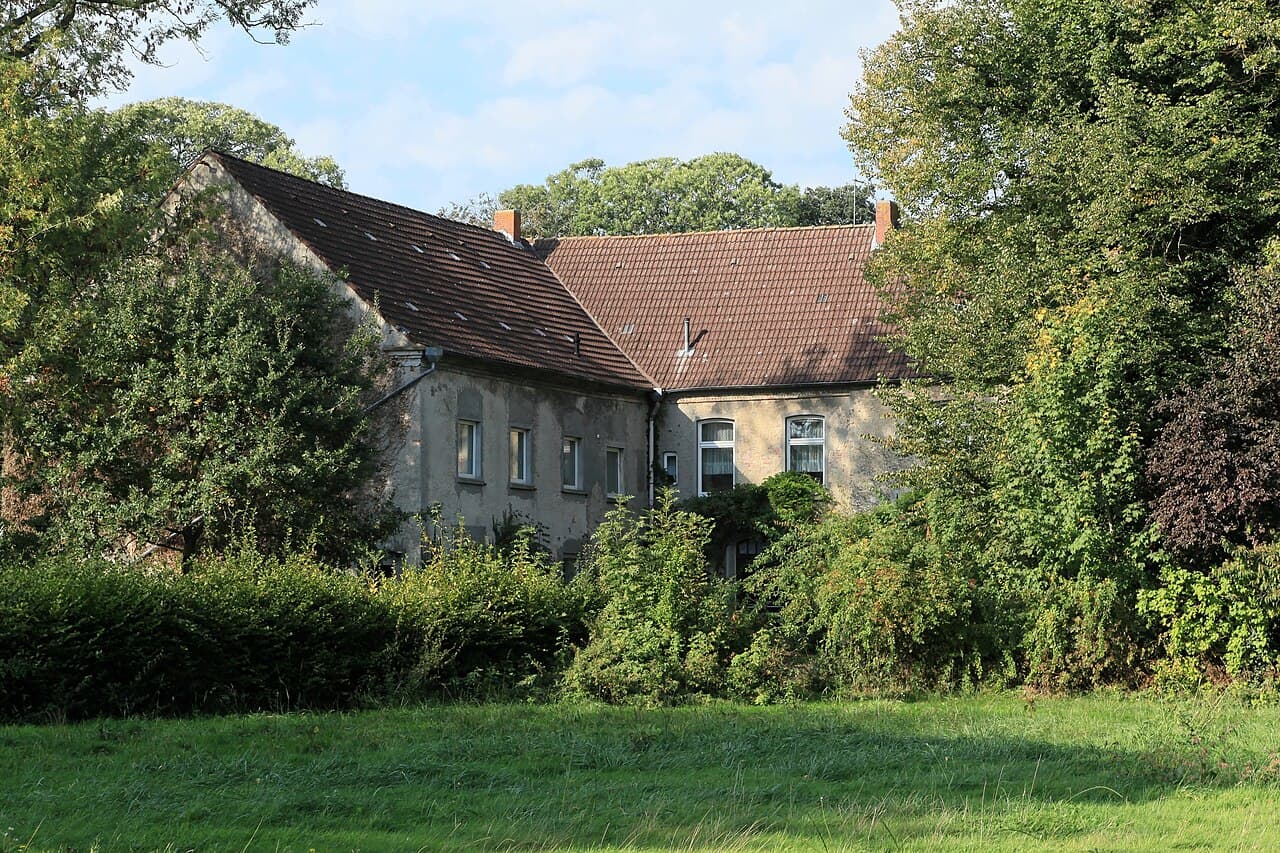
Stickhausen Castle
Stickhausen Castle stands as a remarkable example of medieval hill castle architecture located on the western edge of the village of Stickhausen in the municipality of Detern, Germany. Constructed around 1345, this fortress was strategically established by the Hanseatic city of Hamburg to protect vital trade routes along the Jümme and Leda rivers. These waterways were critical arteries for commerce during the medieval and early modern periods, making Stickhausen Castle a key military and economic stronghold in the region.
The castle's initial role was to secure Hamburg's western trade interests, but its significance evolved through the centuries as it became a contested fortress on the border between East Frisia and the County of Oldenburg. Around 1453, Hamburg pledged the castle to the East Frisian chieftain Ulrich I, who expanded the complex to replace the older Schlüsselburg fortress in Detern, enhancing its defensive capabilities. The castle's fortifications were further augmented in the late 15th century by Count Edzard I, notably with the addition of a large round tower circa 1498, which became a dominant feature of the castle's silhouette and served multiple functions including as a prison and bailiff's residence.
Architectural evolution and fortifications
Medieval foundations and expansions
The original layout of Stickhausen Castle featured a stone residential building surrounded by a moat and an outer bailey containing agricultural buildings and a gatehouse. The entire complex was protected by two defensive walls and encompassed by two moats, embodying the layered defense typical of medieval fortresses. This design reflected the need to guard against both military assault and control of trade routes.
Renaissance military enhancements
In 1558, Countess Anna introduced significant military upgrades by constructing the Dwenger, a polygonal bastion-style gun platform. This bastion was ingeniously built using repurposed stones from the abandoned Barthe Abbey and the demolished Uplengen Castle, showcasing practical reuse of materials and adaptation to evolving artillery warfare. The bastion improved the castle's artillery coverage and defensive strength during a period when gunpowder weaponry was transforming fortress design.
Thirty years' war fortifications and expansions
During the Thirty Years' War, Stickhausen Castle's military importance surged. From 1622 to 1624, it was occupied by mercenary forces under Ernst von Mansfeld, who reinforced the defenses. Later, between 1637 and 1640, Hessian troops held the castle and completed further expansions, including a fortified substation to the east with barracks, living quarters, and farm buildings to support the garrison. The fortress featured a three-winged main castle with a corner tower, an old bailey with stables, a peat barn, the burgrave's house, and a garrison church housed in the gatehouse's upper floor.
The defensive perimeter included an outer wall with a powder tower for safe gunpowder storage and a ravelin positioned on the southern side between the Jümme river and the main castle, designed to enhance fields of fire and protect the fortress from assault. The castle's artillery complement consisted of five batteries, four within the main complex and one at the substation, ensuring overlapping fields of fire.
Historical significance and ownership transitions
Stickhausen Castle's history reflects the turbulent political landscape of East Frisia and northern Germany. After its foundation by Hamburg, it became a focal point in regional power struggles, including the Saxon feud in the late 15th century when it was occupied by a coalition of princes led by George of Saxony. The castle's strategic importance continued through the Reformation and the Thirty Years' War, adapting to changing military technologies and political alliances.
Following the Prussian annexation of the region in 1744, Frederick the Great ordered the dismantling of the fortress, ending its military role. The castle buildings were largely demolished, and the former substation area developed into the village of Stickhausen. The gatehouse was repurposed in 1822 as the local bailiff's office, preserving a 1578 coat of arms on its exterior wall, linking the site to its noble patrons and administrative history.
Preservation, museum, and cultural heritage
In 1885, Stickhausen Castle entered private ownership. The large round tower suffered damage from artillery fire during World War II, but preservation efforts began in 1951, transforming the tower into a museum dedicated to local history and folklore. The museum features the original prison cells with period torture instruments such as a rack and clamps, living quarters of the prison guard, and exhibits detailing the castle's past. The attic houses a collection of birds and bird eggs, reflecting the region's natural heritage.
More recently, the municipality of Jümme acquired the site in 2019, and a dedicated castle association has undertaken restoration projects, including significant exterior work on the round tower completed by August 2020. These efforts aim to preserve Stickhausen Castle as a cultural landmark and educational resource, highlighting its architectural evolution and historical importance in East Frisia.
Architectural features and surviving elements
The most prominent surviving structure is the large round tower, constructed around 1498, which dominates the castle's remains. This tower historically served multiple roles, including as a prison and the bailiff's residence. Inside, the ground floor retains original prison cells equipped with torture devices, providing insight into medieval and early modern penal practices. The upper floors display the living conditions of the prison guards and the castle's historical narrative, while the attic's ornithological collection adds a unique cultural dimension.
Remnants of the castle's original fortifications, including sections of the defensive walls and traces of the moats, are still visible around the site. The polygonal Dwenger bastion remains a notable example of Renaissance military architecture, demonstrating the adaptation of the castle to gunpowder-era warfare. The gatehouse, with its preserved 1578 coat of arms, stands as a testament to the castle's administrative role in the post-medieval period.
Surrounding earthworks and the layout of the former outer bailey provide valuable archaeological insights into the castle's scale and complexity. These features collectively illustrate the transition from medieval fortress to Renaissance stronghold and eventually to a historical monument and museum.
Frequently asked questions (FAQ)
- What are the visiting hours for Stickhausen Castle museum?
- The Stickhausen Castle museum is typically open during weekends and public holidays, but visitors should check the official website or local tourist information for current opening times and seasonal variations.
- Is there an entry fee to visit Stickhausen Castle?
- Entry to the Stickhausen Castle museum usually requires a small admission fee, which helps support preservation efforts. Prices may vary, so it is recommended to verify ticket costs before visiting.
- Can I see the original prison cells and torture instruments at Stickhausen Castle?
- Yes, the museum inside the large round tower preserves original prison cells equipped with period torture devices such as racks and clamps, offering a vivid insight into historical penal practices.
- How did Stickhausen Castle's architecture evolve over time?
- Stickhausen Castle evolved from a medieval stone residential fortress with moats to a Renaissance bastion-style fortress with artillery platforms, reflecting changes in military technology and regional conflicts.
- What is the significance of the Dwenger bastion at Stickhausen Castle?
- The Dwenger is a polygonal bastion-style gun platform built in 1558 using stones from Barthe Abbey and Uplengen Castle, exemplifying Renaissance military architectural adaptations to gunpowder warfare.
Photo gallery

Information
Website
Visit websiteSources & official resources
Verify the information above using these authoritative references.
Loading map...
Visitor reviews
No reviews yet. Been here? Write the first review and help other travelers!
Write the first reviewVisited this castle? Share your experience
Your review helps other travelers and adds first-hand knowledge to our encyclopedia.