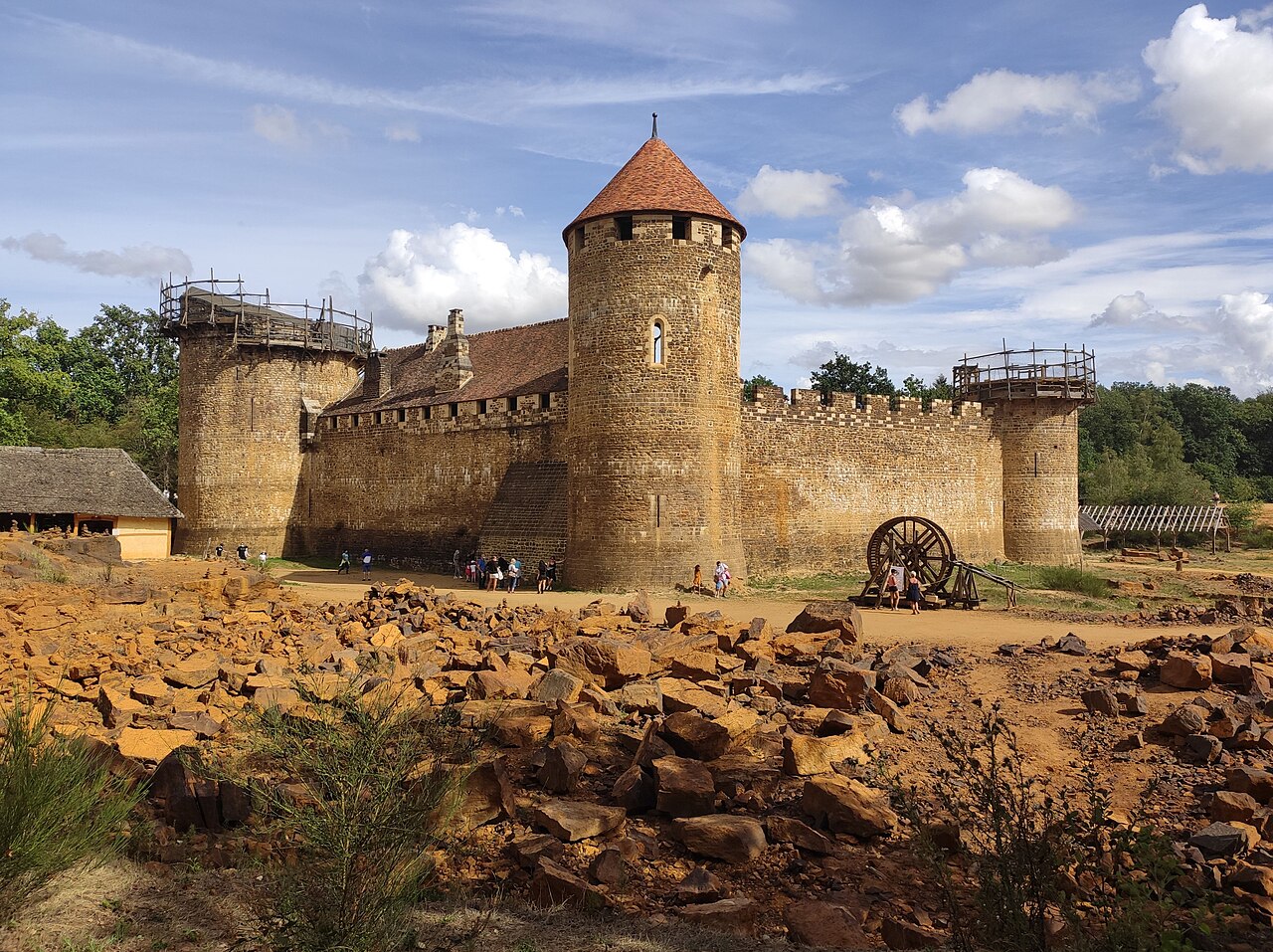
St. Vérain Castle
St. Vérain Castle, also known locally as Donjon de Saint-Vérain, is a notable medieval fortress located next to the village of Saint-Vérain in the Nièvre department of France. This castle stands as a remnant of a once strategically vital fortified town that controlled an important passage between Dony and Saint-Amand during the High Medieval period.
The origins of Saint-Vérain trace back to around the year 1000, when the village was initially protected by a wooden palisade. By the late 12th century, the settlement had expanded into a fortified town, prompting the powerful Lords of Vérain, direct vassals of the Bishop of Auxerre, to replace the wooden defenses with imposing stone ramparts. The surviving structure today is predominantly the circular stone keep that once guarded the town.
Architectural design and fortifications
The castle was strategically built on a motte—the highest point of the town—providing commanding views of the surrounding landscape. The core of the castle was a circular keep, surrounded by a small enclosure fortified with five towers. This inner enclosure connected to a larger bailey featuring ten towers, which contained the seigneurial chapel and various outbuildings essential for the lord's household and defense.
Beyond this, a third and largest enclosure encircled the entire town. This outer wall was reinforced with towers spaced approximately every 80 meters and equipped with three heavily fortified gates to control access. The overall layout is said to have been influenced by the castle plans of Margat Castle in Syria, reflecting the Crusader experience of the lords who commissioned its construction.
Influence of Crusader architecture
The Lords of Vérain had participated in the Crusades, and their exposure to Middle Eastern fortifications is evident in the castle's design. The use of multiple concentric enclosures and robust towers reflects military architectural principles aimed at maximizing defense and control. This influence makes St. Vérain an intriguing example of cross-cultural architectural exchange during the medieval period.
Historical context and ownership changes
In 1320, the last male heir of the Lords of Vérain died, and through marriage, the castle passed to Hugues I of Amboise, lord of Chaumont. The Amboise family did not reside here but appointed a captain to oversee the castle and its affairs.
The castle and surrounding area endured significant turmoil during the Hundred Years' War. The region suffered multiple invasions by English forces in 1356, 1367, and 1423. In 1434, the castle and town fell to the troops of Perrinet Gressard, a mercenary aligned with the English and Philip the Good, Duke of Burgundy. Philip already controlled several nearby castles, including those at La Charité-sur-Loire and Passy-lès-Tours, consolidating his power in the region.
By 1489, the fiefdom was acquired by the Count of Nevers and incorporated into his domains. The Count appointed attendants to manage the estate, marking the decline of Saint-Vérain's strategic importance. Over time, the once fortified town diminished into the quiet village known today.
Current condition and accessibility
Today, St. Vérain Castle is primarily preserved as a ruin, with the keep as its most prominent surviving feature. Portions of the original enclosures remain, though many are on private property and not accessible to the public. Due to the risk of falling masonry, the castle itself is not open for interior visits.
Visitors can view the castle from the adjacent public road, appreciating its imposing silhouette against the landscape. The village of Saint-Vérain offers a glimpse into the region's medieval past, with the castle standing as a testament to the area's historical significance.
Architectural highlights to observe
- The circular keep constructed on the motte, showcasing typical 12th-century defensive design.
- Remnants of the stone ramparts and towers that once formed the multiple concentric enclosures.
- The layout reflecting Crusader military architecture, inspired by fortresses like Margat Castle.
- The strategic placement of fortified gates controlling access to the town.
Saint-Vérain in the broader medieval landscape
St. Vérain Castle exemplifies the evolution of medieval fortifications in France, transitioning from wooden defenses to complex stone structures. Its design illustrates the influence of international military architecture brought back by Crusader lords, blending local needs with broader strategic concepts.
The castle's history reflects the turbulent political landscape of medieval France, marked by feudal allegiances, dynastic changes, and the impact of prolonged conflicts such as the Hundred Years' War. Although its prominence faded after the 15th century, the castle remains an important cultural and historical landmark within the Nièvre region.
Preservation and heritage significance
Efforts to preserve St. Vérain Castle focus on maintaining the structural integrity of the keep and stabilizing remaining walls. While full restoration is limited by safety concerns and private ownership of parts of the site, the castle's ruins continue to attract historians and enthusiasts interested in medieval military architecture and regional history.
The castle's presence enriches the cultural landscape of Nièvre, offering educational opportunities and a tangible connection to France's medieval past. Its architectural features provide valuable insights into the defensive strategies and feudal society of the High Middle Ages.
Frequently asked questions (FAQ)
- How do I get to St. Vérain Castle?
- St. Vérain Castle is located in the picturesque village of Saint-Vérain, France. You can reach the castle by car or public transport, with the nearest train station located in a nearby town. There is ample parking available for visitors.
- What are the opening hours of St. Vérain Castle?
- St. Vérain Castle is open to visitors from 10 AM to 6 PM, Tuesday through Sunday. It is closed on Mondays and during certain public holidays. It is advisable to check the official website for any seasonal changes in hours.
- Is there an entrance fee to visit St. Vérain Castle?
- Yes, there is an entrance fee to visit St. Vérain Castle. Ticket prices are generally €10 for adults and €5 for children aged 6 to 12, with discounts available for families and groups. Children under 6 can enter for free.
- When was St. Vérain Castle built?
- St. Vérain Castle was originally constructed in the late 12th century, showcasing a blend of medieval and Renaissance architectural styles. Over the centuries, it has undergone several renovations, enhancing its historical significance. The castle offers a glimpse into the rich history of the region.
- Can I take guided tours of St. Vérain Castle?
- Yes, guided tours of St. Vérain Castle are available and highly recommended for a deeper understanding of its history and architecture. Tours are conducted in multiple languages and typically last about an hour. Audio guides are also available for those who prefer a self-guided experience.
- Why is St. Vérain Castle historically significant?
- St. Vérain Castle is historically significant due to its strategic location and its role in regional conflicts during the medieval period. The castle has been home to notable figures and has witnessed many important events in French history. Its well-preserved architecture attracts historians and tourists alike.
- What is the best time to visit St. Vérain Castle?
- The best time to visit St. Vérain Castle is during the spring and early autumn when the weather is pleasant and the gardens are in full bloom. Summer can be busy with tourists, while winter may limit outdoor activities. Visiting during weekdays can also help avoid crowds.
- Is St. Vérain Castle accessible for visitors with disabilities?
- St. Vérain Castle aims to be accessible to all visitors, with ramps and designated pathways for those with mobility challenges. However, some areas may have limited accessibility due to the castle's historic architecture. It is recommended to contact the castle in advance for specific accessibility inquiries.
- Are there any nearby attractions to visit after St. Vérain Castle?
- Yes, there are several nearby attractions worth exploring after your visit to St. Vérain Castle. The charming village of Saint-Vérain offers local shops and cafes, and the surrounding region is known for its beautiful vineyards and scenic walking trails. Additionally, the historic town of Vézelay is just a short drive away.
Information
Address
Chemin du Château, Saint-Vérain, Nièvre, France
Loading map...
Visitor reviews
No reviews yet. Been here? Write the first review and help other travelers!
Write the first reviewVisited this castle? Share your experience
Your review helps other travelers and adds first-hand knowledge to our encyclopedia.