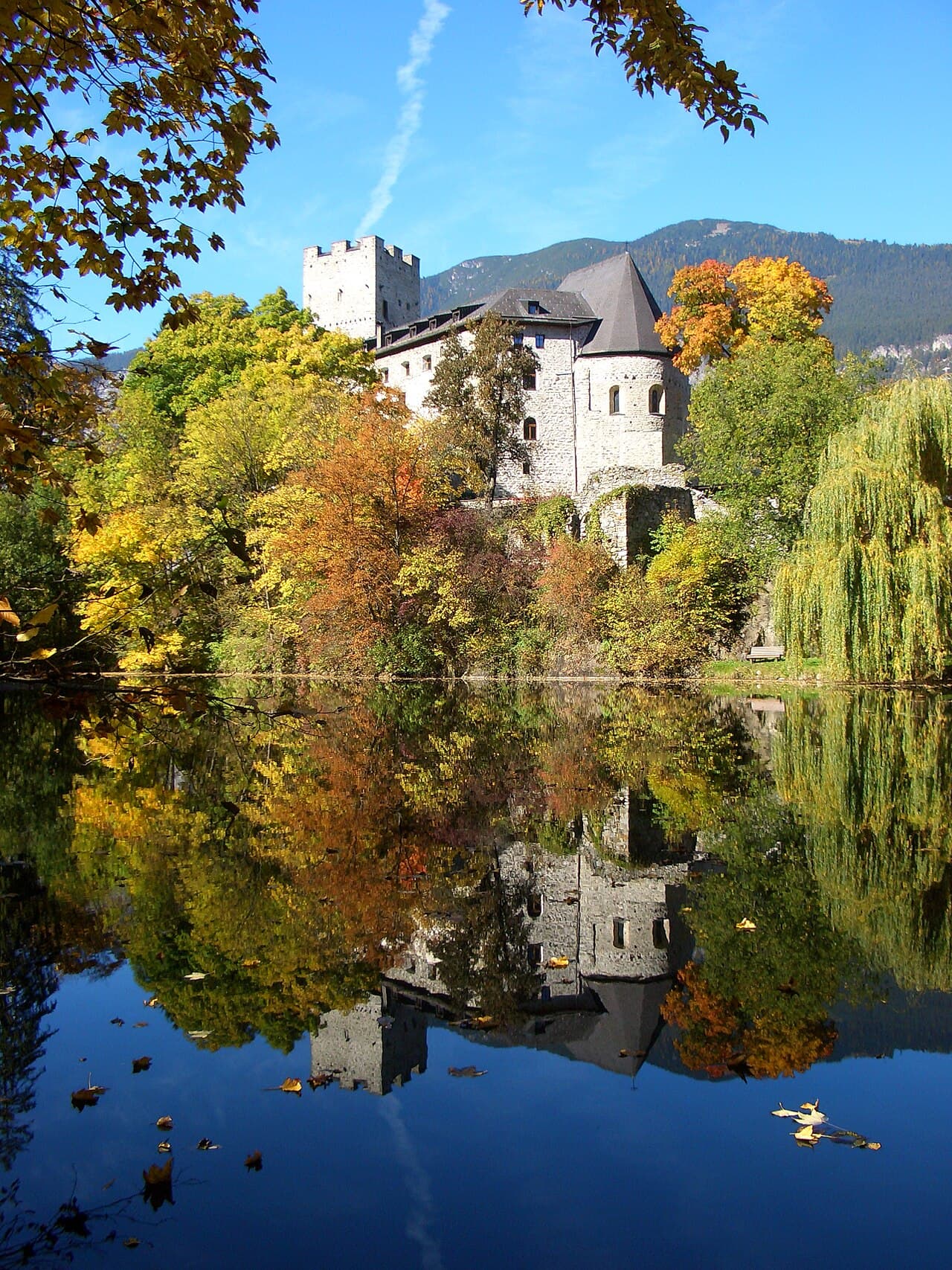
St Petersberg Castle
St Petersberg Castle is a remarkable example of a high medieval hill castle located on a prominent hill west of the village of Silz in Austria. This castle stands as a testament to centuries of strategic importance, architectural evolution, and regional governance in the Inn Valley. Its commanding position overlooking the valley, combined with its robust defensive features, highlights its role as a center of power and administration from the 11th century onward.
The castle complex is dominated by a five-story square keep, known as the bergfried, which is crowned with original battlements and features narrow arrow slits that provided defensive coverage. This tower was historically used as a prison, emphasizing its defensive and judicial functions. Adjacent to the bergfried is the palas, the main residential hall, which was rebuilt in the 20th century but retains much of its early 14th-century masonry. The palas now serves as a kitchen and dining area, preserving the castle's medieval character despite past damages.
Historical significance and ownership
The origins of St Petersberg Castle trace back to the House of Welf, who established it as an imperial fief and the administrative center of the earldom in the Oberinn Valley. The castle first appears in historical records around 1090-1097, initially known as Neuhaus during the 12th and 13th centuries. By the late 13th century, it adopted the name St Petersberg, reflecting the dedication of its chapel to St Peter.
Throughout the Middle Ages, the castle served as a judicial and administrative hub, functioning as a bailiff's seat (Vogtburg) overseeing the surrounding territories. Ownership transitioned through notable families, including the Counts of Tirol, the Milser, and the Freundsberg families. In the early 17th century, the influential Fugger family acquired the castle, continuing its use as a regional power center.
In the 19th century, the castle suffered a significant fire in 1857, which destroyed much of the wooden structures, sparing only the chapel and archive. Subsequent rebuilding efforts restored parts of the castle, including the palas and the Schnitzer Tower (also known as the Faul Tower), a five-story square tower originally serving as the seat of the burgraves and later adapted for munitions storage.
Architectural features and layout
Defensive structures
The castle is enclosed by an irregular polygonal curtain wall that surrounds a central courtyard, providing a formidable defense. A notable feature is the shield wall rising to the second story between the bergfried and chapel, dating from around 1300. This wall added an extra layer of protection against attackers. Outside the main enclosure are remnants of a 14th-century zwinger or outer ward, which included a four-bay bridge leading to the main gate, enhancing the castle's defensive depth.
The bergfried and the palas
The bergfried is constructed from roughly cut rubble stone with finely dressed corner stones, showcasing medieval masonry techniques. It features original rectangular battlements and narrow arrow slits on each floor. The elevated entrance, once located on the first floor, and traces of wooden battlements supported by stone corbels illustrate typical medieval fortification strategies.
Adjacent to the bergfried, the palas served as the main residential and administrative building. Although reduced in size after the 1857 fire, it retains significant early 14th-century masonry. The palas now houses functional spaces such as the kitchen and dining rooms, preserving its medieval ambiance despite modern adaptations.
Chapel and religious elements
Attached to the northeast corner of the palas is the castle chapel, originally dedicated to St Peter and later to St Ursula. This two-story structure faces east and features a broad nave with a projecting apse externally supported by a triangular buttress. The chapel is notable for its Romanesque round-arched windows made of volcanic tuff stone with intricately carved frames dating back to the 12th century. Beneath the choir lies a crypt containing remains of an earlier chapel, possibly from the 11th or 12th century, underscoring the site's long religious significance.
Schnitzer tower and other buildings
On a lower hillock east of the main castle stands the Schnitzer Tower or Faulturm, a five-story square tower dating from the 13th century. Restored in the 20th century, it features a pyramid-shaped roof and stone walls composed of roughly dressed stones with well-cut corners. The tower retains original light slits and a late 15th-century rounded arched portal made of tuff stone. Inside, the third floor contains a vaulted chamber with rectangular windows and built-in stone seats, highlighting its historical use and architectural detail.
The castle's inner gatehouse is the oldest visible structure, featuring a simple round-arched portal made of sandstone blocks with a keystone and a segmental arch, likely dating to the 12th century. The iron-reinforced door with an inspection hatch dates from the 16th century, reflecting ongoing modifications to the castle's defenses.
Later history and current status
After its medieval prominence, the castle experienced various changes, including use as a military hospital during World War I under Emperor Franz Joseph I and occupation by Italian forces post-war. Since 1965, it has been owned by religious orders, initially the Engelwerk (Order of the Guardian Angels) and later the Canons Regular of the Holy Cross, who converted it into an all-male monastery. A convent is located at the foot of the hill, complementing the castle's religious function.
Recent restoration efforts have focused on preserving the castle's outer walls and maintaining its structural integrity. These works, supervised by Austria's Federal Monuments Office since 2022, aim to conserve the castle as a protected cultural monument. The castle remains privately owned and is not open for interior tours, but visitors can appreciate its impressive exterior and historical setting.
Archaeological significance and surroundings
Archaeological findings indicate continuous human settlement at the site since prehistoric times, including the Bronze Age and the Roman era. The castle's foundations rest on layers of earlier constructions, revealing a long history of occupation and strategic importance in the region.
The castle is surrounded by fields and forested areas, with a historic pond to the south fed by mountain streams. This water source historically supported mills and sawmills downhill from the castle, demonstrating the integration of the castle within the local economic landscape.
Today, the entire complex, including medieval structures and archaeological remains, is legally protected as a cultural monument, ensuring the preservation of this significant piece of Austrian heritage.
Frequently asked questions (FAQ)
- How do I get to St Petersberg Castle?
- St Petersberg Castle is located in Silz, Austria, and can be accessed by car or public transportation. The nearest train station is a short bus ride away, and ample parking is available for visitors arriving by car.
- What is the historical significance of St Petersberg Castle?
- St Petersberg Castle dates back to the 13th century and has played a crucial role in the region's history, serving as a defensive stronghold and residence for nobility. Its architecture reflects the transition from medieval to Renaissance styles, making it an important site for those interested in European history.
- When was St Petersberg Castle built?
- The construction of St Petersberg Castle began in the early 1200s, with various renovations and expansions occurring over the centuries. The castle's current structure showcases elements from both medieval and Renaissance periods.
- Can I take guided tours of St Petersberg Castle?
- Yes, guided tours are available at St Petersberg Castle, providing visitors with insights into its rich history, architecture, and legends. These tours typically run several times a day, and advance booking is recommended during peak tourist seasons.
- Why is St Petersberg Castle considered an architectural gem?
- St Petersberg Castle is celebrated for its unique blend of architectural styles, including Gothic, Romanesque, and Renaissance elements. Its well-preserved features, such as the grand entrance and fortified walls, highlight the craftsmanship of the era and its strategic importance.
- Is it possible to host events at St Petersberg Castle?
- Yes, St Petersberg Castle offers facilities for hosting various events, including weddings, corporate gatherings, and private parties. The picturesque setting and historic ambiance make it a popular choice for memorable occasions.
- What are the opening hours for St Petersberg Castle?
- St Petersberg Castle is open to visitors daily from 10 AM to 6 PM, with extended hours during the summer months. It is advisable to check the official website for any seasonal changes or special events that may affect opening times.
- What is the best time to visit St Petersberg Castle?
- The best time to visit St Petersberg Castle is during the spring and early autumn when the weather is mild and the surrounding scenery is at its most beautiful. Additionally, visiting during weekdays can help you avoid larger crowds typically present on weekends.
- Are there any nearby attractions to visit along with St Petersberg Castle?
- Yes, visitors to St Petersberg Castle can explore nearby attractions such as the charming village of Silz, scenic hiking trails, and the stunning Ötztal Alps. These nearby sites offer a great opportunity to experience the natural beauty and cultural heritage of the region.
- What are the ticket prices for St Petersberg Castle?
- Ticket prices for St Petersberg Castle are generally affordable, with discounts available for children, students, and seniors. Special rates may apply for guided tours or group visits, so it's recommended to check the castle's official website for the most current pricing information.
Photo gallery

Information
Loading map...
Visitor reviews
No reviews yet. Been here? Write the first review and help other travelers!
Write the first reviewVisited this castle? Share your experience
Your review helps other travelers and adds first-hand knowledge to our encyclopedia.



