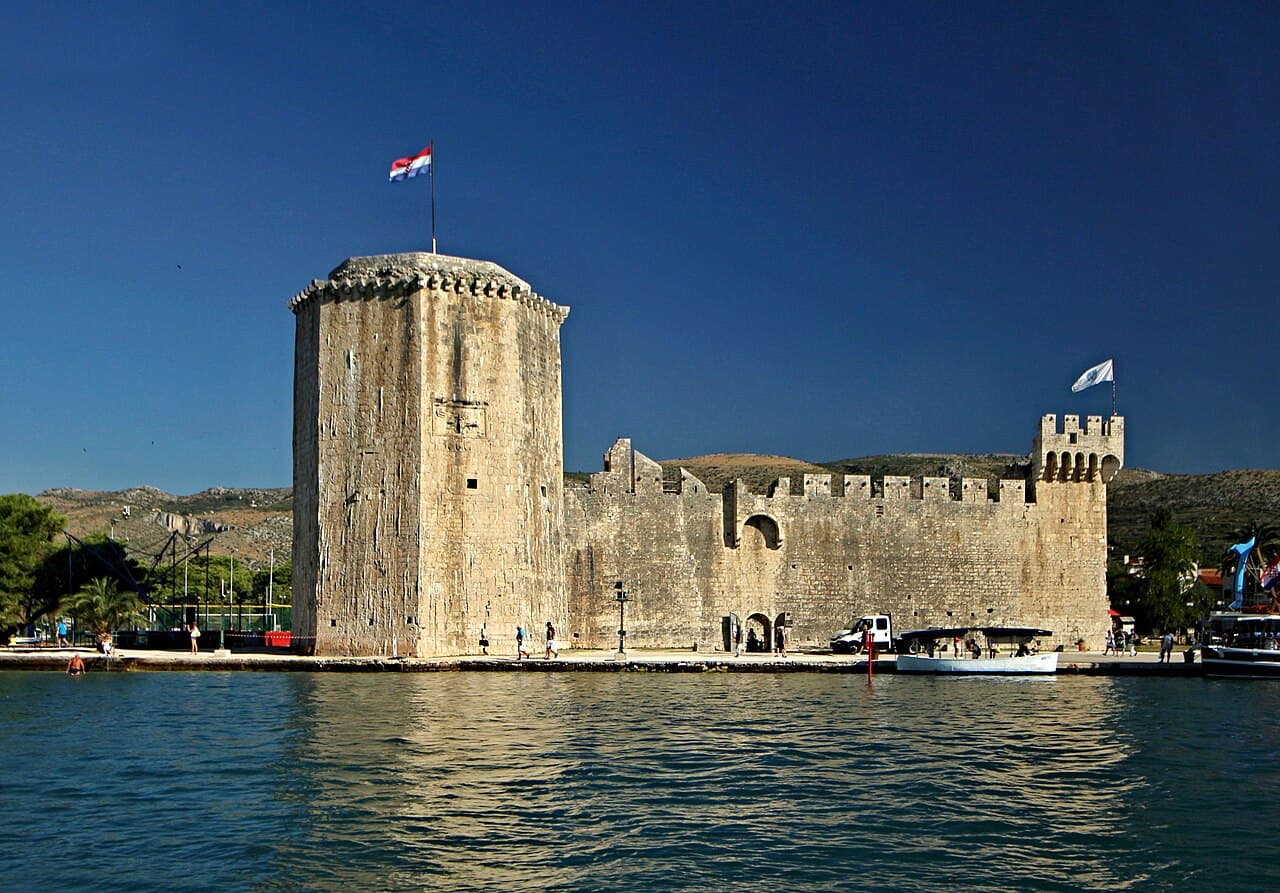
St. Mark's Tower, locally known as Kula svetog Marka, is a significant late-medieval fortress located in the historic city of Trogir, in the Split-Dalmatia region of Croatia. This tower stands as a testament to the Venetian military architecture of the 15th century and forms part of the city's once formidable fortifications.
Trogir itself is situated on a rectangular island nestled in a sea channel between the mainland and the island of Čiovo. Historically, it was a fortified city with defensive walls that enclosed the old town. St. Mark's Tower occupies what was originally the northwest corner of these city walls, strategically positioned almost surrounded by water, which enhanced its defensive capabilities.
Construction and architectural features
Construction of St. Mark's Tower began in 1470 under Venetian rule, a period when the Republic of Venice was expanding its maritime influence along the Adriatic coast. The building process was gradual, with completion occurring by the end of the 15th century. The tower was designed as a robust, circular structure with walls up to 3 meters thick, providing formidable resistance against sieges and artillery attacks common in the late-medieval period.
The tower consists of two stories and was originally topped with a parapet, which would have allowed defenders to patrol and defend the structure effectively. However, historical records indicate that the parapet had disappeared by the first half of the 17th century. The circular plan of the tower is characteristic of Venetian military architecture of the time, emphasizing both strength and the ability to cover multiple angles of approach.
Historical context and strategic importance
During the 15th century, the Adriatic coast was a contested region, with the Venetian Republic seeking to secure its trading routes and coastal holdings against rival powers, including the Ottoman Empire. St. Mark's Tower played a crucial role in the defense system of Trogir, guarding the northwest approach to the city and the sea channel between the mainland and Čiovo island.
The tower’s location allowed it to control naval access and provide early warning of approaching enemy ships. Its integration into the city walls created a continuous defensive line that protected Trogir’s inhabitants and its valuable port facilities. The Venetian emphasis on fortifying Trogir reflects the city's importance as a maritime hub during this period.
Later history and current condition
Over the centuries, St. Mark's Tower has witnessed various phases of use and neglect. In more recent history, the tower was repurposed as a small bar, indicating adaptive reuse of historical military structures in modern times. However, the tower currently stands abandoned and is not accessible to the public, which has contributed to its state as ruins.
Despite its condition, the tower remains an important cultural and historical landmark within Trogir. It is located near the more prominent Kamerlengo Castle, another Venetian fortress from the early 15th century, which is well-preserved and open to visitors. Together, these fortifications illustrate the extensive defensive network that once protected the city.
The surrounding historic city of trogir
The old town of Trogir is renowned for its well-preserved medieval architecture, narrow alleyways, and historical buildings. It has been recognized as a UNESCO World Heritage Site for its cultural significance and architectural heritage. Visitors to the city can explore a variety of landmarks, including Romanesque and Gothic churches, Renaissance palaces, and the Venetian fortresses that guarded the city.
The proximity of St. Mark's Tower to these sites makes it part of a rich historical tapestry that reflects the city's evolution from a Greek settlement through Roman times to its Venetian period and beyond.
Architectural comparison with kamerlengo castle
Nearby Kamerlengo Castle is a larger and more complex fortress built slightly earlier in the 15th century. It features a polygonal plan with multiple defensive walls, towers, and a moat, showcasing advanced military architecture designed to withstand artillery sieges. In contrast, St. Mark's Tower is smaller and more focused on its role as a corner bastion integrated into the city walls.
While Kamerlengo Castle served as a residence for the Venetian governor and housed garrisons, St. Mark's Tower primarily functioned as a watchtower and defensive stronghold. Both structures together represent the layered defense strategy employed by the Venetians to secure Trogir.
Visiting information and cultural significance
Currently, St. Mark's Tower is not open to visitors due to its abandoned state and safety concerns. However, its exterior can be admired from the surrounding areas, providing insight into the military architecture of the late medieval Adriatic coast. Visitors to Trogir often combine a visit to Kamerlengo Castle with a walk through the old town to experience the city's rich history and scenic beauty.
The tower stands as a symbol of Trogir's Venetian heritage and maritime importance. Preservation efforts for such structures are vital to maintaining the historical narrative of the region and promoting cultural tourism.
Frequently asked questions (FAQ)
- How do I get to St. Mark's Tower?
- St. Mark's Tower is located in the heart of Trogir, Croatia. You can easily reach it by walking from the main square or by taking a local bus if you're coming from nearby cities. The tower is well-signposted, making it easy for visitors to find.
- What is the historical significance of St. Mark's Tower?
- St. Mark's Tower, built in the 15th century, is an iconic symbol of Trogir's rich history. It served as a watchtower and a defense structure, showcasing the strategic importance of Trogir during the Middle Ages. The tower is also a testament to the Venetian influence on the region's architecture.
- When was St. Mark's Tower built?
- St. Mark's Tower was constructed in the late 15th century, specifically between 1445 and 1464. Its construction was commissioned by the citizens of Trogir as a means to enhance the city’s defenses. The tower has since become a significant historical landmark in the area.
- Can I climb St. Mark's Tower?
- Yes, visitors can climb to the top of St. Mark's Tower for a stunning panoramic view of Trogir and the surrounding Adriatic Sea. The climb involves a series of narrow stairs, so be prepared for a bit of a workout. The view from the top is well worth the effort!
- Why is St. Mark's Tower considered an architectural gem?
- St. Mark's Tower is celebrated for its unique blend of Gothic and Renaissance architectural styles. The intricate stonework and elegant design reflect the craftsmanship of the period, making it a must-see for architecture enthusiasts. Its striking façade and historical details contribute to its status as a key feature of Trogir's landscape.
- Is it possible to visit St. Mark's Tower year-round?
- Yes, St. Mark's Tower is open to visitors year-round; however, the opening hours may vary depending on the season. It is advisable to check the official website for the most current visiting hours before your trip. This ensures you have the best chance to explore the tower and enjoy its views.
- What are the ticket prices for visiting St. Mark's Tower?
- The ticket prices for St. Mark's Tower are quite affordable, typically ranging from €2 to €5 for adults, with discounts available for children and seniors. Tickets can be purchased on-site at the entrance. Keep in mind that prices may vary during peak tourist seasons.
- When is the best time to visit St. Mark's Tower?
- The best time to visit St. Mark's Tower is during the spring and early fall when the weather is mild and the tourist crowds are smaller. Visiting in the early morning or late afternoon can also provide a more peaceful experience. These times allow you to enjoy both the views and the historical significance of the tower without the rush of peak hours.
- What nearby attractions can I explore after visiting St. Mark's Tower?
- After visiting St. Mark's Tower, you can explore the nearby Cathedral of St. Lawrence and the charming streets of Trogir's Old Town, a UNESCO World Heritage site. Other attractions include the Kamerlengo Fortress and the beautiful waterfront promenade. Trogir is rich in history, making it easy to spend a full day exploring.
Photo gallery

Information
Website
Visit websiteSources & official resources
Verify the information above using these authoritative references.
Loading map...
Visitor reviews
No reviews yet. Been here? Write the first review and help other travelers!
Write the first reviewVisited this castle? Share your experience
Your review helps other travelers and adds first-hand knowledge to our encyclopedia.



