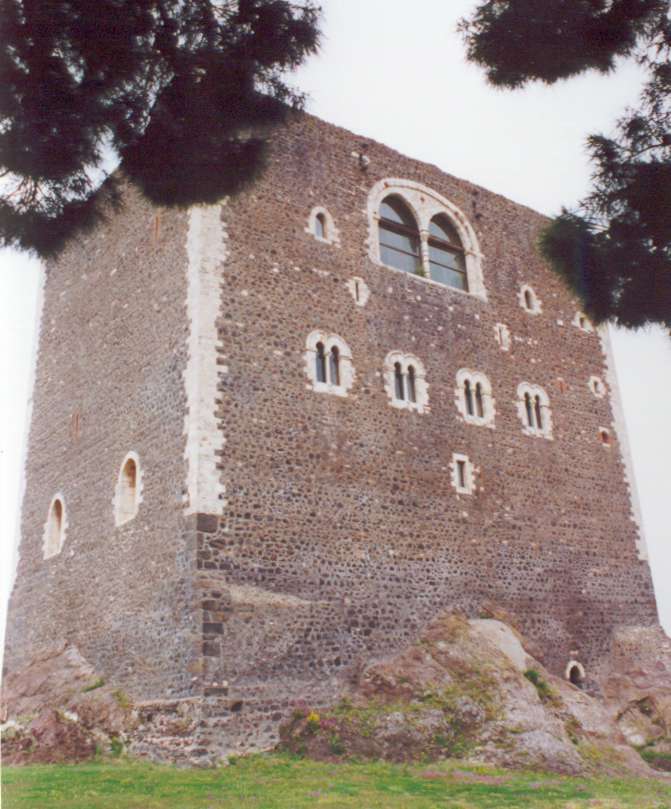
Solicchiata Castle
Solicchiata castle stands a few kilometers outside the town of Adrano in Sicily, Italy. Constructed in 1875 by Baron Spitaleri, it was originally designed as a rural building with a strong industrial purpose. The castle is notable for its role in the production of the renowned Solicchiata wine, which became a significant local industry.
Architectural style and structure
Though built in the modern period, the castle's design deliberately evokes a medieval architectural style. It is constructed primarily from lava stone, a material abundant in the region due to the proximity of Mount Etna. The castle's layout includes a surrounding moat, which was a typical defensive feature in medieval fortifications, and access is provided by a functional drawbridge. These elements were likely incorporated to give the building a fortress-like appearance rather than for actual defensive needs.
Historical context and purpose
The construction of Solicchiata castle in the late 19th century reflects a period in Sicily when rural estates were often developed with industrial and agricultural functions. Baron Spitaleri intended the building to serve as a center for wine production, capitalizing on the fertile volcanic soils of the area. The Solicchiata wine gained recognition, contributing to the local economy and agricultural heritage.
Location and surroundings
Located in the Solicchiata district near Adrano, the castle benefits from the rich volcanic terrain of eastern Sicily. This environment is ideal for viticulture, which explains the castle's association with wine production. The rural setting also means the castle is somewhat isolated, emphasizing its original function as an agricultural-industrial estate rather than a noble residence.
Preservation and current condition
Solicchiata castle remains a well-preserved example of a 19th-century building inspired by medieval design. Its lava stone construction has helped it withstand the test of time, and the moat and drawbridge are still notable features. While it does not serve a defensive purpose today, the castle's architecture provides insight into the romanticized medieval revival trends of the period.
Legacy and cultural significance
The castle is an important landmark in the Adrano area, symbolizing the intersection of industrial ambition and architectural nostalgia in Sicily's rural history. It highlights how 19th-century landowners like Baron Spitaleri sought to blend functionality with stylistic homage to the past. The production of Solicchiata wine remains a point of local pride, linking the castle to the region's agricultural identity.
Frequently asked questions (FAQ)
- What is the history behind Solicchiata castle?
- Solicchiata castle was built in 1875 by Baron Spitaleri near Adrano, Sicily, as a rural estate focused on wine production, particularly the famous Solicchiata wine.
- What architectural style characterizes Solicchiata castle?
- The castle features a medieval-inspired design with lava stone construction, a moat, and a drawbridge, reflecting a romanticized revival of medieval architecture in the modern period.
- Can visitors access Solicchiata castle?
- Information about public access and visiting hours for Solicchiata castle is limited, so potential visitors should check locally before planning a visit.
- Why was lava stone used in the construction of Solicchiata castle?
- Lava stone was used due to its local availability from Mount Etna, providing durability and a distinctive appearance consistent with the castle's medieval style.
- What role did Solicchiata castle play in local industry?
- The castle was central to the production of Solicchiata wine, an important agricultural product in the region that contributed to the local economy.
Information
Loading map...
Visitor reviews
No reviews yet. Been here? Write the first review and help other travelers!
Write the first reviewVisited this castle? Share your experience
Your review helps other travelers and adds first-hand knowledge to our encyclopedia.