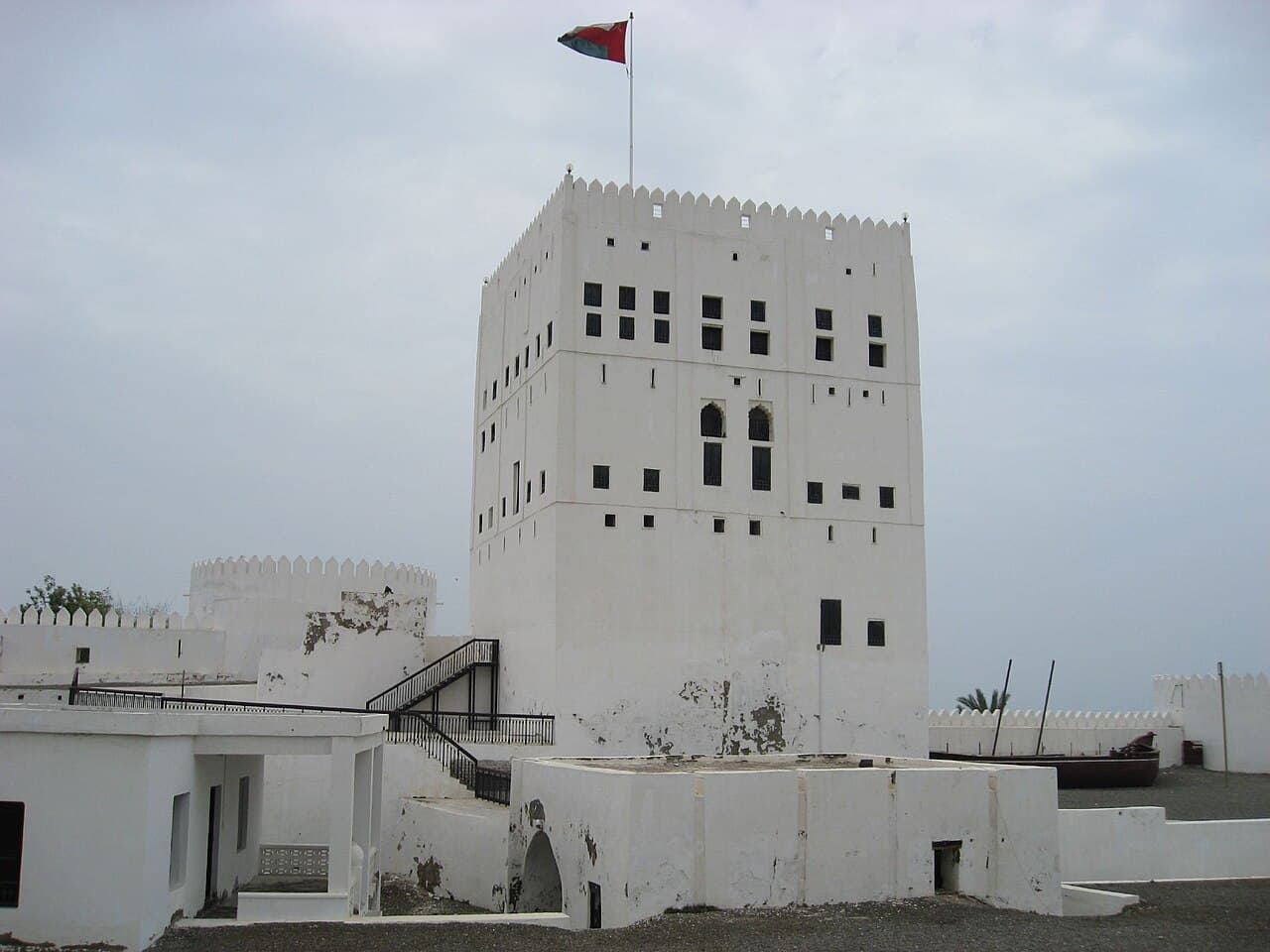
Sohar Fort — Oman castle

Sohar Fort

Sohar fort in oman
Sohar, Oman
Well Preserved

Sohar Fort is a prominent bastioned fortress located in the coastal city of Sohar in northern Oman. This historic fortification played a crucial role in the defense of the region, particularly during the medieval and early modern periods. Its strategic position near the Gulf of Oman allowed it to control maritime trade routes and protect the city from naval attacks and piracy.

Historical context and significance

The origins of Sohar Fort date back several centuries, with the structure evolving through various phases of construction and renovation. The fort's history is intertwined with the rise of Sohar as an important trading port on the Arabian Peninsula. It was a key stronghold during the Islamic Golden Age and later periods, witnessing conflicts involving regional powers and European colonial interests.

Throughout its history, the fort served as a military base, administrative center, and a symbol of local authority. It was instrumental in resisting invasions and maintaining control over the surrounding territory. The fort's bastioned design reflects the adaptation of European military architectural principles, which were incorporated to enhance its defensive capabilities against artillery and siege warfare.

Architectural features and layout

Sohar Fort is characterized by its robust bastioned walls, which are designed to provide overlapping fields of fire and improved defense against attackers. The fort's walls are constructed from local stone and mortar, exhibiting the traditional building techniques of the region.

The fortress includes several towers and bastions positioned at strategic points along the walls. These structures allowed defenders to monitor the surrounding landscape and sea approaches effectively. The fort's main gate is fortified and often features a heavy wooden door reinforced with metal studs.

Inside the fort, there are remnants of residential quarters, armories, and storage rooms, indicating its multifunctional use. The layout includes a central courtyard, which was likely used for military drills and gatherings.

Defensive adaptations

The bastioned design of Sohar Fort represents a significant advancement in fortification techniques in Oman. The angular bastions allowed defenders to cover blind spots and provided better protection against cannon fire. The thick walls and elevated platforms were constructed to withstand prolonged sieges and bombardments.

Additionally, the fort's location near the coastline enabled it to oversee and control access to the harbor, making it a vital point of defense against naval incursions.

Restoration and current status

In recent decades, Sohar Fort has undergone restoration efforts aimed at preserving its structural integrity and historical value. These conservation projects have helped stabilize the walls and restore some of the fort's architectural details, making it accessible to visitors and researchers.

Today, the fort stands as a well-preserved example of Omani military architecture and serves as a cultural landmark. It attracts tourists interested in the history of Oman and the Arabian Peninsula's coastal defenses.

Visiting sohar fort

Visitors to Sohar Fort can explore its extensive walls, towers, and internal courtyards. The site offers insights into the military strategies employed in the region and the historical significance of Sohar as a trading hub.

The fort is typically open to the public during daylight hours, and guided tours may be available to provide detailed historical context and architectural explanations.

Sohar fort in the broader context of oman's heritage

Sohar Fort is part of a network of historic forts and castles across Oman that illustrate the country's rich history of maritime trade, defense, and cultural exchange. These fortifications collectively highlight the strategic importance of Oman in regional politics and commerce over the centuries.

The preservation of Sohar Fort contributes to understanding Oman's architectural evolution and the adaptation of military technologies in the Arabian Peninsula.

Frequently asked questions (FAQ)

When was Sohar Fort built?
The exact construction date of Sohar Fort is uncertain, but it dates back several centuries and was developed through various historical periods.
What architectural style is Sohar Fort?
Sohar Fort features a bastioned fortress design, reflecting adaptations of European military architecture suited to local defensive needs.
Can visitors tour Sohar Fort?
Yes, Sohar Fort is open to visitors during daylight hours, offering a chance to explore its walls, towers, and courtyards.
Why is Sohar Fort historically important?
The fort played a key role in protecting Sohar as a strategic trading port and served as a military and administrative center in the region.
Is Sohar Fort well preserved?
Yes, Sohar Fort is well preserved thanks to recent restoration efforts that have stabilized its structure and enhanced its accessibility.

Photo gallery

Sohar Fort
Click to view

Photo by Keirn OConnor from New York City, United States•CC BY-SA 2.0

1 photo • Click any image to view in full screen

Information

Bastioned Fortress

Loading map...

Visitor reviews

No reviews yet. Been here? Write the first review and help other travelers!

Write the first review

Visited this castle? Share your experience

Your review helps other travelers and adds first-hand knowledge to our encyclopedia.

Write a review

(5/5)

0/2000 characters

Your review will be visible after admin approval

Nearby castles

1.4 km

Al Hadhirah Tower

Al Hadhirah, Oman

Al Hadhirah Tower is a modest yet historically significant circular watchtower located in the quiet town of Al Hadhirah, within the Al Batinah North Governorate of Oman. This tower is constructed primarily from mud bricks, a traditional building material that reflects the indigenous architectural practices of the region. Although now in a state of ruin, the tower remains an accessible site for visitors interested in the defensive structures that once dotted the Omani landscape. Architectural characteristics and construction The tower's cylindrical form is typical of many coastal and inland watchtowers found throughout Oman, designed to provide a 360-degree vantage point for monitoring approaching threats. Built from mud bricks, the structure exemplifies the use of locally available materials suited to the arid climate, offering insulation against heat while being relatively easy to construct and repair. Its simple design lacks the complexity of larger fortifications but serves the essential purpose of early warning and territorial surveillance. The tower's walls, though weathered and partially crumbling, still convey the robustness required to withstand environmental conditions over centuries. Historical context and regional significance While specific historical records about Al Hadhirah Tower are scarce, such towers were commonly erected along Oman’s coastlines and inland routes from the early medieval period onward. They functioned as lookout points to alert local communities of potential maritime or tribal threats. These watchtowers played a role in the broader network of defensive structures that protected trade routes and settlements, reflecting the strategic importance of the Al Batinah region in Oman’s history. The tower’s presence indicates the need for vigilance in this area, which historically served as a corridor for commerce and cultural exchange. Current condition and accessibility Today, Al Hadhirah Tower stands as a partially preserved ruin, gradually succumbing to natural erosion. Despite its fragile state, the site is freely accessible to visitors, offering an opportunity to explore a tangible piece of Oman's defensive heritage. Visitors should exercise caution due to the tower’s deteriorating condition, but the site provides a quiet and evocative glimpse into the region's past defensive strategies. Preservation challenges and cultural value The tower’s gradual decay highlights the challenges of preserving mudbrick structures in harsh desert environments. Conservation efforts in Oman often focus on more prominent forts and castles, leaving smaller watchtowers like Al Hadhirah vulnerable to neglect. Nevertheless, these towers contribute valuable insights into the everyday military architecture of Oman and the historical landscape of the Al Batinah region. They represent an important cultural heritage asset that merits attention for future preservation initiatives.

Early Medieval (5th–10th c.)
Details
3.6 km

Sohar Castle

Sohar, Oman

Sohar Castle is a significant historic fortress located in the coastal city of Sohar, within the Al Batinah North Governorate of Oman. This coastal fortress stands as a testament to the region's strategic maritime importance over several centuries, particularly during the era of Portuguese expansion in the Arabian Peninsula. The origins and early fortifications The earliest fortifications at the site of Sohar Castle are believed to have been constructed under the direction of Baha Al Din Ayaz, the Prince of Hormuz, during his reign from 1294 to 1312. This initial structure likely served as a defensive stronghold to protect the vital port city of Sohar, which was an important hub for trade and maritime control in the region. Portuguese occupation and architectural transformation In 1507, the Portuguese seized control of Sohar Castle, establishing the city as a tributary to their expanding empire. The Portuguese faced multiple rebellions from the local population, leading to several military engagements. They retook the fort in 1516 and again in 1521, reaffirming their dominance. Between 1559 and 1561, the Portuguese undertook extensive reconstruction of the fortress. They transformed it into a square inner castle featuring bastions at the corners and surrounded by robust defensive walls. This redesign reflected the military architectural trends of the period, emphasizing bastioned fortifications to withstand artillery attacks. Sieges and modifications in the early 17th century The castle's strategic importance prompted further military action in 1616, when the Portuguese laid siege to retake Sohar Castle. After regaining control, the fortress was garrisoned with a captain and 40 soldiers, equipped with six small artillery pieces to defend against future assaults. Due to financial constraints, the Portuguese captain Joao de Souza Pinel initiated a significant rebuilding effort in 1621. He constructed a new and stronger keep—the central fortified tower—and reduced the size of the enclosed area by the defensive walls from 150 meters to 70 meters. This reconstruction gave the castle much of its present-day form, focusing on a more compact and defensible structure. Decline of Portuguese control and local rule Despite the Portuguese efforts, their control over Sohar was challenged by regional powers. In 1622, the Persians expelled the Portuguese from the castle, although the Portuguese briefly returned afterward. The final Portuguese rule ended in 1643 when the garrison surrendered to Imam Nasi bin Murshid al-Ya'arubi. The surrender was followed by the massacre of the Portuguese soldiers, marking the end of European dominance in Sohar. Following the Portuguese departure, Sohar Castle became the residence of the local wali (governor), serving as a center of regional administration and authority. Restoration and current status Between 1985 and 1993, Sohar Castle underwent a comprehensive restoration project. During this period, the entire castle was whitewashed, enhancing its visual prominence and preserving its structure. The restoration aimed to maintain the castle's historical integrity while stabilizing its walls and architectural features. Currently, Sohar Castle is closed to the public. It has been inaccessible for several years due to ongoing restoration and conservation efforts. The reopening date remains uncertain, limiting opportunities for visitors to explore the castle's interior, including the notable keep and defensive works. Architectural features and significance Sohar Castle exemplifies a blend of medieval Arabian and Portuguese military architecture. Its bastioned walls and compact keep represent adaptations to evolving artillery technology and defensive needs of the 16th and 17th centuries. The castle's position overlooking the sea allowed it to control maritime traffic and defend against naval threats. The fortress's historical layers reflect the complex interactions between local rulers, Portuguese colonizers, and Persian forces, making it a valuable site for understanding the geopolitical dynamics of the Arabian Gulf region during the late medieval and early modern periods.

Late Medieval (14th–15th c.)
Details
23.9 km

Liwa Castle

Liwa Al Jadidah, Oman

Liwa Castle is a notable historical fortress located east of the town of Liwa Al Jadidah in the Al Batinah North Governorate of Oman. Constructed in the 17th century, this castle served as a strategic military and administrative center during its time. It later became the residence of the local wali, or governor, highlighting its importance in regional governance and defense. Architectural layout and design The castle is built on a somewhat square ground plan, a common design choice for fortifications aiming for efficient defense and internal organization. Each corner of the castle is reinforced with round towers, which provided vantage points for surveillance and defense against attackers. Additionally, there is an extra round tower adjacent to the entrance, enhancing the security of the main gate by allowing defenders to monitor and control access effectively. At the heart of the castle stands a prominent square keep, which served as the last line of defense and the residence of the castle's commanding officer or governor. The keep's interiors are particularly noteworthy, featuring traditional Omani architectural elements that reflect the cultural and historical context of the period. Historical context and significance Liwa Castle's construction in the 17th century places it within the broader historical period when Oman was consolidating its regional power and defending its territories against external threats. The castle's role as a governor's residence underscores its function not only as a military stronghold but also as an administrative hub overseeing local governance and security. The strategic location of Liwa Castle in the Al Batinah region, a coastal plain along the Gulf of Oman, was crucial for controlling trade routes and protecting the hinterland from potential incursions. Its robust fortifications reflect the military architectural practices of the time, adapted to the local environment and the threats faced by the region. Preservation and visitor experience Today, Liwa Castle is accessible to visitors, offering insights into Oman's historical military architecture and governance. The castle is open during specific hours for a small entrance fee, making it an attractive destination for those interested in history and architecture. Visitors often highlight the well-preserved interiors of the central keep, which provide a tangible connection to the past and showcase traditional construction techniques. The castle's imposing walls, towers, and layout convey the defensive priorities of the era while allowing guests to explore a significant cultural landmark. Architectural features in detail The round corner towers are designed to eliminate blind spots and allow defenders to fire upon attackers approaching from multiple angles. The additional round tower near the entrance serves both as a watchtower and a defensive bastion, reinforcing the castle's main point of vulnerability. The square keep in the center is a classic feature of fortifications, providing a secure refuge and command center. Its interiors likely include chambers for the governor, storage rooms, and possibly a small mosque or prayer room, reflecting the multifunctional nature of such keeps. Cultural and heritage importance Liwa Castle stands as a testament to the military architecture and governance structures of 17th-century Oman. Its preservation allows for a deeper understanding of the region's historical defense strategies and administrative organization. The castle contributes to Oman's cultural heritage, attracting scholars, historians, and tourists alike. Efforts to maintain and promote Liwa Castle ensure that it remains a valuable educational resource and a symbol of the area's historical identity.

Renaissance (15th–17th c.)
Details

