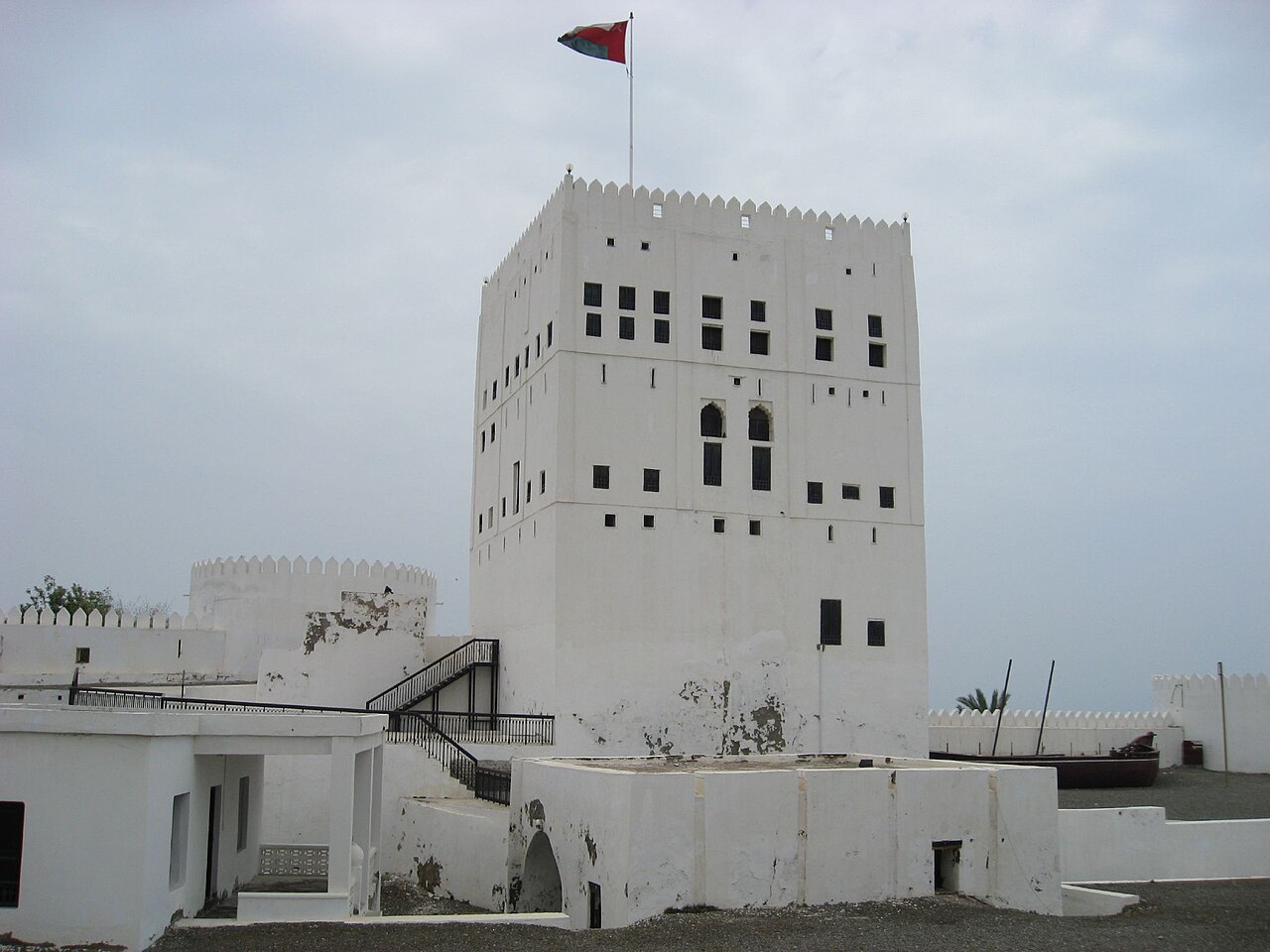
Sohar Castle
Sohar Castle is a significant historic fortress located in the coastal city of Sohar, within the Al Batinah North Governorate of Oman. This coastal fortress stands as a testament to the region's strategic maritime importance over several centuries, particularly during the era of Portuguese expansion in the Arabian Peninsula.
The origins and early fortifications
The earliest fortifications at the site of Sohar Castle are believed to have been constructed under the direction of Baha Al Din Ayaz, the Prince of Hormuz, during his reign from 1294 to 1312. This initial structure likely served as a defensive stronghold to protect the vital port city of Sohar, which was an important hub for trade and maritime control in the region.
Portuguese occupation and architectural transformation
In 1507, the Portuguese seized control of Sohar Castle, establishing the city as a tributary to their expanding empire. The Portuguese faced multiple rebellions from the local population, leading to several military engagements. They retook the fort in 1516 and again in 1521, reaffirming their dominance.
Between 1559 and 1561, the Portuguese undertook extensive reconstruction of the fortress. They transformed it into a square inner castle featuring bastions at the corners and surrounded by robust defensive walls. This redesign reflected the military architectural trends of the period, emphasizing bastioned fortifications to withstand artillery attacks.
Sieges and modifications in the early 17th century
The castle's strategic importance prompted further military action in 1616, when the Portuguese laid siege to retake Sohar Castle. After regaining control, the fortress was garrisoned with a captain and 40 soldiers, equipped with six small artillery pieces to defend against future assaults.
Due to financial constraints, the Portuguese captain Joao de Souza Pinel initiated a significant rebuilding effort in 1621. He constructed a new and stronger keep—the central fortified tower—and reduced the size of the enclosed area by the defensive walls from 150 meters to 70 meters. This reconstruction gave the castle much of its present-day form, focusing on a more compact and defensible structure.
Decline of Portuguese control and local rule
Despite the Portuguese efforts, their control over Sohar was challenged by regional powers. In 1622, the Persians expelled the Portuguese from the castle, although the Portuguese briefly returned afterward. The final Portuguese rule ended in 1643 when the garrison surrendered to Imam Nasi bin Murshid al-Ya'arubi. The surrender was followed by the massacre of the Portuguese soldiers, marking the end of European dominance in Sohar.
Following the Portuguese departure, Sohar Castle became the residence of the local wali (governor), serving as a center of regional administration and authority.
Restoration and current status
Between 1985 and 1993, Sohar Castle underwent a comprehensive restoration project. During this period, the entire castle was whitewashed, enhancing its visual prominence and preserving its structure. The restoration aimed to maintain the castle's historical integrity while stabilizing its walls and architectural features.
Currently, Sohar Castle is closed to the public. It has been inaccessible for several years due to ongoing restoration and conservation efforts. The reopening date remains uncertain, limiting opportunities for visitors to explore the castle's interior, including the notable keep and defensive works.
Architectural features and significance
Sohar Castle exemplifies a blend of medieval Arabian and Portuguese military architecture. Its bastioned walls and compact keep represent adaptations to evolving artillery technology and defensive needs of the 16th and 17th centuries. The castle's position overlooking the sea allowed it to control maritime traffic and defend against naval threats.
The fortress's historical layers reflect the complex interactions between local rulers, Portuguese colonizers, and Persian forces, making it a valuable site for understanding the geopolitical dynamics of the Arabian Gulf region during the late medieval and early modern periods.
Frequently asked questions (FAQ)
- What is the historical significance of Sohar Castle?
- Sohar Castle is a prominent historical landmark in Oman, believed to date back to the 13th century. It played a crucial role in the maritime trade routes and served as a defense against invasions, making it a symbol of the region's rich cultural heritage.
- When was Sohar Castle built?
- Sohar Castle was constructed in the 13th century, although it has undergone several renovations and restorations throughout the years. Its current structure reflects a blend of traditional Omani architecture and later influences.
- What are the opening hours for Sohar Castle?
- Sohar Castle is typically open to visitors from 8:00 AM to 4:00 PM, Saturday through Thursday. It is closed on Fridays, so plan your visit accordingly to ensure you have ample time to explore this historic site.
- Can I take photographs inside Sohar Castle?
- Yes, visitors are generally allowed to take photographs inside Sohar Castle, capturing its stunning architecture and historical artifacts. However, be mindful of any specific restrictions in certain areas, especially where sensitive exhibits may be present.
- Is it possible to access Sohar Castle with public transportation?
- Yes, Sohar Castle is accessible via public transportation, with local buses and taxis available to take you to the site. It's recommended to check local schedules for the most convenient options and plan your trip accordingly.
- What is the best time to visit Sohar Castle?
- The best time to visit Sohar Castle is during the cooler months, from October to March, when temperatures are more pleasant for outdoor exploration. Additionally, visiting during this season allows you to enjoy various local events and festivals in the region.
- Are there any nearby attractions to visit after exploring Sohar Castle?
- After visiting Sohar Castle, consider exploring the nearby Sohar Fort and the beautiful beaches along the coast. The area is rich in history and natural beauty, providing a perfect opportunity for a full day of sightseeing.
- How much do tickets cost for visiting Sohar Castle?
- Entry to Sohar Castle is usually free, making it an affordable option for visitors. However, be sure to check for any special exhibitions that may have a fee, ensuring you have all the details before your visit.
Information
Loading map...
Visitor reviews
No reviews yet. Been here? Write the first review and help other travelers!
Write the first reviewVisited this castle? Share your experience
Your review helps other travelers and adds first-hand knowledge to our encyclopedia.