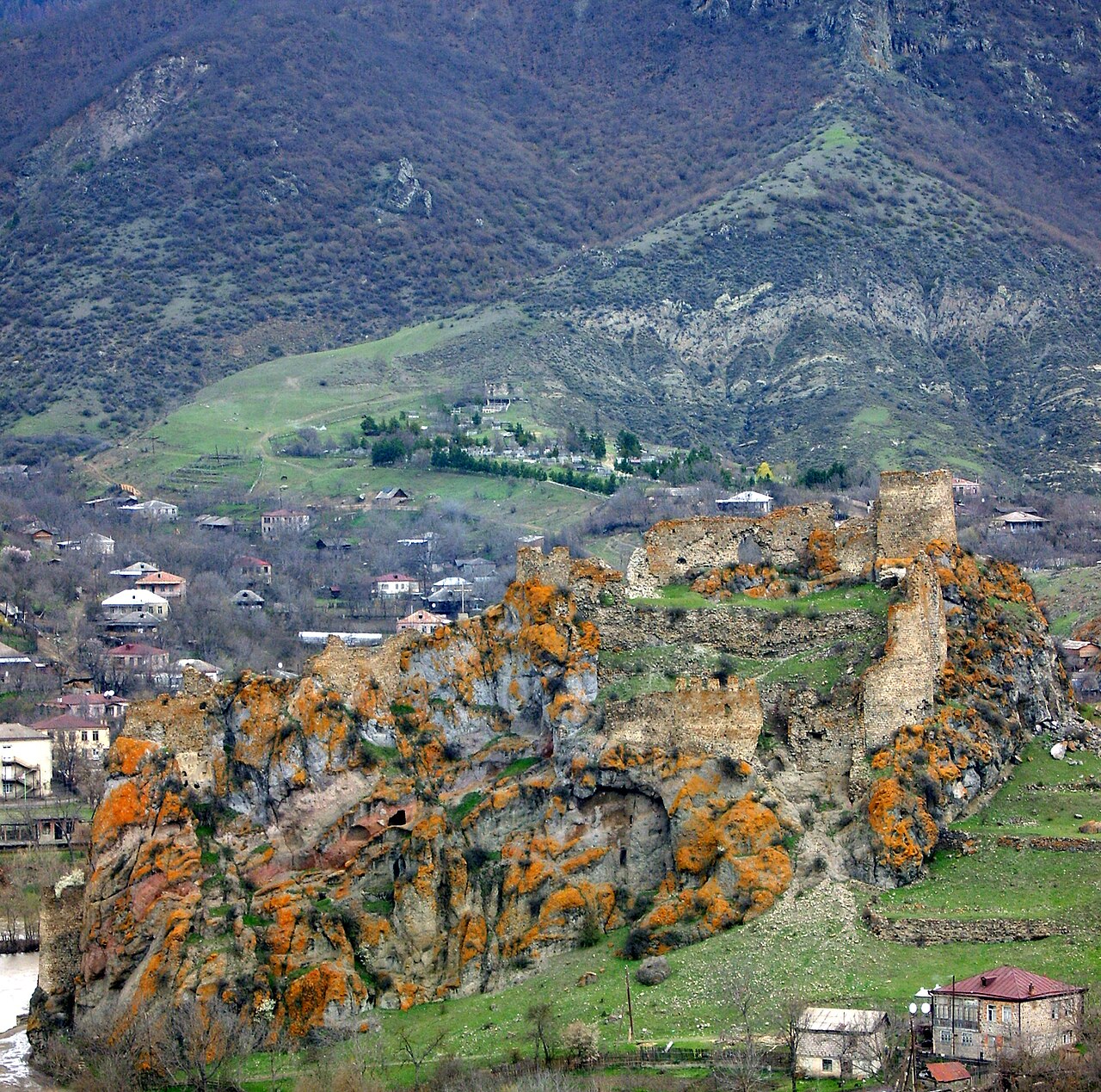
Slesa Castle is a notable high medieval fortress located northeast of the village of Atskuri in the Akhaltsikhe municipality, within the Samtskhe–Javakheti region of Georgia. This castle complex is strategically positioned on the left bank of the Kura River (known locally as the Mtkvari), guarding the crucial southern approach into the Georgian heartland through the river gorge.
Historical background and strategic importance
The origins of Slesa Castle date back to the 10th or 11th century, placing it firmly within the high medieval period. Its primary function was military defense, serving as a vital checkpoint to control movement along the gorge and protect the region from invasions coming from the south. This defensive role was part of a broader network of fortifications along the Kura River gorge, which communicated through bonfires to signal the approach of enemy forces, a common medieval warning system.
Despite its early construction, the castle is first documented in historical records only in the 16th century, during the period of the Ottoman Empire's expansion into Georgian territories. At this time, Slesa Castle played a role in resisting Ottoman incursions, highlighting its continued military relevance several centuries after its initial construction.
Architectural layout and features
Slesa Castle is unique in that it comprises two separate fortifications situated on two adjacent hills. These are often referred to as Slesa Castle itself and the nearby Moktseva Castle. While some sources suggest that Moktseva is simply an alternate name for Slesa, the physical separation and distinct locations suggest these names correspond to two different defensive structures within the same complex.
The main castle sits prominently on a rocky hill overlooking the river, providing commanding views of the gorge and surrounding landscape. The second fortification, often called the southern tower, is located on another hill nearby but is more difficult to access due to steep terrain and requires rock climbing skills to reach safely. This tower likely served as an advanced lookout or secondary defense point.
The castle's construction features typical high medieval defensive elements such as thick stone walls, battlements, and strategically placed towers. The use of natural rock formations integrated into the fortifications enhanced its defensive capabilities, making it a formidable obstacle for attackers.
Current condition and accessibility
Today, Slesa Castle remains in a state of ruins, with many of its walls and structures partially preserved. Visitors can freely access the site, which lies adjacent to the S8 road connecting Borjomi and Akhaltsikhe. However, reaching some parts of the castle, especially the southern tower, involves challenging rock climbing and is not recommended without proper equipment and experience.
The site offers a compelling experience for history enthusiasts and hikers alike, combining natural beauty with the evocative remains of medieval military architecture. Its location along a historic route and proximity to other Georgian cultural sites make it a valuable destination for those interested in the region's past.
Role in Georgian medieval defense network
Slesa Castle was part of a larger chain of fortifications that secured the Kura River gorge, a critical corridor for trade and military movements. The system of castles and towers in this area used visual signals such as bonfires to warn of approaching enemies, facilitating rapid communication across difficult terrain. This network was essential for the defense of medieval Georgia against invasions from the south, particularly during periods of conflict with the Ottoman Empire and other regional powers.
Visiting tips and historical significance
Visitors to Slesa Castle should prepare for a physically demanding visit due to the rugged landscape and the partial ruinous state of the structures. The castle's remote location and limited signage mean that some navigation skills are helpful. Despite these challenges, the site provides valuable insights into the military architecture and regional history of medieval Georgia.
Its dual-fortification layout and strategic placement illustrate the complexity of Georgian defensive strategies during the high medieval period. The castle stands as a testament to the region's turbulent history and the enduring importance of controlling key geographic chokepoints.
Frequently asked questions (FAQ)
- How do I get to Slesa Castle from Borjomi?
- Slesa Castle is accessible via the S8 road from Borjomi to Akhaltsikhe. The castle is located near the road but requires some hiking and rock climbing to reach the ruins safely.
- What is the historical significance of Slesa Castle?
- Slesa Castle was built in the 11th century as part of a defensive network guarding the Kura River gorge, protecting Georgia from southern invasions, particularly during the Ottoman expansion.
- Is Slesa Castle suitable for family visits?
- Due to its rugged terrain and the need for rock climbing to access some parts, Slesa Castle is not recommended for young children or visitors with limited mobility.
- Can I visit both fortifications of Slesa Castle?
- The main castle is accessible to visitors, but the southern tower is difficult to reach safely and may require climbing skills and equipment.
- When is the best time to visit Slesa Castle?
- The best time to visit is during late spring to early autumn when weather conditions are favorable for hiking and exploring the ruins.
Information
Loading map...
Visitor reviews
No reviews yet. Been here? Write the first review and help other travelers!
Write the first reviewVisited this castle? Share your experience
Your review helps other travelers and adds first-hand knowledge to our encyclopedia.