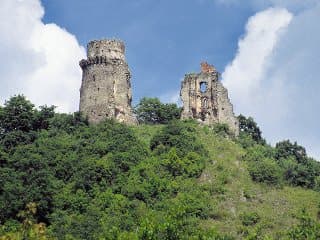
Slanec Castle stands as a remarkable hilltop fortress ruin in Slovakia, perched on a volcanic cone overlooking the village of Slanec. Its origins trace back to the high medieval period, with construction likely commencing in the 13th century following the Mongol invasion of Europe. The castle's strategic location atop a 170-meter-high volcanic hill provided commanding views over a natural passage through the Szalánc Mountains, underscoring its military and economic importance through centuries of Central European history.
The castle's earliest documented mention appears in a 1303 charter from the chapter of Eger, referencing the Szalánczi family, who were instrumental in the castle's early development. Over the following centuries, Slanec Castle was a focal point of regional power struggles, ownership transfers, and military engagements that reflect the turbulent history of Upper Hungary (present-day eastern Slovakia).
Historical development and ownership
The initial establishment of Slanec Castle is attributed to Peter, son of Csama from the Aba clan, a prominent noble family of the Kingdom of Hungary. Originally known as Castrum Salis due to its role as a fortified salt storage site, the castle evolved into a stone fortress by 1281, featuring a distinctive round tower that symbolized its defensive strength. That year, it was besieged and captured by royal forces during a conflict between Palatine Aba Finta and King Ladislaus IV, highlighting its strategic significance.
By the late 13th century, the castle returned to the Szalánc family and later passed to the influential Drugeth family around 1330. The Drugeths enhanced the castle’s defenses by constructing the prominent old tower or donjon, a central keep that served as the stronghold's core defensive feature. The 15th century saw the castle under the ownership of the Losonczy family, who undertook major rebuilding efforts circa 1490 after damage sustained during a siege led by John Giskra's mercenaries in 1440.
In the 17th century, the castle became embroiled in the anti-Habsburg uprisings. It was seized by forces loyal to Stephen Bocskai in 1605 and later occupied by Imre Thököly in 1678. The castle changed hands multiple times amid these conflicts, culminating in its destruction by imperial troops under General Count Jakab Lestie in 1679. This event marked the end of its military use, leaving Slanec Castle in ruins.
Despite its ruinous state, the castle remained significant to the Forgách family, who owned it from 1601 until the 19th century. In 1815, Count József Forgách initiated partial repairs on the old tower to secure family valuables, reflecting a shift from military fortress to heritage site. The ruins suffered further damage during World War II but have since been the focus of conservation and archaeological efforts led by the local municipality since 2010.
Architectural features and layout
Slanec Castle was originally constructed on a rectangular plan adapted to the volcanic hill’s shape, narrowing on the northwest side. Defensive earthworks and a ditch protected the northern approach, remnants of which remain visible today. The castle’s core featured a three-story residential tower with a defensive gallery—a covered walkway for guards—later extended by two additional floors. The uppermost floor included a gallery supported by large stone corbels, which are projecting stones that provide structural support.
Adjacent to this tower stood a large round tower equipped with a corbelled gallery at the same height as the palace gallery. This tower remains one of the most prominent surviving elements of the ruins. The entire complex was enclosed by a defensive wall approximately 140 centimeters thick, emphasizing the fortress's robust construction.
In the 15th century, the castle expanded northwestward with the addition of a bastion near the entrance, which was fortified by a Gothic gate and a drawbridge. This bastion enhanced the castle’s defensive capabilities against siege warfare. Nearby, a circular cistern about 10 meters deep was carved into the living rock and lined with stone blocks, providing a vital water supply for the castle’s occupants.
The old tower or donjon remains a key architectural highlight, alongside the northwest Nebojsa tower, which still rises to four stories and retains parts of its original roof. Sections of the palace’s southeast wall survive, including a window from a Gothic chapel decorated with early 14th-century profile moldings. These architectural details reflect the castle’s evolution through the medieval period.
At the foot of the hill, remnants of a 19th-century landscaped garden reveal the site’s later cultural significance beyond its military origins. Recent conservation efforts have stabilized the ruins, including wall reinforcements, vault replacements, and roofing restorations on the tower, ensuring the preservation of this historic monument.
Military and political significance
Throughout its history, Slanec Castle played a crucial role in the military and political landscape of Upper Hungary. Its strategic location allowed control over important trade and military routes through the Szalánc Mountains. The castle was repeatedly contested during conflicts such as the struggles between Hungarian noble families, the Hussite incursions in the 15th century, and the anti-Habsburg uprisings of the 17th century.
Notable historical figures associated with the castle include Miklós III Drugeth, the supremus comes of Ung County and ban of Szörény, and George I Rákóczi, a Transylvanian prince involved in the Thirty Years’ War. The castle’s capture and destruction in 1644 by Transylvanian troops and its final ruin in 1679 by imperial forces illustrate its central role in regional power dynamics.
Conservation and cultural heritage
Today, Slanec Castle is a protected cultural monument owned by the municipality of Slanec. Conservation efforts focus on preserving the structural remains and facilitating archaeological research to uncover further insights into the castle’s layered history. The site attracts visitors interested in medieval architecture, Hungarian and Slovak history, and the dramatic stories of noble families and military conflicts that shaped the region.
Interpretive signage and guided tours provide educational opportunities, while the castle’s scenic hilltop location offers panoramic views of the surrounding landscape. As a significant example of a high medieval hill castle with a complex history of construction, destruction, and restoration, Slanec Castle remains a valuable heritage site in Slovakia.
Frequently asked questions (FAQ)
- How do I get to Slanec Castle Ruins?
- Slanec Castle Ruins are located in Slanec, Slovakia, and can be accessed by car or public transport. The nearest major city is Košice, from where you can take a local bus or taxi to reach the castle.
- What is the historical significance of Slanec Castle?
- Slanec Castle dates back to the 13th century and served as a strategic fortress in the region. It played a crucial role in defending against invasions and has witnessed various historical events throughout the centuries.
- When was Slanec Castle built?
- Construction of Slanec Castle began in the 13th century, with significant modifications made in the following centuries. The castle showcases a blend of architectural styles that reflect its long history.
- Can I visit Slanec Castle Ruins year-round?
- Yes, Slanec Castle Ruins are open for visitors throughout the year. However, accessibility may vary during winter months due to weather conditions, so it’s advisable to check local weather forecasts before your visit.
- Why is Slanec Castle a popular tourist attraction?
- Slanec Castle attracts visitors due to its rich history, stunning views of the surrounding landscape, and fascinating architectural features. It's an ideal spot for history enthusiasts and those looking to explore Slovakia's cultural heritage.
- What are the opening hours for Slanec Castle Ruins?
- The castle ruins are typically accessible during daylight hours, but it's best to check local resources for specific opening times, especially during the off-peak season. Always plan your visit to ensure you have enough time to explore the site.
- What is the best time to visit Slanec Castle?
- The best time to visit Slanec Castle is during the spring and autumn months when the weather is mild and the surrounding nature is at its most beautiful. Summer can be busy with tourists, while winter may present challenges due to snow.
- Are there any nearby attractions to visit?
- Yes, there are several nearby attractions, including the town of Slanec itself, which offers charming architecture and local culture. Additionally, the city of Košice, with its historical sites and vibrant atmosphere, is just a short drive away.
- What are the ticket prices for visiting Slanec Castle Ruins?
- There is no formal entry fee to visit the ruins, making it an accessible destination for all visitors. However, donations for maintenance and preservation are appreciated.
Photo gallery

Photo by Jofo•Public domain
Information
Website
Visit websiteSources & official resources
Verify the information above using these authoritative references.
Loading map...
Visitor reviews
No reviews yet. Been here? Write the first review and help other travelers!
Write the first reviewVisited this castle? Share your experience
Your review helps other travelers and adds first-hand knowledge to our encyclopedia.