Skály Castle
Skály Castle is a remarkable late 14th-century hill castle located near the municipality of Teplice nad Metují in the Czech Republic. Established likely by Matěj Salava of Lípa, a member of the medieval Bohemian nobility, the fortress stands out for its unique integration with the surrounding sandstone rock formations. This castle exemplifies medieval fortification methods adapted to natural terrain, combining stone masonry with carved rock chambers, staircases, and defensive structures.
The founding and early history of Skály Castle
The castle was constructed in the late 14th century, possibly replacing an earlier stronghold at nearby Stárkov. Some historical accounts attribute its foundation to Rubín ze Žampachu, a former owner of Stárkov, though the more widely accepted founder is Matěj Salava. The castle's strategic location allowed control over the surrounding region, which was significant during the turbulent times of the Hussite Wars in the early 15th century.
During the Hussite Wars, Matěj Salava aligned with the Hussite movement and expanded his estates by seizing church lands belonging to the Broumov monastery. However, after the Battle of Lipany in 1434, which marked the decisive defeat of the radical Hussites, Salava switched allegiance back to the Catholic side and retained his holdings. The castle's garrison was active in launching raids into neighboring Silesia and Lusatia, provoking military responses from Silesian forces. This culminated in the purchase and destruction of Skály Castle by Silesian troops in 1447 to eliminate the threat posed by its occupants.
Reconstruction and ownership transitions
By 1454, the castle was rebuilt by a figure named Kočka, who gave it the German name Katzenstein. Ownership passed through several noble families, including Hanuš of Varnsdorf (1466–1484), Zbyněk Buchovec of Buchov (1488), and Jan Špetle of Janovice (1497). In 1513, the castle came under the control of Prince Bartoloměj of Münsterberg. During his tenure, the fortress endured a significant siege in late August 1513, when approximately 2,000 Silesian soldiers led by Prince Friedrich II of Liegnitz bombarded it with artillery for three days. The attackers withdrew only after receiving news of reinforcements arriving from Prague.
Following Bartoloměj’s death in 1515, ownership reverted to Jan Špetle, who became involved in a contested sale with Petr Adršpach of Dubá. The dispute ended with the estate's sale in 1528 to Zdeněk Lev of Rožmitál and Jan Krušina of Lichtenburk, including nearby villages and the ruins of Adršpach castle. In 1534, Jan of Pernštejn acquired the property, incorporating it into the Náchod estate.
By 1544, Bernard Žehušický of Nestajov owned the castle but chose to reside in Stárkov rather than repair the fortress. Consequently, Skály was recorded as deserted by 1576. Over a century later, in 1662, the Diocese of Hradec Králové purchased the castle ruins and estate, renaming the site Bischofstein to reflect its ecclesiastical ownership. The first bishop of the diocese, Matouš Ferdinand Sobek of Bílenberk, constructed a modest summer residence within the castle’s outer courtyard. The property remained under diocesan control until 1948.
Architectural features and castle remains
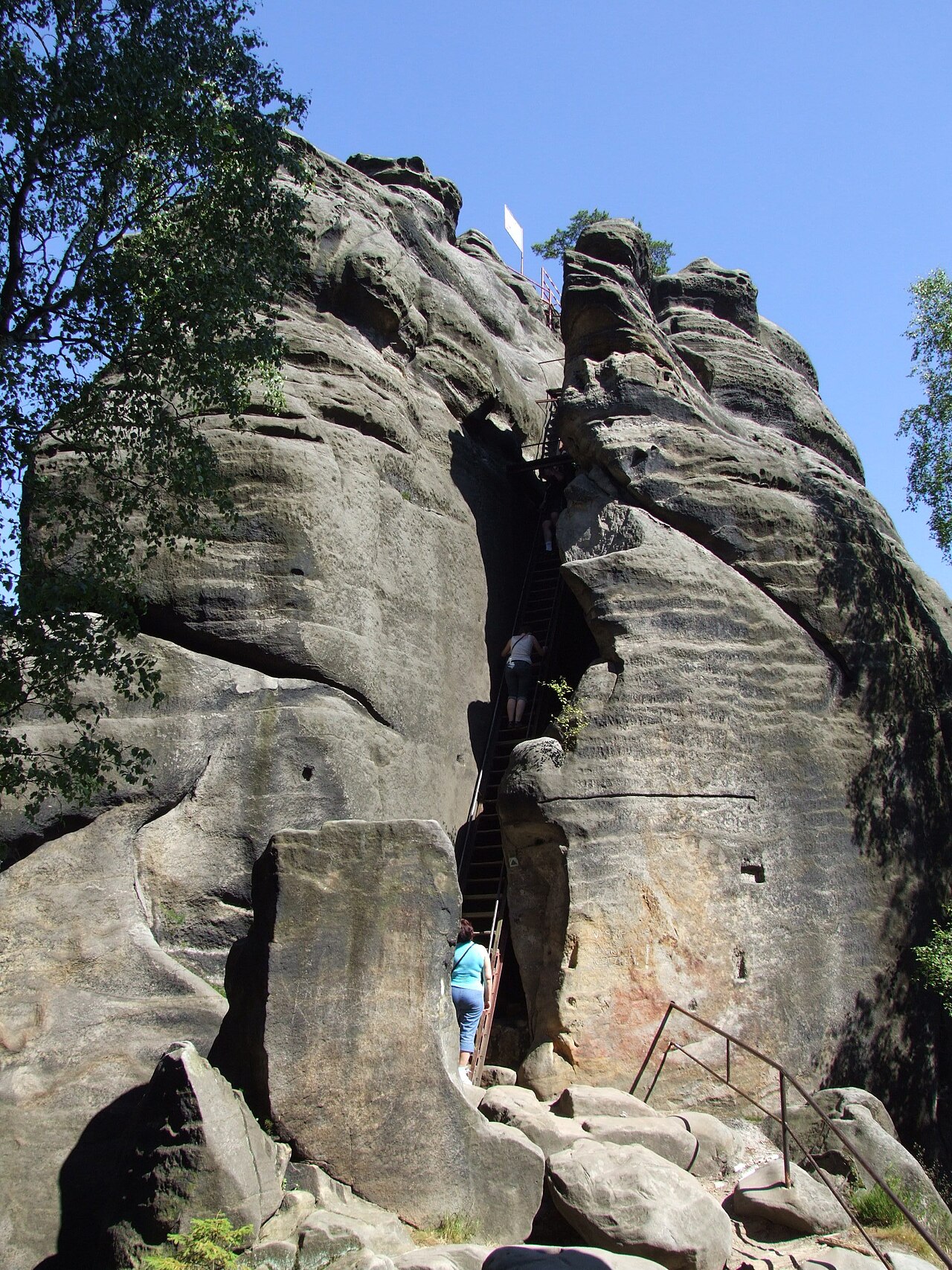
Skály Castle is notable for its location within a sandstone rock city, a natural formation of towering sandstone pillars and ridges. Instead of carving a traditional rock castle inside a single large stone, builders integrated multiple rock masses into the fortress's structure, using them as essential defensive and residential elements.
The castle’s core included a substantial palace building attached directly to the largest sandstone tower, combining defensive and residential functions. A smaller tower stood within the palace walls, fully enclosed by later masonry. Surrounding the core, outer defenses likely connected various rock outcrops with walls and enclosures, although much of these have disappeared over time.
On the northern plateau, a walled area enclosing a cistern remains visible, indicating a water storage system vital for the castle’s survival during sieges. The eastern side formed the main core, where the strongest defensive works were concentrated. Southwest of this core, a ditch and an outer rampart partially survive, marking the position of the original fortifications. In front of these earthworks lie the carved remains of a square bastion, designed to strengthen the castle against attackers.
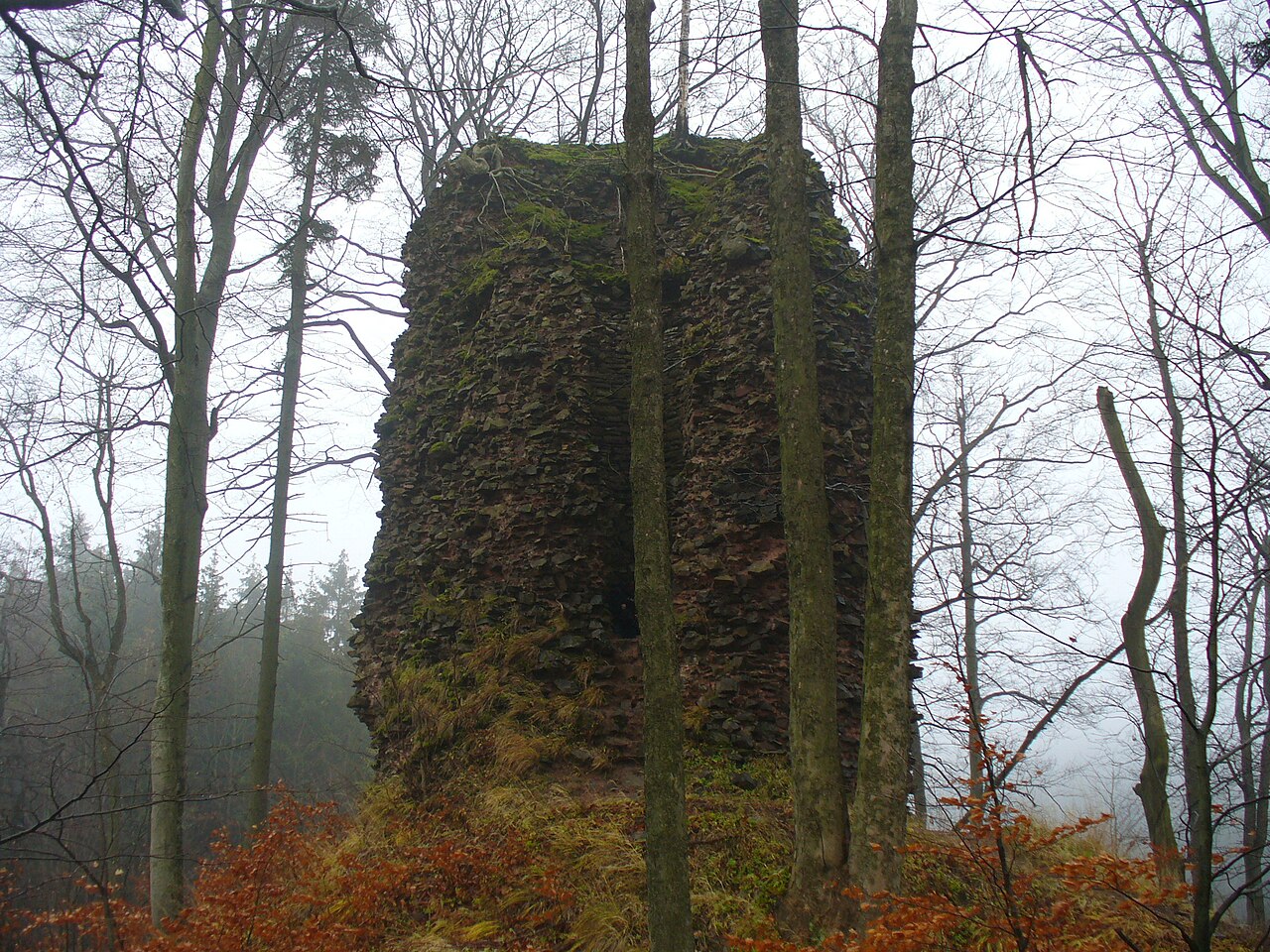
Within the sandstone itself, rooms and staircases were carved to create functional spaces. Some of these rock-cut chambers remain accessible today, demonstrating a careful blend of natural terrain and man-made modifications. Masonry remnants reveal parts of the palace’s stone perimeter walls and a vaulted chamber characterized by a pointed barrel vault, a typical feature of medieval construction.
After the castle’s decline, portions of the forecourt were adapted in the 17th century for a small bishop’s summer residence, reflecting a transition from military fortress to clerical retreat. The site is a protected cultural monument and an important archaeological record of medieval fortification strategies adapted to challenging sandstone landscapes.
Skály castle in the context of regional history
The castle's history is intertwined with the broader political and military struggles of medieval Bohemia and Silesia. Its role during the Hussite Wars illustrates the complex allegiances and conflicts of the period. The repeated sieges, ownership disputes, and eventual destruction highlight the strategic importance of Skály in controlling regional trade routes and territorial influence.
Later incorporation into the Náchod estate and ownership by prominent noble families such as the Pernštejns reflect the castle's integration into the feudal structures of the Renaissance period. Its abandonment and conversion into a bishop’s retreat mark a shift in the castle’s function and the changing nature of power and residence in the early modern era.
Archaeological research and preservation efforts
Archaeological interest in Skály Castle has been ongoing since the 19th century, with the Belcredi family initiating early excavations focused on defensive walls and gate structures. Renewed digs in the 1970s and from 1996 onwards have uncovered significant remains, including foundations of the original palace buildings and artifacts dating from the 15th century. These findings provide valuable insights into the castle’s construction techniques, defensive features, and daily life during its active period.
The ruins are accessible to visitors and protected as part of a cultural heritage site within a designated natural monument area. Historical drawings and photographs, including notable works by K. Liebscher, have helped preserve the castle’s memory and guide ongoing studies. Skály Castle remains a compelling example of medieval fortress architecture adapted to a unique geological environment.
Frequently asked questions (FAQ)
- How do I get to Skály Castle?
- Skály Castle is located in Teplice nad Metují, Czechia, and can be easily accessed by car or public transport. The nearest train station is in Teplice nad Metují, from where you can take a short bus ride or walk to the castle.
- What are the opening hours of Skály Castle?
- Skály Castle is open to visitors from April to October, with varying hours depending on the month. Typically, the castle opens at 9 AM and closes at 5 PM, so be sure to check the specific hours for your visit.
- Can I take guided tours of Skály Castle?
- Yes, guided tours are available at Skály Castle, providing insight into its rich history and architectural features. These tours are led by knowledgeable guides and are offered in multiple languages to accommodate international visitors.
- When was Skály Castle built?
- Skály Castle was constructed in the early 14th century, showcasing Gothic architecture that reflects the era's design principles. Over the centuries, it has undergone various renovations, preserving its historical significance.
- Is it possible to visit Skály Castle with a wheelchair?
- While Skály Castle's historic nature presents some challenges for accessibility, efforts have been made to accommodate visitors with mobility issues. Certain areas of the castle are accessible, but it is advisable to contact the castle in advance for specific information on wheelchair access.
- Why is Skály Castle historically significant?
- Skály Castle played a crucial role in the region's defense during the medieval period and served as a residence for nobility. Its strategic location and architectural design contribute to its historical importance in Czechia.
- What is the ticket price for visiting Skály Castle?
- The ticket prices for Skály Castle are quite reasonable, with discounts available for children, students, and seniors. Typically, adult tickets range from 100 to 150 CZK, so be sure to check the official website for the most current pricing information.
- What is the best time to visit Skály Castle?
- The best time to visit Skály Castle is during the late spring and early autumn months, when the weather is pleasant and the surrounding nature is in full bloom. Additionally, visiting during these months allows you to enjoy the outdoor areas around the castle.
- Are there any nearby attractions to Skály Castle?
- Yes, there are several nearby attractions, including the beautiful Teplice nad Metují nature reserve and the picturesque Adršpach-Teplice Rocks. These natural formations provide excellent opportunities for hiking and photography, making them perfect additions to your visit to Skály Castle.
Information
Website
Visit websiteSources & official resources
Verify the information above using these authoritative references.
Loading map...
Visitor reviews
No reviews yet. Been here? Write the first review and help other travelers!
Write the first reviewVisited this castle? Share your experience
Your review helps other travelers and adds first-hand knowledge to our encyclopedia.