Radosno Castle
Radosno Castle stands as a notable example of a medieval hill castle located in the municipality of Rybnica Leśna, Poland. Constructed in the late 13th century, it was originally part of the Duchy of Świdnica-Jawor, a significant territorial entity in the Silesian region. The castle's position on a strategic border facing Bohemia underscored its importance in controlling and protecting a vital medieval trade route, which linked regional economic centers and facilitated commerce.
Historical background and political significance
The castle's early history is closely tied to prominent regional rulers such as Duke Bolko I of Świdnica-Jawor and his successor Duke Bolko II the Small. These rulers played critical roles in shaping the political landscape of Silesia during the late medieval period. By the mid-14th century, Radosno Castle was documented as a royal fief under Bohemian sovereignty, reflecting the shifting allegiances and power dynamics within Central Europe.
Ownership of the castle changed hands multiple times, passing through noble families including the Swenkinvalds, Hersko of Rozkowice, and later the bishops of Wrocław. The Seidlitz and Rechenberg families also held control over the fortress, illustrating its continued importance as a noble residence and administrative center. The castle was not only a military stronghold but also served as the administrative hub for the surrounding domain, which included the nearby town of Mieroszów and various villages.
Strategic role and military history
Radosno Castle was part of a defensive network that included other nearby fortresses such as Rogowiec, Grodno, and Nowy Dwór. This chain of castles guarded the borderlands and trade routes against external threats, particularly from Bohemia. During the Hussite Wars in the early 15th century, the castle endured two recorded sieges in 1427 and 1434. Although records do not confirm its capture, these attacks highlight the fortress's military significance during a turbulent period of religious and territorial conflict.
In the mid-15th century, Radosno Castle gained notoriety as a refuge for robber knights, who disrupted local peace and security. This criminal activity provoked a military response, culminating in a partial destruction of the castle in 1443 when forces from the city of Wrocław attacked it. Despite this setback, the castle was rebuilt in 1466 by the Schellendorf brothers, who continued the practice of banditry from the stronghold.
The castle's contested status persisted into the late 15th century, evidenced by its seizure by troops under Hungarian king Matthias Corvinus in 1483. Ultimately, the fortress was decisively destroyed in 1497 by order of King Vladislaus II Jagiellon, ending its active military and administrative role. After this final assault, Radosno Castle was abandoned and fell into ruin.
Architectural features and layout
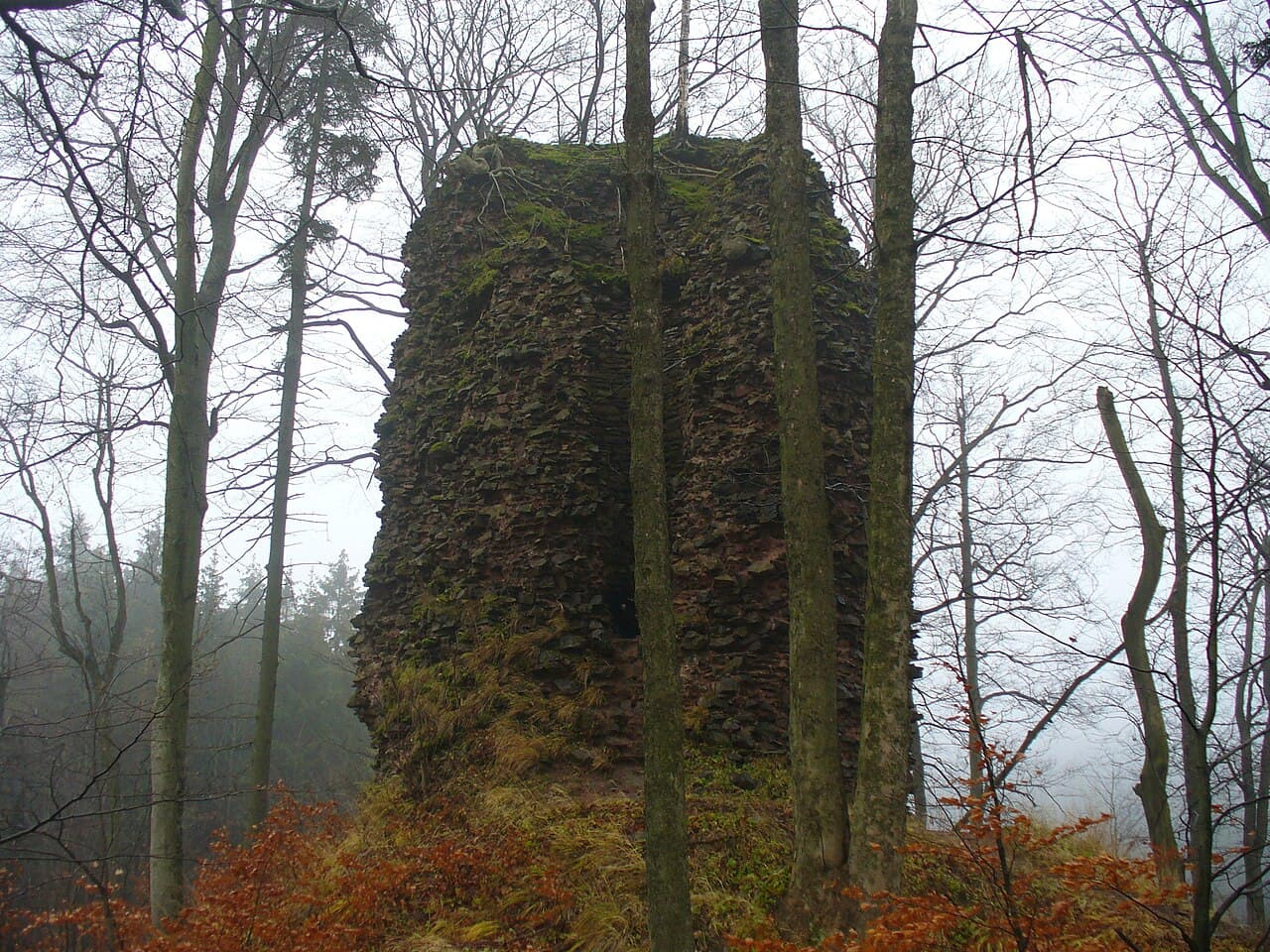
The castle was constructed predominantly from local stone materials, including durable melaphyre rock quarried nearby. Its most prominent feature was a large cylindrical tower, approximately 7.2 meters in diameter. This tower was strategically placed on the highest point of the castle's southeastern side, guarding the most vulnerable approach. The entrance to this tower was raised about four meters above ground level, a defensive design intended to hinder attackers.
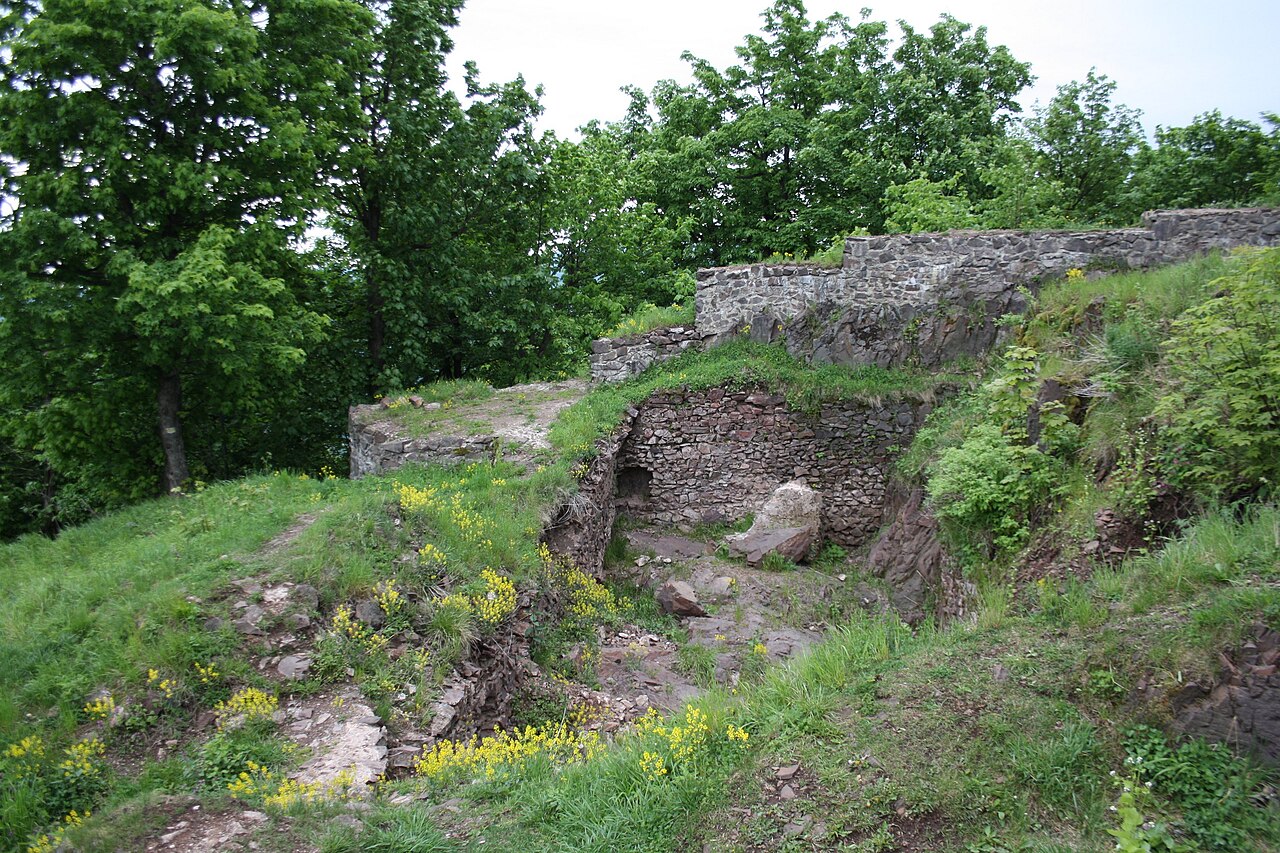
Originally, the castle's defenses included wooden and earthen structures, but these were replaced during the 14th century by substantial stone curtain walls enclosing a roughly rectangular courtyard of about 300 square meters. The main castle section measured approximately 17 by 30 meters, with residential buildings located in the northern corner and the main cylindrical tower in the southeastern corner.
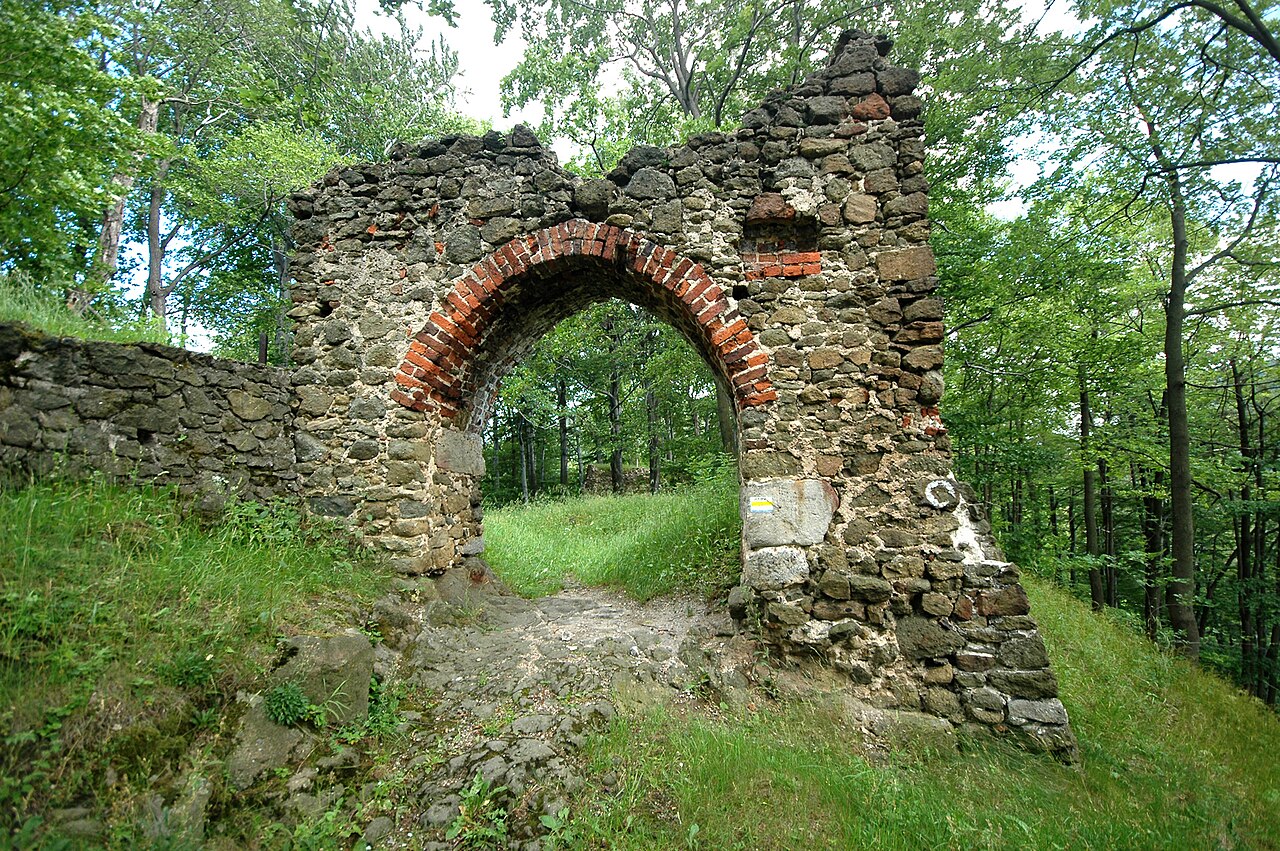
In addition to the round tower, a quadrangular tower measuring around 6 by 6 meters was integrated into the defensive wall on the northwestern side. This tower contained the main gate, controlling access to the stronghold. Adjacent to the southern side of the castle was a smaller rectangular outer bailey measuring about 14 by 18 meters, which likely served as an additional defensive layer or space for auxiliary functions.
The fortress was further protected by defensive ditches carved into the rock, varying from 3.5 to 7 meters wide and up to 4 meters deep. These ditches significantly impeded any assault on the walls. Today, the most visible surviving element is the 12-meter-high lower section of the principal cylindrical tower. Archaeological excavations have also uncovered fragments of the residential building near the northwestern edge of the complex.
Geographical setting and surrounding fortifications
Radosno Castle occupies a spur projecting into a small side valley known as Freudengraben. A medieval road passed roughly 50 meters south of the summit, providing access from the east. The nearby fortress of Rogowiec, located about four kilometers to the east, was part of the same defensive system. This network of fortifications was designed to secure the border and trade routes in a contested and strategically important region.
Legacy and present condition
Although now in ruins, Radosno Castle remains an important archaeological site that offers valuable insights into medieval military architecture and the turbulent history of Silesia. The surviving structural elements, including the cylindrical tower and remnants of the curtain walls, allow historians and visitors to appreciate the castle's original defensive capabilities and layout.
The castle's history as a defensive fortress, administrative center, and even a refuge for outlaw knights illustrates the complex social and political dynamics of the region during the late medieval period. Its strategic placement and architectural features reflect the evolving nature of fortification design in response to military and political challenges.
Frequently asked questions (FAQ)
- How do I get to Radosno Castle?
- Radosno Castle is located in Rybnica Leśna, Lower Silesian Voivodeship, Poland. Visitors can reach the site by car or local transport, with parking available nearby. The castle is accessible via hiking trails from the village center.
- What is the best time to visit Radosno Castle?
- The best time to visit Radosno Castle is during late spring to early autumn when the weather is favorable for hiking and exploring the ruins. The site is open year-round, but some paths may be challenging in winter due to snow.
- Is Radosno Castle suitable for families?
- Yes, Radosno Castle is suitable for families who enjoy outdoor activities and history. However, visitors should be cautious around the ruins as some areas may be uneven or steep. Supervision of children is recommended.
- Can I explore the interior of the castle?
- Visitors can explore the castle ruins, including the base of the cylindrical tower and surrounding walls. There are no fully intact interior rooms, but the site offers interpretive signage and pathways to guide exploration.
- Are there guided tours available at Radosno Castle?
- Guided tours may be available through local tourism offices or historical societies in Rybnica Leśna. It is advisable to check in advance for tour availability and scheduling.
Photo gallery

Information
Current owner
Municipality
Loading map...
Visitor reviews
No reviews yet. Been here? Write the first review and help other travelers!
Write the first reviewVisited this castle? Share your experience
Your review helps other travelers and adds first-hand knowledge to our encyclopedia.