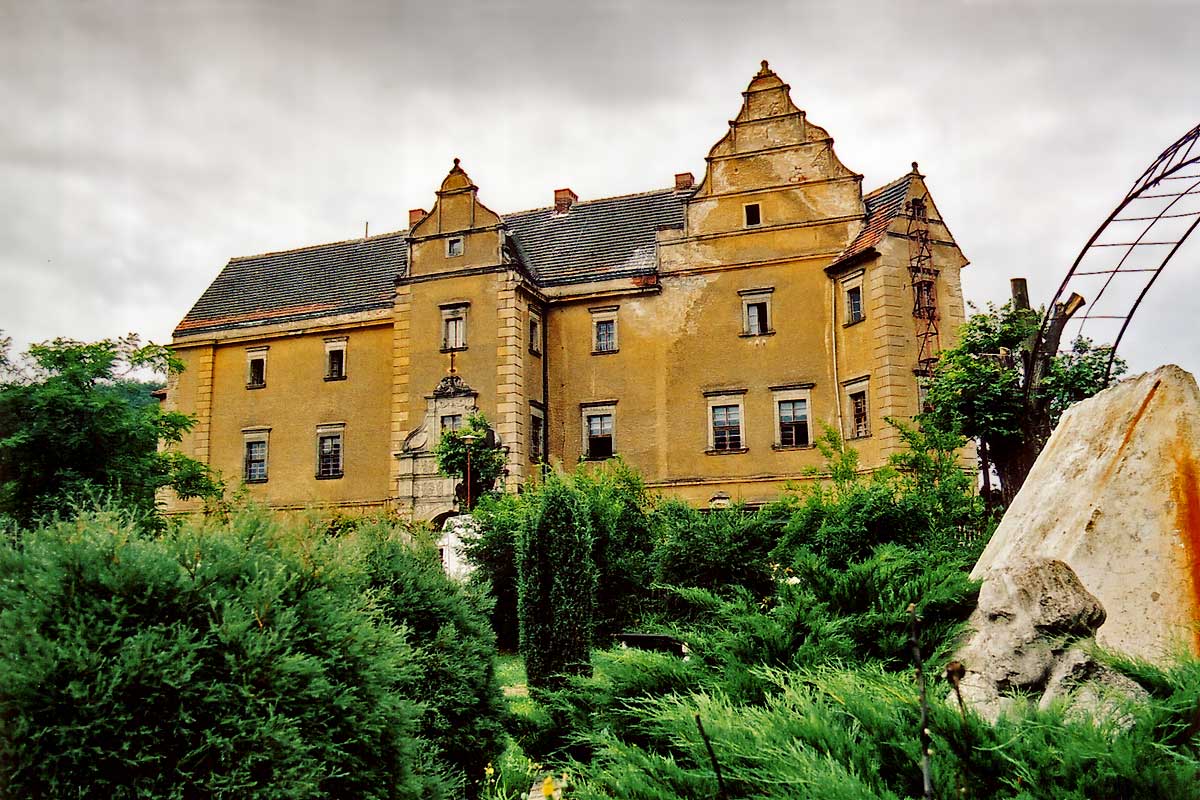
Skała
Skała castle stands as a significant historical site in Skała, Poland, known today primarily for its evocative ruins that reflect a complex history of noble ownership and architectural evolution. While some earlier accounts suggest the existence of a castle belonging to the Świdnica dukes in the 14th century, allegedly destroyed by Hussite forces in 1428, these claims lack firm historical evidence and are likely later romanticized attempts to attribute a medieval origin to the site.
Early history and ownership transitions
The first well-documented record dates to 1347, when Duke Bolko II granted the village of Skała to Seyfried von Raussendorf. Over the following decades, the ownership of Skała passed through several hands, reflecting the shifting political and social landscape of the region. By 1423, the estate was acquired by Fritsche von Kopatsch, whose descendants are credited with erecting a manor house in the village. This structure was likely built of stone, serving as their noble residence and forming the nucleus of what would later develop into a more complex fortified site.
Architectural development through the centuries
16th-century transformation
In the late 16th century, the estate came under the ownership of Adam von Lest, who replaced the original manor with a more representative residence. This new building featured a viewing loggia and a tower housing a staircase, elements that highlighted both the aesthetic sensibilities and defensive considerations of the period. These architectural features not only enhanced the visual appeal but also provided practical benefits, such as improved vantage points and vertical circulation within the residence.
17th and 18th-century expansions
The residence underwent significant expansions in the second half of the 17th century. The building was extended northward and a western wing was added, increasing the overall footprint and functionality of the complex. At the turn of the 18th and 19th centuries, further modifications gave the palace a distinctive horseshoe-shaped plan with a courtyard and a risalit in the southern corner. These changes reflect evolving architectural trends and the desire to create a more grandiose and comfortable noble residence.
Architectural style and classification
Despite being referred to as a bastioned fortress in some sources, Skała castle's architecture primarily reflects the characteristics of a noble residence with defensive features rather than a full military fortress. The presence of a tower with a staircase and the layout of the complex suggest a blend of residential and defensive functions typical of late-medieval and early modern manor houses. The castle's style incorporates elements from the late-medieval period, with later Renaissance and Baroque influences visible in its expansions and decorative details.
Decline and current condition
Following the upheavals of the 20th century, particularly after World War II, the castle suffered significant damage and neglect. As a result, the site has fallen into a state of ruin, with many original structures partially preserved or lost entirely. Today, Skała castle is recognized as a valuable cultural heritage site, albeit in a dilapidated condition, attracting visitors interested in the layered history and architectural evolution of Polish noble residences.
Cultural and historical significance
Skała castle serves as a testament to the region's complex feudal history and the architectural transitions from fortified medieval structures to more comfortable noble residences. Its successive owners and architectural adaptations reflect broader trends in Polish and Central European aristocratic life from the late medieval through the early modern periods. Despite its ruined state, the castle remains a poignant symbol of the area's historical legacy and cultural identity.
Visiting information and accessibility
As the castle is currently in ruins, visitors should exercise caution when exploring the site. The ruins offer a unique opportunity to engage with Poland's medieval and early modern history in an authentic setting. While there may be limited facilities on-site, the location in Skała provides access to other regional attractions and historical landmarks, making it a worthwhile destination for enthusiasts of history and architecture.
Frequently asked questions
- When was Skała castle originally built? The earliest confirmed construction related to the castle dates to the early 15th century, with the manor house established by the Kopatsch family after 1423.
- What architectural styles are present in Skała castle? The castle features a mix of late-medieval, Renaissance, and Baroque architectural elements due to its various expansions over the centuries.
- Is Skała castle accessible to visitors? Yes, visitors can explore the ruins, but should be cautious due to the site's deteriorated condition and lack of extensive visitor facilities.
- What caused the castle's ruin? Damage and neglect after World War II led to its current ruined state.
- Are there any guided tours available? Information on guided tours is limited; visitors are advised to check locally for any available services.
- What is the significance of the castle's bastioned fortress classification? While classified as a bastioned fortress, Skała castle functioned more as a fortified noble residence with defensive features rather than a full military fortress.
Frequently asked questions (FAQ)
- How do I get to Skała Castle?
- Skała Castle is located in the town of Skała, Poland, which is easily accessible by car or public transport from nearby cities like Kraków. The nearest bus and train stations are within a short walking distance from the castle.
- What is the historical significance of Skała Castle?
- Skała Castle has a rich history dating back to the 14th century and served as a defensive stronghold in the region. It played a significant role in various historical conflicts and has been a site of cultural importance throughout the centuries.
- When was Skała Castle built?
- Construction of Skała Castle began in the late 14th century, and it was completed in the early 15th century. Over the years, the castle underwent various renovations and expansions, reflecting the architectural trends of different periods.
- Can I visit Skała Castle year-round?
- Yes, Skała Castle is open to visitors throughout the year, though specific opening hours may vary by season. It's recommended to check the official website or contact local tourism offices for the most accurate information before planning your visit.
- Why is the architecture of Skała Castle noteworthy?
- The architecture of Skała Castle is notable for its blend of Gothic and Renaissance styles, which showcases the evolution of architectural design in Poland. The castle features impressive stonework, arched windows, and a majestic tower that provides stunning views of the surrounding landscape.
- Is it possible to explore the interior of Skała Castle?
- Yes, visitors can explore certain areas of the castle's interior, including museums that display artifacts related to its history. Guided tours are often available, providing insights into the castle's past and its architectural features.
- What are the ticket prices for Skała Castle?
- Ticket prices for Skała Castle are generally affordable, with discounts available for students and seniors. It's best to check the official website for the most current pricing and any special offers that may be available during your visit.
- What is the best time to visit Skała Castle?
- The best time to visit Skała Castle is during the spring and fall when the weather is mild, and the surrounding scenery is particularly beautiful. Summer can be busy with tourists, but it also offers a lively atmosphere with various events and activities around the castle.
- Are there any nearby attractions to visit after Skała Castle?
- Yes, after visiting Skała Castle, you can explore several nearby attractions, including the picturesque landscapes of the Ojców National Park and the charming town of Ojców. There are also other historical sites and natural parks within a short drive, making it easy to plan a full day of exploration.
Information
Loading map...
Visitor reviews
No reviews yet. Been here? Write the first review and help other travelers!
Write the first reviewVisited this castle? Share your experience
Your review helps other travelers and adds first-hand knowledge to our encyclopedia.