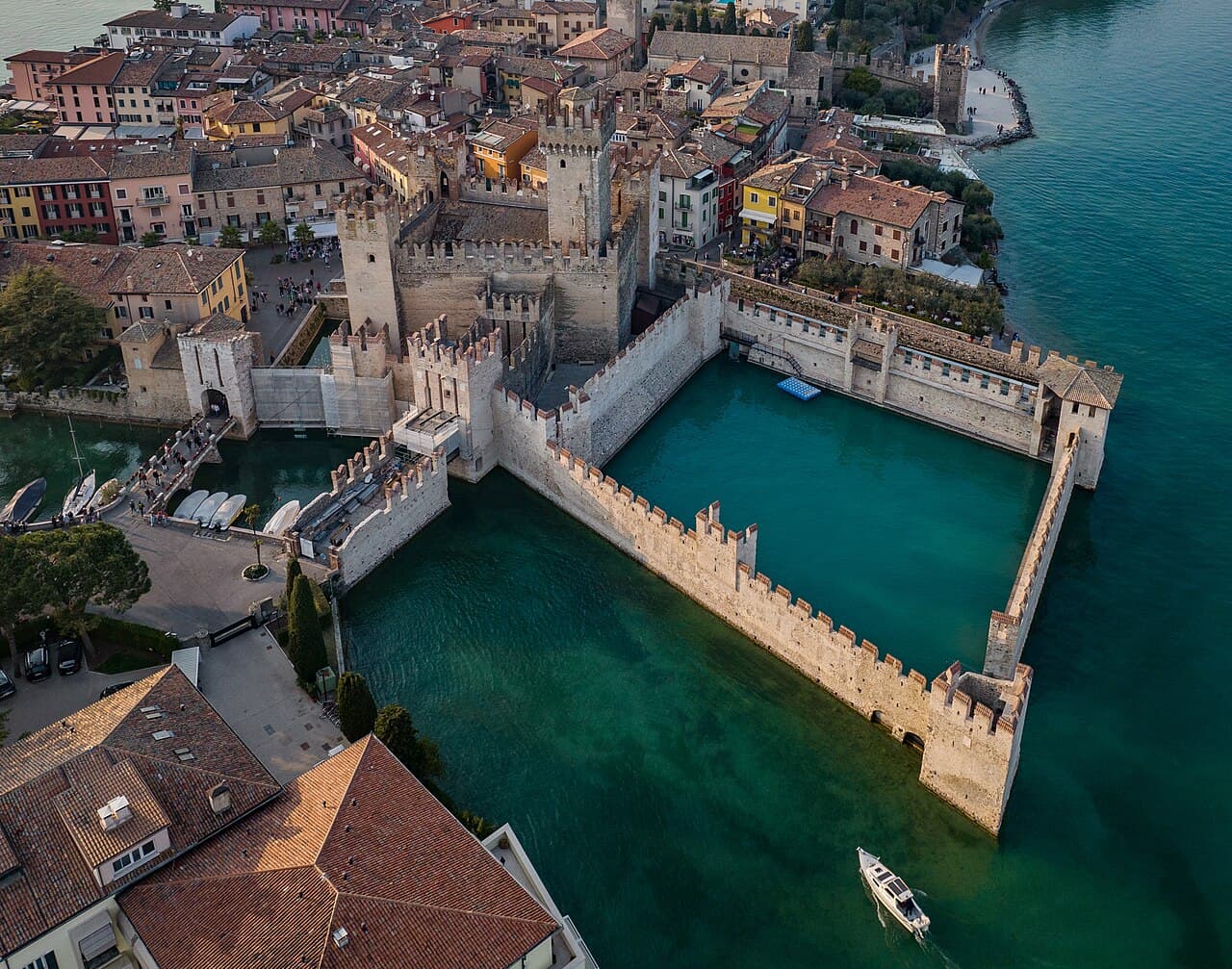
Sirmione Castle
Sirmione Castle, also known as the Scaliger Castle, stands as one of the most remarkable medieval fortresses in Europe, uniquely built on water in the southern part of Lake Garda in Lombardia, Italy. Constructed in the 13th century by the powerful Della Scala family, the lords of Verona, this castle served as a strategic military stronghold and a symbol of Scaliger power during the turbulent High Medieval period. Its imposing presence, surrounded on all sides by water, rises steeply from the narrow peninsula of Sirmione, offering both formidable defense and commanding views over the lake.
Historical context and strategic significance
The location of Sirmione Castle on a narrow strip of land extending more than two miles into Lake Garda made it a vital defensive and control point. The castle was likely built upon the ruins of an ancient Roman fortification, emphasizing continuity in military importance from antiquity through the Middle Ages. During the late 13th and 14th centuries, the castle was integral to the defense network of the Scaligeri, who sought to protect their territories from rival city-states such as Milan.
Following the conquest of Sirmione by the Republic of Venice in 1405, the castle's fortifications were significantly enhanced to secure Venice's northern borders. Venice's modifications included strengthening the outer walls and expanding the harbor facilities, modeled after the famous Venetian Arsenal. This transformation secured the castle's role as a critical military outpost and naval refuge well into the 16th century.
Architectural features and defensive structures
Bastioned fortress design
Sirmione Castle is classified as a bastioned fortress, a style characterized by angular bastions designed to deflect cannon fire and provide overlapping fields of defensive fire. The castle's design reflects the transition from medieval fortifications to early modern military architecture, with a focus on water defenses. It is completely surrounded by water, creating a natural moat that enhances its impregnability.
Drawbridge, towers, and battlements
The castle is accessed exclusively via a drawbridge that connects the fortress to the mainland, a critical defensive feature that could be raised to prevent enemy access. The walls are punctuated by multiple towers and battlements, which provided vantage points for archers and later artillery. The battlements are crenellated, allowing defenders to shield themselves while firing upon attackers.
Main courtyard and inner structures
Upon entering the castle, visitors encounter a large rectangular courtyard enclosed by high walls and corner towers. This courtyard served as the heart of the castle's daily life and military operations. Within the castle, a porch houses a collection of Roman and medieval lapidary artifacts, emphasizing the site's long historical continuity. A staircase and secondary drawbridge lead to the inner walls' walkways, offering panoramic views of the harbor and the surrounding lake.
Evolution and usage through the centuries
After its initial construction by the Scaliger family, the castle underwent several expansions and improvements under Venetian rule. The Venetian authorities fortified the outer walls and modernized the harbor, ensuring the castle remained a key defensive and naval base. The docks served as a safe haven for both Scaliger and Venetian fleets, highlighting the castle's dual military and maritime functions.
In the centuries following the 16th century, as military technology and political boundaries evolved, Sirmione Castle's strategic importance declined. It was repurposed as an armory, military barracks, and later housed municipal offices and a police station after the unification of Italy. It even functioned as a small jail, reflecting its continued civic utility beyond military purposes.
The castle suffered some neglect but was restored after World War I and transformed into a museum, preserving its rich history and architectural heritage for public education and tourism.
Significance and visitor experience today
Today, Sirmione Castle is one of the best-preserved examples of a medieval bastioned fortress on water, attracting visitors from around the world. Its unique position on Lake Garda, combined with its architectural grandeur and historical significance, makes it a must-see landmark in northern Italy.
Visitors can explore the castle's drawbridge, towers, and battlements, walk the ramparts for sweeping views of the lake and town, and visit the lapidary collection that connects the site to its Roman past. The castle's museum offers insights into the military and political history of the Scaliger and Venetian periods, enriching the visitor experience.
Access and amenities
The castle is accessible via the drawbridge from the mainland, with pathways leading to the main courtyard and upper walkways. The preservation of the castle allows for safe exploration of its defensive structures and scenic vantage points. Its location within the picturesque town of Sirmione also provides visitors with opportunities to enjoy local culture, cuisine, and the natural beauty of Lake Garda.
Architectural legacy and cultural importance
Sirmione Castle exemplifies the evolution of military architecture from the High Middle Ages into the early modern era. Its bastioned design and water defenses illustrate the adaptation of fortresses to new military technologies such as artillery. The castle's continuous use and modifications by the Scaliger and Venetian powers reflect the shifting political landscape of northern Italy during the medieval and Renaissance periods.
As a cultural monument, the castle symbolizes the heritage of the Lombardia region and the historical significance of Lake Garda as a strategic and economic hub. Its preservation as a museum allows contemporary audiences to engage with this layered history and appreciate the architectural ingenuity of medieval and Renaissance fortifications.
Frequently asked questions (FAQ)
- What is the historical significance of Sirmione Castle?
- Sirmione Castle, also known as Castello Scaligero, dates back to the 13th century and was built by the Scaliger family to defend the strategic port on Lake Garda. Its well-preserved structure showcases medieval military architecture and provides insight into the region's historical conflicts and power struggles.
- When was Sirmione Castle built?
- Construction of Sirmione Castle began in 1277 and was completed in the early 14th century. The castle was strategically designed to protect the area from invasions and to control access to Lake Garda.
- What are the opening hours for Sirmione Castle?
- Sirmione Castle is typically open to visitors every day, with hours varying by season. Generally, from April to October, it opens from 9:00 AM to 7:30 PM, and from November to March, it closes earlier, around 5:30 PM.
- Can I buy tickets online for Sirmione Castle?
- Yes, tickets for Sirmione Castle can be purchased online through official tourism websites or at the castle entrance. Buying tickets in advance is recommended during peak tourist seasons to avoid long lines and ensure entry.
- Is Sirmione Castle accessible for visitors with mobility issues?
- Sirmione Castle has some accessibility features, but due to its historical nature, certain areas may be challenging for visitors with mobility impairments. It's advisable to check ahead and contact the castle's administration for specific accessibility arrangements.
- When is the best time to visit Sirmione Castle?
- The best time to visit Sirmione Castle is during the spring (April to June) or early fall (September to October) when the weather is pleasant and the tourist crowds are smaller. Summer months can be quite busy, so planning your visit during off-peak times can enhance your experience.
- What nearby attractions should I visit while in Sirmione?
- While visiting Sirmione Castle, other attractions include the Grotte di Catullo, an ancient Roman villa, and the beautiful thermal baths at Aquaria. The charming old town of Sirmione also offers picturesque streets, shops, and local cuisine to explore.
- How much do tickets cost for Sirmione Castle?
- As of 2023, the ticket prices for Sirmione Castle are approximately €8 for adults, with reduced rates for children and seniors. Special family rates and free admission for children under a certain age may also apply, so it's best to check the latest information before your visit.
Photo gallery

Information
Website
Visit websiteSources & official resources
Verify the information above using these authoritative references.
Loading map...
Visitor reviews
No reviews yet. Been here? Write the first review and help other travelers!
Write the first reviewVisited this castle? Share your experience
Your review helps other travelers and adds first-hand knowledge to our encyclopedia.



