Şeytan Castle — Turkey castle

Şeytan Castle

Şeytan Castle near Yıldırımtepe, Ardahan
Near Yıldırımtepe Köyü Yolu, Ardahan, Turkey
High Medieval (11th–13th c.)
Partially Preserved

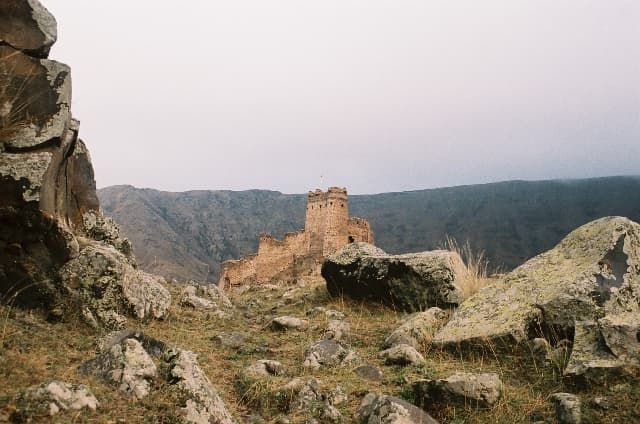
Şeytan Castle, also known locally as Şeytan Kalesi and in Georgian as ქაჯის ციხე (kajis tsikhe), is a remarkable hill castle situated on a precipitous cliff overlooking a canyon of the Kura River, approximately 1.5 kilometers northeast of the village of Yıldırımtepe in the Çıldır district of Ardahan Province, Turkey. Its strategic position on rugged terrain provided natural defenses that complemented its man-made fortifications, making it a formidable stronghold throughout its history.

The castle's name, translating to "Devil's Castle", stems from local folklore about an evil spirit or devil once seen in the area, a superstition that persists among the local population. This evocative name adds to the castle's mystique and cultural significance in the region.

Historical context and continuous use

While the exact date of Şeytan Castle's original construction remains uncertain, archaeological and architectural evidence suggests its origins might trace back to the Urartian period, given some of its foundational features. However, the current visible structures primarily date from the 13th century, a time when the region was under the control of Georgian kings. During this period, the castle likely functioned as a critical border fortress, guarding the frontier between competing realms.

Throughout its long history, the castle's location placed it at the crossroads of many empires and cultures. It has been governed or contested by the Medes, Persians, Macedonians, Romans, Sassanians, Georgians, Seljuks, Ilkhanids, Karakoyunlus (Black Sheep Turkomans), Akkoyunlus (White Sheep Turkomans), Safavids, and finally the Ottomans. Each successive ruler likely adapted and renovated the castle to suit their military and administrative needs, contributing to its layered architectural character.

Architectural features and layout

Şeytan Castle is notable for its integration with the natural landscape. The cliffs surrounding the castle were as crucial to its defense as its thick stone walls. Large sections of the walls, including the keep and the entrance gate, remain standing today, offering insight into medieval military architecture in the region.

The castle features machicolations atop the keep's walls, similar to those found in the nearby Kinzi Castle, which allowed defenders to launch projectiles or boiling substances on attackers below. Within the castle's enclosure, remnants of a cistern attest to sophisticated water storage solutions essential for sustaining inhabitants during sieges, while a chapel indicates the presence of religious practices within the fortress.

Additional features include a staircase descending to the water, which would have provided access to the river below, crucial for water supply and possibly escape routes. The castle also reportedly contained a prison, as noted by the Georgian historian Ekvtime Takaishvili, highlighting its role in regional governance and control.

Construction materials and techniques

The castle's construction utilizes local stone, carefully shaped and fitted to create robust defensive walls capable of withstanding prolonged assaults. The use of natural rock formations in the castle's design exemplifies medieval builders' skill in blending architecture with the environment to maximize defensive advantages.

Legends and cultural significance

The legend of a Georgian king's daughter buried within the castle walls, along with treasures of gold and valuables, has fueled illegal treasure hunting at the site. Despite this, the castle remains an important cultural landmark, embodying the complex history of the region where diverse empires and peoples intersected.

The castle's name and associated myths contribute to its allure for visitors and locals alike, preserving a sense of mystery and historical depth. Its continuous occupation from the Hellenistic era through the Ottoman period underscores its enduring strategic and symbolic importance.

Visiting Şeytan Castle today

Today, Şeytan Castle is freely accessible to visitors. A recently constructed dead-end road from the village of Yıldırımtepe improves access, although reaching the castle still requires a roughly 15-minute walk along a mountainous footpath. The journey rewards visitors with stunning views of the surrounding canyon and the opportunity to explore the well-preserved ruins firsthand.

The castle's remote setting and dramatic cliffside position make it a fascinating destination for those interested in medieval architecture, regional history, and natural beauty. Despite its partial ruinous state, the castle's substantial surviving features offer valuable insights into the defensive strategies and daily life of its former occupants.

Visitor information

  • Access: Freely accessible; requires a short hike from the nearest road.
  • Location: Approximately 1.5 km northeast of Yıldırımtepe village, Ardahan Province, Turkey.
  • Condition: Partially preserved with significant structural remains.

Historical mentions and research

The castle is mentioned in the chronicles of Alp Arslan dating back to 1064, indicating its strategic relevance during the Seljuk period. Georgian scholar Ekvtime Takaishvili documented the existence of a prison within the castle, adding to the understanding of its administrative functions.

Despite the limited detailed historical records, ongoing archaeological interest and local traditions continue to shed light on the castle's multifaceted past. Its architectural features link it to a broader network of fortifications in the Caucasus and Anatolian borderlands.

Frequently asked questions (FAQ)

How do I get to Şeytan Castle?
Şeytan Castle is located about 1.5 kilometers northeast of Yıldırımtepe village in Ardahan Province, Turkey. Visitors can reach the castle by a short hike of approximately 15 minutes from the end of a newly constructed dead-end road leading from the village.
What historical periods does Şeytan Castle span?
Şeytan Castle has been used continuously from the Hellenistic era through the Ottoman period, reflecting the influence of many empires including the Urartians, Georgians, Seljuks, and Ottomans.
What are the main architectural features of Şeytan Castle?
The castle features thick defensive stone walls, a keep with machicolations similar to Kinzi Castle, a chapel, cisterns, and a staircase leading down to the river, all integrated with the natural cliff landscape.
Is Şeytan Castle open to visitors?
Yes, Şeytan Castle is freely accessible to the public. Visitors should be prepared for a moderate hike along a mountainous footpath to reach the site.
Why is it called 'Devil's Castle'?
The name 'Devil's Castle' originates from a local legend about an evil spirit or devil sighted in the area, a superstition that remains part of local folklore.

Photo gallery

Şeytan Castle
Click to view

Photo by სერაფიტა (რუსუდან ბერიძე)•CC BY-SA 3.0

1 photo • Click any image to view in full screen

Information

Hill Castle

Address

Near Yıldırımtepe Köyü Yolu, Turkey

Loading map...

Visitor reviews

No reviews yet. Been here? Write the first review and help other travelers!

Write the first review

Visited this castle? Share your experience

Your review helps other travelers and adds first-hand knowledge to our encyclopedia.

Write a review

(5/5)

0/2000 characters

Your review will be visible after admin approval

Nearby castles

20.9 km

Altaş Castle

Near Altaş Köyü Yolu, Turkey

Altaş Castle, known locally as Altaş Kalesi, is situated on a somewhat circular hill on the northern bank of the river Kura, adjacent to the village of Altaş in the province of Ardahan, Turkey. The village was historically known as Ur, and the castle is often associated with this name, suggesting it may have been referred to as Ur Castle in earlier times. This castle is an example of early medieval fortification in the region, dating back to the 8th century.The castle's location was strategically significant, overseeing a key crossing where the road to the north, toward Hanak, traversed the river. This positioning indicates its role in controlling movement and trade routes in the area during the early medieval period.Architectural features and layoutThe remains of Altaş Castle reveal a distinctive circular plan, a feature uncommon among castles in this region. The castle's walls form a roughly circular enclosure, with a circular keep positioned on the southern side. This keep is a notable architectural element, as circular keeps were relatively rare in the area, highlighting a unique design approach for defensive purposes.The entrance to the castle appears to have been located opposite the keep, likely on the northern side, providing controlled access to the interior. Along the eastern wall, foundations of three wall towers have been identified, which would have enhanced the castle's defensive capabilities by allowing defenders to cover the curtain walls and approach routes.Construction materials and techniquesWhile detailed studies of the construction materials are limited, the castle's walls were likely built using local stone, a common practice in early medieval fortifications in Anatolia. The use of stone would have provided durability and resistance against attacks, while the circular design helped to deflect projectiles and reduce blind spots.Historical context and significanceThe exact date of construction for Altaş Castle remains uncertain due to limited historical records. However, archaeological evidence from surrounding settlements dating to the 7th and 8th centuries supports the hypothesis that the castle was constructed during this period, aligning with the early medieval era in Anatolia.The castle likely served as a military and administrative center, controlling the vital river crossing and nearby road to Hanak. Its presence would have been crucial for regional defense and the regulation of trade and travel routes in northeastern Anatolia during a time of political fragmentation and frequent conflicts.Historical mentions and research challengesAltaş Castle is sparsely documented in ancient sources, with only its name and location recorded. This scarcity of information poses challenges for historians and archaeologists attempting to reconstruct its full history and significance. Despite this, the castle's unique architectural features and strategic location provide valuable insights into early medieval fortifications in the region.Current condition and accessibilityToday, Altaş Castle remains in a state of ruin, with only partial walls and foundations visible. The circular keep and the foundations of the wall towers on the eastern side are among the most prominent surviving features. The site is freely accessible to visitors, although it is not heavily developed for tourism and lacks extensive facilities.While the ruins may not be visually spectacular compared to larger castles, the site is significant for its unique circular design and its role in the early medieval history of the Ardahan region. Visitors interested in castle architecture and Anatolian history will find the site particularly intriguing.Visiting Altaş CastleThe castle is located near the village of Altaş, accessible via the Altaş Köyü Yolu road. Visitors should prepare for a modest visit, as the site offers limited amenities and no formal guided tours. The surrounding landscape provides a scenic backdrop, with views over the river Kura and the surrounding hills.Exploring the castle offers a glimpse into the early medieval period's military architecture and the strategic importance of this region in northeastern Turkey.

Early Medieval (5th–10th c.)
Details
24.9 km

Kirnav Castle

Near D955, Turkey

Kirnav Castle, known locally as Kirnav Kalesi, is a historic fortress situated on a prominent hill northwest of the village of Çayağzi in the Ardahan province of northeastern Turkey. This hill castle occupies a strategic position overlooking the surrounding plains, commanding views of the nearby river crossing and the road leading north towards Hanak. The castle's location suggests it played a role in controlling important regional routes during its active use. Architectural features and layout The castle exhibits a somewhat triangular ground plan, a distinctive shape that likely reflects the topography of the hill it occupies and the defensive needs of its builders. Although much of the structure is now in ruins, scattered wall fragments indicate that the castle was once enclosed by substantial defensive walls. These walls appear to have been constructed using building techniques similar to those of Ardahan Castle, which is located nearby and dates to the same period. The masonry style, characterized by robust stonework and the use of mortar, aligns with 16th-century Ottoman military architecture. The castle's walls may have included towers or bastions at key points to enhance its defensive capabilities, though much of this detail is lost due to the ruinous state of the site. Historical context and significance The exact date of construction of Kirnav Castle remains uncertain, but architectural analysis and comparison with nearby fortifications suggest it was built during the 16th century, a time when the Ottoman Empire was consolidating control over this region. The castle likely served as a military outpost or watchtower to monitor and secure the important road leading north to Hanak, as well as to oversee the river crossing in the area. While there is a lack of detailed historical records specifically mentioning Kirnav Castle, its similarities with Ardahan Castle and its strategic placement imply that it was part of the Ottoman defensive network in northeastern Anatolia. This network was essential for controlling trade routes, military movements, and regional administration during the Renaissance period under Ottoman rule. Current condition and accessibility Today, Kirnav Castle is in a ruined condition. The scattered remains of its walls suggest that parts of the structure may have been deliberately destroyed, possibly with dynamite, which has contributed to the fragmentation of the site. Despite this, the castle remains freely accessible to visitors, who can explore the ruins and enjoy panoramic views of the Ardahan plains and surrounding landscape. The site offers a quiet and evocative glimpse into the region's past military architecture and provides opportunities for historical exploration and photography. Its hilltop position makes it a notable landmark within the local geography. Visitor information and surrounding area Kirnav Castle can be reached via the nearby D955 road and is located close to the village of Çayağzi. There are no formal visitor facilities or entrance fees, making it an open site for those interested in history and architecture. Visitors should prepare for uneven terrain and bring appropriate footwear for exploring the ruins safely. The castle's proximity to Ardahan and other historical sites in the region makes it a worthwhile stop for travelers exploring northeastern Turkey's rich cultural heritage. The surrounding area is characterized by natural beauty, including rolling plains and river valleys, which complement the historical experience.

Renaissance (15th–17th c.)
Details
28.6 km

Kazan Castle

Near D010, Turkey

Kazan Castle, locally called Kazan Kale, is a historic fortress situated on a strategic hill overlooking the southern bank of the Kura River in the province of Ardahan, Turkey. Positioned between the city of Ardahan and the village of Çamliçatak, this castle occupies a commanding location that once controlled important regional routes and river crossings. The exact date of Kazan Castle's construction remains uncertain, but archaeological evidence suggests it was established during the early medieval period, likely in the 8th or 9th century. The castle was built atop a pre-existing settlement, indicating the site's long-standing strategic importance. Notably, coins discovered at the site originating from Turkmenistan support the theory that Turkmen groups were responsible for its foundation during this time. Architectural features and surviving structures Today, Kazan Castle is largely in ruins, with the most prominent remaining feature being a square tower approximately 15 meters tall. This tower is accessible to visitors and provides insight into the castle's original defensive design. The tower's robust stone masonry and simple, sturdy form are characteristic of early medieval military architecture in the region. The castle likely included other fortifications such as curtain walls, gates, and possibly additional towers, although these have not survived or have yet to be excavated. The tower's elevated position would have offered extensive views of the surrounding landscape, essential for monitoring movement along the Kura River and nearby routes. Historical context and significance The location of Kazan Castle near the Kura River placed it at a crossroads of cultural and military interactions between various powers in the Caucasus and Anatolia during the early medieval period. The presence of Turkmen coins suggests connections with Central Asian peoples who migrated westward during this era, contributing to the castle's historical narrative. While detailed records of the castle's role in specific historical events are scarce, its enduring presence highlights its importance as a regional stronghold. It may have served as a defensive outpost, a local administrative center, or a refuge during periods of conflict. Access and visitor information Kazan Castle is freely accessible to the public, though reaching the site requires a moderate hike. There are no roads immediately adjacent to the castle, so visitors must walk for at least half an hour through fields and light woodland from the nearest road. Using a GPS device is advisable to navigate the rural terrain effectively. The relatively remote location of the castle means it remains off the main tourist paths, offering a quiet and contemplative experience for visitors interested in early medieval fortifications and the history of the Ardahan region. Preservation and current condition The castle is classified as ruins, with only the square tower still standing in a well-preserved state. There is limited evidence of restoration, and the site remains largely in its original ruined condition. This state provides valuable archaeological insight but also underscores the need for ongoing preservation efforts to protect the remaining structure from natural decay.

Early Medieval (5th–10th c.)
Details

