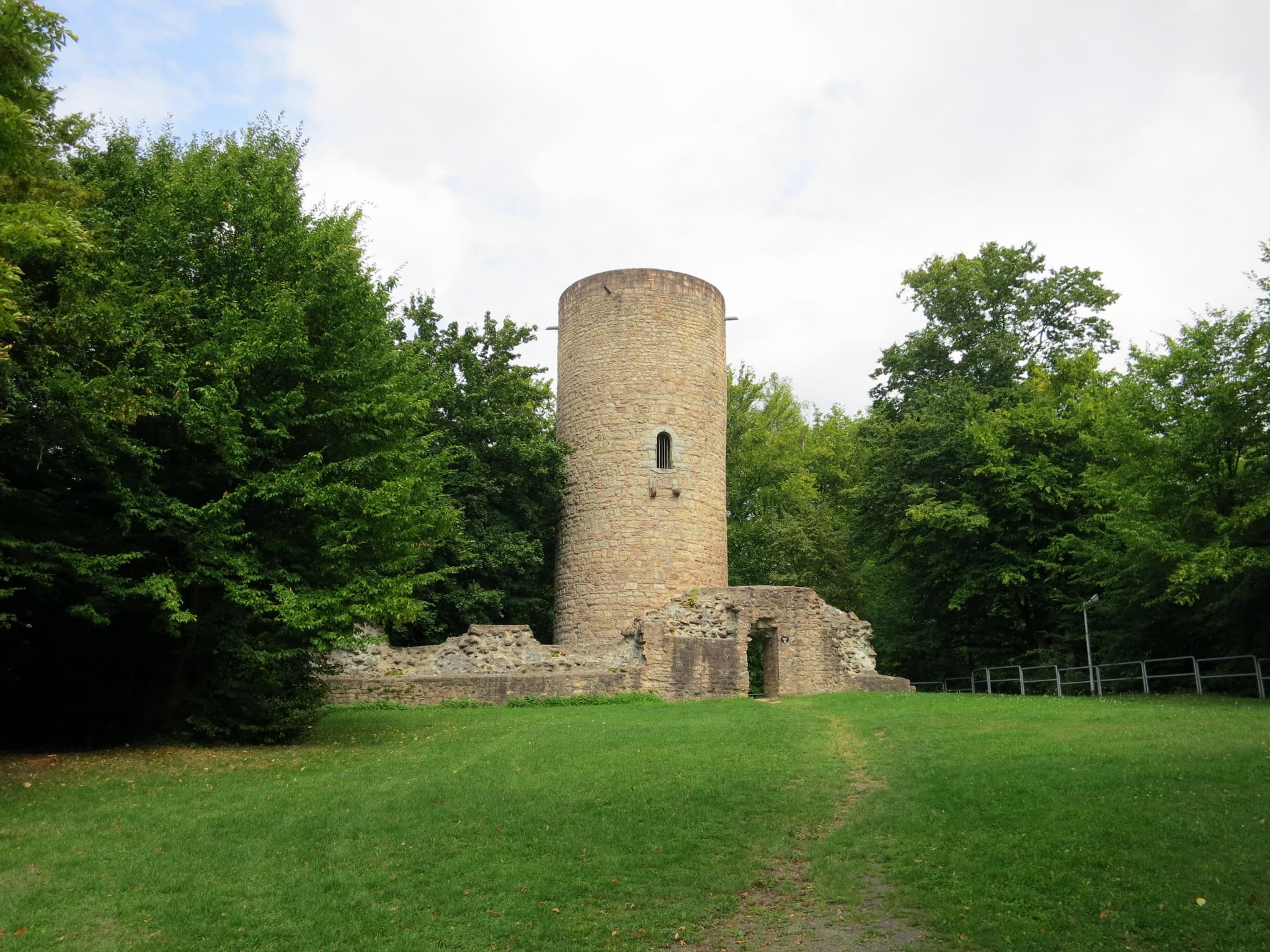
Schloss Steinau
Schloss Steinau stands as a remarkable example of a Renaissance hill castle with medieval roots, located in the town of Steinau an der Straße in modern-day Germany. The castle's origins trace back to the medieval period, though its exact original form remains uncertain. It is believed that the initial foundations were laid by the influential Abbey of Fulda, a religious institution with significant regional power. By the late 13th century, the castle came under the ownership of the Counts of Rieneck, a noble family prominent in the area.
The castle's ownership transitioned through marriage when Elisabeth of Rieneck married Ulrich I of Hanau, thereby integrating Schloss Steinau into the possessions of the House of Hanau. This noble family used the castle primarily as a secondary residence, providing a retreat and administrative center distinct from their main seats. Notably, Schloss Steinau, like other Hanau castles such as Schwarzenfels and Windecken, functioned as a widow’s seat, serving as a residence for countesses after their husbands' deaths.
Renaissance transformation and architectural evolution
The castle’s current form largely dates from the 16th century, reflecting the Renaissance architectural style that replaced much of the original medieval fortress while preserving some earlier elements. A significant construction phase occurred under the guardianship of Count Reinhard zu Solms, who oversaw the works on behalf of Count Philipp III of Hanau-Münzenberg. The local master builder Asmus likely directed the execution of these designs. Around the early 1600s, a connecting building was completed, linking the main castle complex to the northern city gate, which had previously stood separate.
Structural layout and defensive features
Schloss Steinau is arranged in a distinctive pentagonal layout, inspired by early Italian Renaissance fortification concepts. The castle is encircled by a high dry moat lined with zwinger walls, creating an enclosed defensive zone between two walls that also follow the pentagonal shape. Access across the moat is provided by drawbridges at two gatehouses and a third bridge connecting to the town on the northern side.
Among the surviving medieval features integrated into the Renaissance complex is the imposing bergfried or keep. This large defensive tower has a square base and rises to about 40 meters, including a later-added Baroque-style roof. The bergfried contains eight floors, with a stair tower added in 1571 to provide access to its elevated entrance. The top floor once housed a watchman’s apartment, originally freestanding within the tower but now enclosed by a viewing gallery approximately 32 meters above ground. Above this sits an octagonal half-timbered structure topped by a roofed dome, serving as an observation point with wide views over Steinau and the surrounding hills.
Courtyards and residential wings
Within the pentagonal enclosure lies a zwinger courtyard framed by four bastion-like economic buildings positioned at four corners of the pentagon, each with attached stair towers. The fifth corner contains the field gate, providing an additional entrance. Four stair towers within the courtyard facilitate vertical movement between the structures. Originally, the castle had a fully enclosed pentagonal ring of buildings; however, the southern half-wing was demolished in the 19th century.
The west wing was constructed between 1523 and 1528 under Count Philipp II of Hanau-Münzenberg. This wing features a hall building with late Gothic-style window arches typical of the mid-1520s. A prominent three-story oriel window adorns the north gable. The ground floor contains a two-aisled hall with a net vault ceiling supported by five columns. The floor above housed state chambers for important guests, while the second floor contained a banquet hall with surviving stucco ceiling decorations.
By 1546, a kitchen wing was added south of the hall building, featuring a large fireplace and an ornate oriel window. The count’s private apartments were located above the kitchen, blending domestic and official functions. The north and east wings were completed between 1551 and 1553, finalizing much of the Renaissance residential and administrative complex.
Outbuildings and later uses
Outside the castle walls to the front stand the Marstall (stable), built in 1557-1558, and a livestock yard with buildings from the 16th and 18th centuries. The Marstall housed a marionette theater for several decades in the 20th century and currently contains a large multipurpose room with a vaulted sandstone ceiling and city administration offices above.
Strategic military significance
Strategically, Schloss Steinau was situated to guard the southern approach to the town, historically the most vulnerable direction for attack. The northern side was naturally protected by the difficult terrain of the Kinzig floodplain. The bergfried’s upper observation post formed part of an early warning system, maintaining direct line-of-sight with four watchtowers outside the city defenses. This system allowed rapid communication of danger signals, alerting the town to approaching threats well in advance.
Modern management and cultural heritage
Since 1957, the castle has been under the care of the State Palaces and Gardens of Hesse. It serves educational and commemorative purposes, including a museum and a memorial to the Brothers Grimm, who are closely connected to the region. Since 2015, Schloss Steinau has hosted a major exhibition dedicated to the lives and works of the Brothers Grimm, featuring original documents and artworks from collections in Kassel and Bad Homburg.
Today, Schloss Steinau remains a well-preserved example of Renaissance castle architecture with medieval origins, offering visitors insights into noble life, defensive design, and regional history in the heart of Germany.
Frequently asked questions (FAQ)
- What are the opening hours of Schloss Steinau?
- Schloss Steinau is generally open to visitors during regular museum hours, typically from 10:00 to 16:00 daily, but it is advisable to check the official website for current times and any seasonal variations.
- How can I reach Schloss Steinau by public transport?
- Visitors can reach Schloss Steinau by train or bus to the town of Steinau an der Straße, followed by a short walk to the castle located near the town center.
- What is the historical significance of Schloss Steinau?
- Schloss Steinau is historically significant as a Renaissance castle with medieval origins, associated with the Counts of Rieneck and the House of Hanau, and as a cultural site connected to the Brothers Grimm.
- Is Schloss Steinau accessible for visitors with mobility issues?
- While efforts have been made to improve accessibility, some parts of Schloss Steinau, such as the bergfried tower and older sections, may present challenges for visitors with limited mobility. It is recommended to inquire in advance about specific accommodations.
- Can I attend special exhibitions at Schloss Steinau?
- Yes, Schloss Steinau hosts special exhibitions, including a major permanent exhibition dedicated to the Brothers Grimm, showcasing original documents and artworks. Visitors should check the castle's event calendar for current exhibitions.
Information
Sources & official resources
Verify the information above using these authoritative references.
Loading map...
Visitor reviews
No reviews yet. Been here? Write the first review and help other travelers!
Write the first reviewVisited this castle? Share your experience
Your review helps other travelers and adds first-hand knowledge to our encyclopedia.