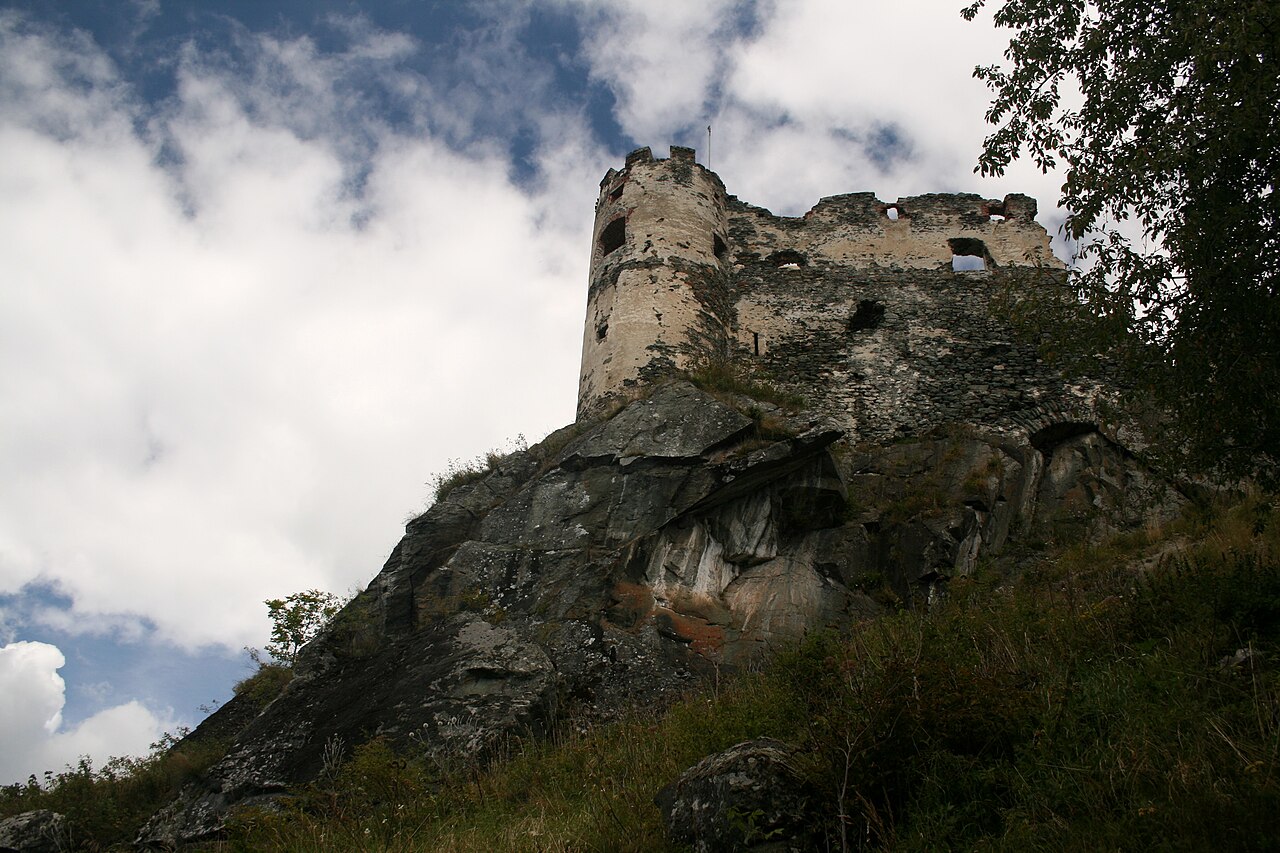
Schloss Rothenfels
Schloss Rothenfels is a remarkable example of a medieval hill castle situated near the town of Oberwölz in the Austrian federal state of Styria. Constructed in the late 12th century by German-speaking settlers, it occupies a strategic position atop a reddish iron-rich rocky hill, which inspired its name, meaning "Red Rock." This location was chosen for its natural defensive advantages, overlooking the surrounding valley and controlling important regional routes.
The castle's origins trace back to a period of intense territorial consolidation in Central Europe. The land originally belonged to the Bishopric of Freising, granted by King Henry II in 1007, making the site an important ecclesiastical holding. By the 12th century, the castle emerged as a fortified stronghold, serving as a seat of local administration and law enforcement within the Wölz valley. The earliest documented burgrave, named Heinrich, appears in records from 1140, indicating the establishment of formal governance early in the castle's history.
Architectural evolution and features
The initial construction centered around a central tower or keep, surrounded by living quarters and economic buildings. Over the centuries, the castle underwent several expansions and modifications, especially notable in the mid-14th century when the chapel dedicated to St. Catherine was enlarged. This chapel, located in the southwest corner of the upper floor, is a significant architectural and artistic feature, showcasing 14th-century Gothic ribbed vaulting with truncated ribs and a polygonal apse. The preservation of wall paintings, including a restored depiction of St. Catherine of Alexandria holding her traditional spiked wheel and painted crosses symbolizing apostles, highlights the castle's religious importance.
The main castle complex divides into a higher citadel and a lower outer bailey. The citadel's design follows the natural contours of the rocky outcrop, with a steep cliff to the south providing formidable natural defense. Defensive architecture includes a triple ring of protective walls on the west, north, and east sides, complemented by a surrounding moat. The southern cliff serves as a natural barrier, eliminating the need for fortifications on that side. Access was controlled through a medieval gate tower in the northeast, approached by a bridge.
Residential and ceremonial spaces
The southern residential wing adjoins a once-formidable defensive tower on the eastern corner, extended westward to create an enclosed courtyard featuring a rectangular water basin essential for daily life. A pointed Gothic arch portal with finely chamfered stone edges on the courtyard's south wall reveals the castle's stylistic evolution.
The court chamber on the second upper floor boasts an 18th-century stucco ceiling divided into decorative sections, with a central fresco from 1725 depicting the hunting scene "Diana with Honoring Knights." This room also houses large archival cabinets from the 17th or 18th centuries, bearing painted inscriptions that testify to the extensive judicial records maintained here.
The knights' hall displays an impressive collection of armor and features neo-Gothic wooden paneling from the 19th century, reflecting historicist aesthetic tastes. Many other rooms were renovated between the 17th and 19th centuries, preserving original elements such as windows, doors, floorboards, and tiled stoves, blending historical authenticity with modern adaptations.
Historical significance and ownership
Throughout the 15th century, Schloss Rothenfels changed hands among various noble families and burgraves, mirroring the turbulent political landscape of the region. From 1656 until the secularization of church lands in 1803, the castle functioned as a significant regional court seat under ecclesiastical authority.
Following the dissolution of church control, the castle became state property and was auctioned in 1823. It subsequently passed through multiple private owners until the Steiner family acquired it in 1965. The family has maintained the estate, supporting its preservation through a forestry business linked to the property.
Defensive structures and landscape integration
Schloss Rothenfels is a prime example of a castle integrating natural topography with man-made fortifications. The steep southern cliff acts as a natural defense, while the constructed walls and moat provide layered protection on other sides. The castle's position at an elevation of approximately 812 meters above sea level, surrounded by peaks rising to about 1,305 meters, offers commanding views and strategic advantage.
The use of local stone and wood is consistent with regional building traditions, and the castle's reddish rock foundation rich in iron minerals is a defining characteristic. The 19th-century additions of crenellations and other decorative elements reflect the neo-Gothic historicist style, enhancing the castle's aesthetic appeal while respecting its medieval origins.
Cultural heritage and current status
Today, Schloss Rothenfels stands as a well-preserved hill castle embodying centuries of architectural evolution and historical significance. Its combination of Gothic architectural features, religious art, and defensive design makes it an important cultural landmark in Styria.
Visitors can appreciate the castle's layered history, from its medieval origins through its role as a judicial center, to its 19th-century aesthetic transformations. The preservation of original structural elements alongside later renovations offers a tangible connection to the past, while the surrounding natural landscape enhances the site's dramatic presence.
Schloss Rothenfels continues to be privately owned by the Steiner family, who have preserved the estate and its forestry resources, ensuring the castle's survival and accessibility for future generations interested in medieval architecture and Austrian history.
Frequently asked questions (FAQ)
- How do I get to Schloss Rothenfels?
- Schloss Rothenfels is located near Oberwölz in Styria, Austria. It is accessible by regional roads, and visitors can reach the castle by car or local transport from Oberwölz town center.
- What architectural styles are visible at Schloss Rothenfels?
- The castle primarily features Gothic architectural elements, including ribbed vaulting in the chapel and pointed arch portals. Additionally, 19th-century neo-Gothic historicist modifications are present, such as crenellations and wooden paneling.
- When was Schloss Rothenfels built?
- Construction of Schloss Rothenfels began in the late 12th century, with significant expansions in the 14th century and renovations through the 17th to 19th centuries.
- Is Schloss Rothenfels open to the public?
- As a privately owned estate, public access to Schloss Rothenfels may be limited. Visitors should check for any available tours or events organized by the owners or local tourism offices.
- What is the historical significance of Schloss Rothenfels?
- Schloss Rothenfels served as a fortified stronghold, local administrative seat, and regional court under ecclesiastical rule. Its history reflects the political and religious dynamics of medieval and early modern Styria.
Information
Sources & official resources
Verify the information above using these authoritative references.
Loading map...
Visitor reviews
No reviews yet. Been here? Write the first review and help other travelers!
Write the first reviewVisited this castle? Share your experience
Your review helps other travelers and adds first-hand knowledge to our encyclopedia.