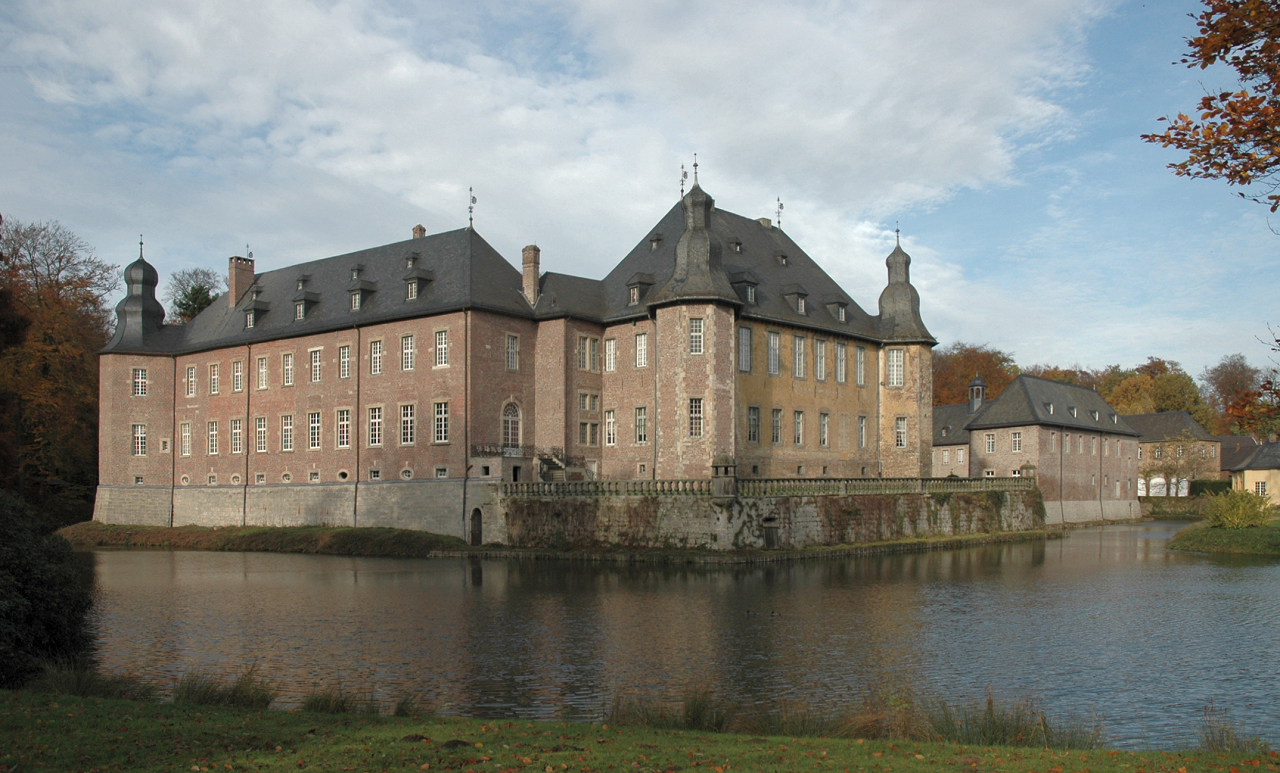
Schloss Rheydt
Schloss Rheydt stands as a remarkable example of a Renaissance palace with deep historical roots tracing back to the 12th century in Mönchengladbach, Germany. Originally established as a castle in 1060, the site evolved significantly over centuries, with its first documented mention dating to 1180 by the Cologne Archbishop Philip I. This early record highlights the castle's role as a seat of power and revenue collection under the Lord of Rheydt, with William of Heppendorf noted as the first lord by name. The castle's transformation from a medieval fortress to a Renaissance palace reflects the architectural and social changes of the region over time.
Historical development and noble ownership
Throughout its history, Schloss Rheydt served as the family seat for several noble families, most notably the Bylandt-Rheydt dynasty, who ruled the area for over 300 years. Their long tenure left a lasting impact on the castle's design and status. The Bylandt family's influence culminated in the significant renovations commissioned by Otto von Bylandt in the 16th century, which gave the palace much of its current Renaissance character.
Medieval origins and early mentions
The castle's origins as a medieval fortress are evidenced by its initial construction around 1060, with the earliest surviving documentation from 1180. During this period, the castle functioned primarily as a defensive stronghold and administrative center. Its strategic location in the Rhineland region made it a key asset for local rulers and the archbishopric of Cologne.
Architectural transformation by Maximilian Pasqualini
A pivotal moment in Schloss Rheydt's history came with the involvement of Maximilian Pasqualini (1534–1572), an Italian architect and son of Alessandro Pasqualini. Under the commission of Otto von Bylandt, Maximilian Pasqualini undertook extensive renovations that reshaped the castle into a Renaissance palace. His work combined defensive features with elegant residential elements, reflecting both the military needs and the aesthetic tastes of the period.
Exterior enhancements
Pasqualini's architectural contributions include the creation of the existing exterior facade, characterized by Renaissance symmetry and ornamentation. He added casemates and bastions, reinforcing the castle's defensive capabilities while integrating these features into the palace's aesthetic. A moat was constructed around the palace, enhancing both its security and visual appeal.
Interior renovations
Inside, Pasqualini introduced numerous refinements such as fireplaces, statues, and various paintings, which elevated the palace's grandeur. These interior elements have been preserved remarkably well, offering insight into Renaissance artistic and architectural sensibilities. The blend of functionality and decoration exemplifies the transition from medieval fortress to noble residence.
Later history and preservation efforts
During the 19th century, Schloss Rheydt experienced a period of decline as ownership changed hands multiple times. The financial burden of maintaining such an extensive property led to gradual disrepair. However, the significance of the palace was recognized by the local community, and in 1917 the town of Rheydt purchased the property from its last private owner.
20th-century restoration and museum conversion
Following acquisition by the municipality, Schloss Rheydt underwent various restoration projects, notably between 1988 and 1993. These efforts aimed to preserve the architectural integrity of the palace while adapting parts of it for public use. Today, large sections of the castle serve as museum spaces, allowing visitors to explore its rich history and architectural features.
Architectural significance and cultural value
Schloss Rheydt represents a rare example of a Renaissance palace that retains significant elements from its original medieval structure. The combination of defensive bastions and ornate Renaissance facades illustrates the evolution of castle architecture in the Rhineland. Its preservation offers valuable insights into the lifestyles of noble families and the architectural trends from the Middle Ages through the Renaissance.
Current condition and visitor experience
The palace is well preserved thanks to ongoing restoration and maintenance. Visitors can appreciate the harmonious blend of military and residential architecture, the moat, and the detailed interior decorations. The museum exhibits provide context on the castle's history, noble lineage, and architectural transformations.
Frequently asked questions (FAQ)
- When was Schloss Rheydt originally built?
- Schloss Rheydt was originally constructed around 1060, with its first documented mention in 1180.
- Who was responsible for the Renaissance renovations of Schloss Rheydt?
- The Renaissance renovations were carried out by Maximilian Pasqualini, an Italian architect, under the commission of Otto von Bylandt in the 16th century.
- What architectural style characterizes Schloss Rheydt today?
- Schloss Rheydt is primarily characterized by Renaissance architectural style with preserved medieval defensive features.
- Is Schloss Rheydt open to the public?
- Yes, Schloss Rheydt is open to visitors, with large parts of the palace converted into museum areas showcasing its history and architecture.
- How has Schloss Rheydt been preserved over time?
- The palace underwent significant restoration between 1988 and 1993 after being purchased by the town in 1917, ensuring its well-preserved condition today.
Information
Sources & official resources
Verify the information above using these authoritative references.
Loading map...
Visitor reviews
No reviews yet. Been here? Write the first review and help other travelers!
Write the first reviewVisited this castle? Share your experience
Your review helps other travelers and adds first-hand knowledge to our encyclopedia.