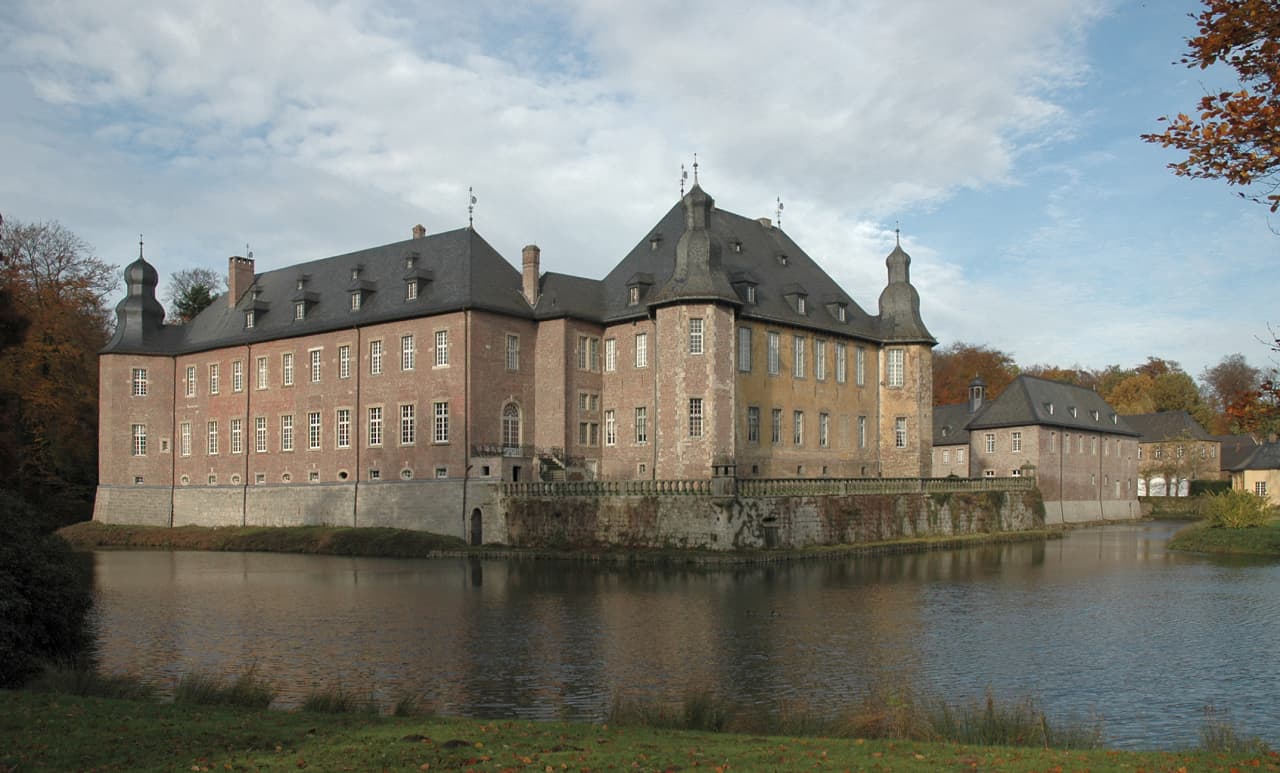
Dyck Castle
Dyck Castle (German: Schloss Dyck) is a prominent moated castle located in the municipality of Jüchen, within the Rhein-Kreis Neuss district of North Rhine-Westphalia, Germany. Situated strategically between the cities of Grevenbroich and Mönchengladbach, the castle stands as a significant monument reflecting the architectural and cultural evolution of the Rhineland region over nearly a millennium.
The origins of Dyck Castle trace back to the 11th century, with the earliest recorded mention dating to 1094 when the knight Hermannus de Disco was documented by the Archbishop of Cologne as lord of a modest fortification on the site. This initial structure was a simple defensive stronghold, which over the centuries was transformed into a fortified moated castle, adapting to the shifting political and military landscape of the High Medieval period.
Medieval origins and early fortifications
The castle's early history is marked by its role within the fragmented territorial politics of the Rhineland. In 1383, Dyck Castle became the focal point of a significant siege involving the allied forces of the cities of Aachen and Cologne, alongside the Archbishop Friedrich III von Saarwerden and Duke William I of Guelders and Jülich. The siege was prompted by accusations against Lord Gerard van Dyck of acting as a robber knight, a common charge used to justify military action against unruly nobles during the period.
Following the death of Gerard van Dyck without male heirs, the castle passed by inheritance to Johann V von Reifferscheidt. This transition marked the beginning of the castle's long association with the Salm-Reifferscheid family, who maintained ownership for over 900 years, shaping the castle's development and status significantly.
Architectural evolution: baroque and rococo transformations
During the 17th century, Dyck Castle underwent extensive renovations that transformed it into an early baroque residence. Under the direction of Count Salentin of Salm-Reifferscheid, the main building was expanded into a four-wing complex. This period saw the renewal of essential functional structures including the stables, watch rooms, and the brewery, reflecting the dual residential and economic functions of the estate.
The 18th century brought further refinement with the castle's transformation into a rococo residence. This era is noted for the introduction of elegant interior decorations, including fine tapestries and exquisite furniture that exemplified the rococo style's emphasis on ornate and graceful aesthetics. Although some original furnishings have been lost over time, including the sale of the renowned library and the armory in the late 20th century, the castle retains much of its historic character.
The castle grounds and cultural landscape
Dyck Castle is uniquely situated on four islands, with the main building, forecourts, outbuildings, and stables spread across these water-surrounded areas. This layout not only provided defensive advantages but also contributed to the castle's picturesque setting.
The surrounding English landscape garden was designed by Prince Joseph zu Salm-Reifferscheidt-Dyck and represents an important example of 18th-century landscape architecture. The garden complements the castle's historic ambiance and serves as a cultural landmark within the region.
Modern usage and preservation efforts
In 1999, Dyck Castle transitioned from a private noble residence to a public cultural site when it became the Centre for Garden Art and Landscape Design. This change was facilitated by the last heiress of the family, Countess Marie Christine Wolff Metternich, who established a foundation to ensure the castle's preservation and public accessibility.
Today, the castle complex includes a hotel and hosts numerous events, exhibitions, and meetings, attracting visitors interested in history, architecture, and garden design. The castle and its park remain open to the public, offering a rich experience of Rhineland heritage and landscape artistry.
Historical significance and territorial context
Dyck Castle historically served as the center of the Salm-Reifferscheid-Dyck territory, a small independent domain known as the Dycker Ländchen. This territory was strategically positioned between the powerful entities of the Electorate of Cologne, Guelders, and Jülich. The castle's location and ownership reflect the complex feudal and political arrangements of the Rhineland during the Middle Ages and early modern period.
The castle's long-standing ownership by the Salm-Reifferscheid family is notable for its continuity, spanning over nine centuries. This continuity allowed for the preservation and adaptation of the castle through various architectural styles and historical epochs, making it a valuable case study in the evolution of noble residences in Germany.
Frequently asked questions (FAQ)
- What is the historical significance of Dyck Castle?
- Dyck Castle, dating back to the 14th century, is a remarkable example of medieval architecture and has played a vital role in the region's history. It has served various purposes over the centuries, including a noble residence and a cultural venue, showcasing the evolution of Jüchen's heritage.
- When was Dyck Castle built?
- Dyck Castle was originally constructed in the early 14th century, with significant renovations occurring in the 17th century. Its long history reflects the architectural styles and trends of the periods it has endured, making it a fascinating site for history enthusiasts.
- What are the opening hours for Dyck Castle?
- Dyck Castle is open to visitors from Tuesday to Sunday, typically from 10 AM to 6 PM. However, it's advisable to check the official website for any seasonal variations or special closures.
- Can I visit Dyck Castle with children?
- Yes, Dyck Castle is family-friendly and welcomes visitors of all ages. There are engaging exhibits and open spaces that children can enjoy, making it a great educational experience for families.
- Is it possible to take guided tours at Dyck Castle?
- Yes, guided tours are available at Dyck Castle, offering visitors a deeper insight into its rich history and architecture. It's recommended to book in advance, especially during peak tourist seasons, to ensure availability.
- What is the best time to visit Dyck Castle?
- The best time to visit Dyck Castle is during the spring and early autumn when the weather is mild and the gardens are in full bloom. Additionally, these seasons tend to have fewer crowds, allowing for a more enjoyable experience.
- Are there any nearby attractions to Dyck Castle?
- Yes, there are several nearby attractions including the beautiful gardens of Dyck Castle and the scenic natural park surrounding it. Visitors can also explore the charming town of Jüchen, which offers a variety of shops and restaurants.
- How much are the ticket prices for Dyck Castle?
- Ticket prices for Dyck Castle vary depending on age and group size, with discounts available for children, students, and seniors. It's best to check the official website for the most current pricing and any special promotions.
- How do I get to Dyck Castle?
- Dyck Castle is easily accessible by car and public transport, located near major highways and train stations. Visitors can also enjoy scenic bike routes leading to the castle, making it a popular destination for cycling enthusiasts.
Photo gallery

Information
Loading map...
Visitor reviews
No reviews yet. Been here? Write the first review and help other travelers!
Write the first reviewVisited this castle? Share your experience
Your review helps other travelers and adds first-hand knowledge to our encyclopedia.



