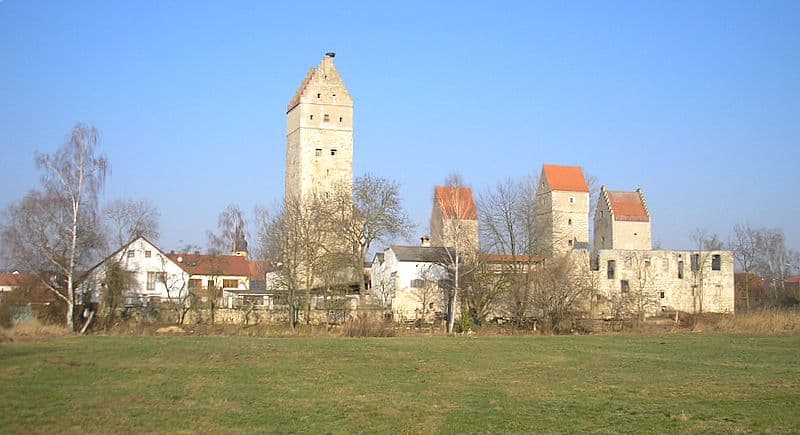
Nassenfels Castle
Nassenfels Castle stands as a remarkable example of a high medieval hill castle located in the village of Nassenfels in Bavaria, Germany. Its origins date back to the 12th century, with the first documented mention in 1245 during a siege when Count Gebhard III of Hirschberg was killed. The castle's strategic position atop a hill overlooking the village reflects its role in regional defense and administration throughout the Middle Ages.
The castle's history is deeply intertwined with the ecclesiastical authorities of Eichstätt, who held sway over the region for centuries. From the late 12th century, episcopal vassals known as the von Nassenfels family managed the site, serving the bishops of Eichstätt. Significant expansions occurred under bishops such as Conrad II of Pfeffenhausen around 1300 and Friedrich IV von Oettingen circa 1400, who commissioned the construction of the castle's three distinctive towers. These expansions transformed Nassenfels into a formidable fortified residence and administrative center.
Historical significance and development
The site of Nassenfels Castle has a history of human occupation extending far beyond the medieval period. It was originally a Roman settlement known as Vicus Scuttarensium, part of the Roman frontier defense system along the Rhaetian Limes. Archaeological evidence reveals the presence of a small Roman fort (castellum) built in the 2nd century AD, constructed from earth and timber to support military and trade activities. This fort was eventually abandoned following the establishment of the larger nearby Pfünz Roman Fort (Vetoniana).
During the early Middle Ages, the area saw resettlement with the construction of Carolingian-era pit houses and a small church featuring spolia from a Roman villa, indicating continuity of habitation and reuse of Roman materials. The medieval castle itself first appears in records in 1245, marking its importance in regional conflicts and governance.
Medieval expansions and restorations
Between the 13th and 15th centuries, Nassenfels Castle underwent multiple phases of reconstruction and enlargement. The current visible form largely dates from around 1400, when the three main towers were built. The castle was restored again in 1464 and later in 1699. The 1699 restoration included the addition of the Kastenhaus, a building used as an administrative office by Jakob Engel, an official of the bishopric.
The castle served as the seat of local officials representing the bishop until the secularization reforms of 1804. Afterward, it briefly functioned as a revenue office before being sold to private owners in 1806. The transition to private ownership led to the castle's decline, with much of its stonework quarried for nearby railway construction. A lightning strike in 1932 destroyed the Kastenhaus, which was never rebuilt.
Architectural features and layout
Nassenfels Castle is characterized by its rectangular enclosure and was originally designed as a water castle, surrounded by a moat that has mostly silted up or been filled in. The surviving defensive walls reach heights of up to five meters and include a zwinger—a narrow outer defense zone before the main curtain walls. The western curtain wall was removed in the 19th century and replaced by residential buildings.
The castle's most prominent architectural elements are its three wall towers and a central bergfried (a tall defensive tower), each topped with steep gable roofs featuring stepped brick gables. The bergfried rises approximately 37 meters to the roof ridge and was constructed atop the remains of an earlier tower. Its ground floor served as a chapel, evidenced by a chancel arch and vaulting remains, accessible through an original southern doorway.
Originally, a small Romanesque chancel tower church stood on the site, later transformed around the 1300s into the larger bergfried tower. A subsequent chapel replaced the initial one but was secularized and demolished by 1808, with its exact location now uncertain. Access to the bergfried's elevated entrance on the eastern side was via a passage connected to a now-demolished administrative residence.
The castle's construction showcases a contrast in masonry: the bergfried is built with carefully cut limestone blocks arranged in regular courses, while the surrounding walls consist of irregular rubble stone. This architectural detail highlights the bergfried's importance as a defensive and symbolic structure.
Later buildings and modifications
The Kastenhaus, built in 1699 near the castle, served as the steward's office but was destroyed by lightning in 1932. Today, only parts of its enclosing walls remain. Most other interior buildings date from the 19th century, reflecting the site's transformation following secularization and private ownership.
Archaeological discoveries and natural environment
Extensive archaeological excavations beginning in the 1980s, led by Karl Heinz Rieder, have uncovered artifacts spanning a vast timeline—from prehistoric times over 70,000 years ago, through the Celtic period around 2000 BC, to Roman and medieval occupations. These finds underscore the site's long-standing significance as a human settlement and defensive location.
Geological studies beneath the castle revealed an ancient coral reef formation dating back approximately 145 million years, adding a unique natural history dimension to the site. This geological feature is rare and enhances the scientific interest in the castle's location.
Current condition and preservation efforts
Today, Nassenfels Castle remains a partially preserved high medieval hill castle with significant ruins that convey its historical and architectural importance. Restoration efforts since the late 20th century have focused on stabilizing the remaining defensive walls and reconstructing parts of the castle's walkway, completed in 1990. These efforts aim to preserve the castle's medieval character while making it accessible and informative for visitors.
Despite the loss of some structures, such as the Kastenhaus and the western curtain wall, the castle's surviving towers and bergfried provide a striking silhouette and insight into medieval fortification techniques. The site continues to attract historians, archaeologists, and tourists interested in the layered history of Bavaria's medieval castles.
Visiting information and cultural significance
Nassenfels Castle is an important cultural heritage site that reflects the complex history of ecclesiastical power, medieval military architecture, and regional development in Bavaria. Its location near the village of Nassenfels makes it accessible for visitors interested in exploring medieval fortifications and archaeological sites.
The castle's combination of Roman, medieval, and natural history elements offers a unique educational experience. Visitors can appreciate the architectural evolution from Roman fortifications to a high medieval hill castle and learn about the site's role in the religious and secular administration of the region.
Frequently asked questions (FAQ)
- When was Nassenfels Castle originally built?
- Nassenfels Castle was originally constructed in the 12th century, with the first recorded mention in 1245 during a siege.
- What architectural style characterizes Nassenfels Castle?
- The castle features medieval architectural elements typical of high medieval hill castles, including a central bergfried with Romanesque influences and stepped brick gables.
- Is Nassenfels Castle open to visitors?
- Yes, Nassenfels Castle is accessible to visitors who can explore its partially preserved ruins and learn about its history through onsite information.
- What is the historical significance of Nassenfels Castle?
- Nassenfels Castle played a key role as a fortified seat of the bishops of Eichstätt and reflects centuries of ecclesiastical and regional power from the 12th to 18th centuries.
- Are there any archaeological findings at Nassenfels Castle?
- Extensive excavations have revealed artifacts from prehistoric, Celtic, Roman, and medieval periods, highlighting the site's long history of human occupation.
Photo gallery

Information
Website
Visit websiteSources & official resources
Verify the information above using these authoritative references.
Loading map...
Visitor reviews
No reviews yet. Been here? Write the first review and help other travelers!
Write the first reviewVisited this castle? Share your experience
Your review helps other travelers and adds first-hand knowledge to our encyclopedia.


