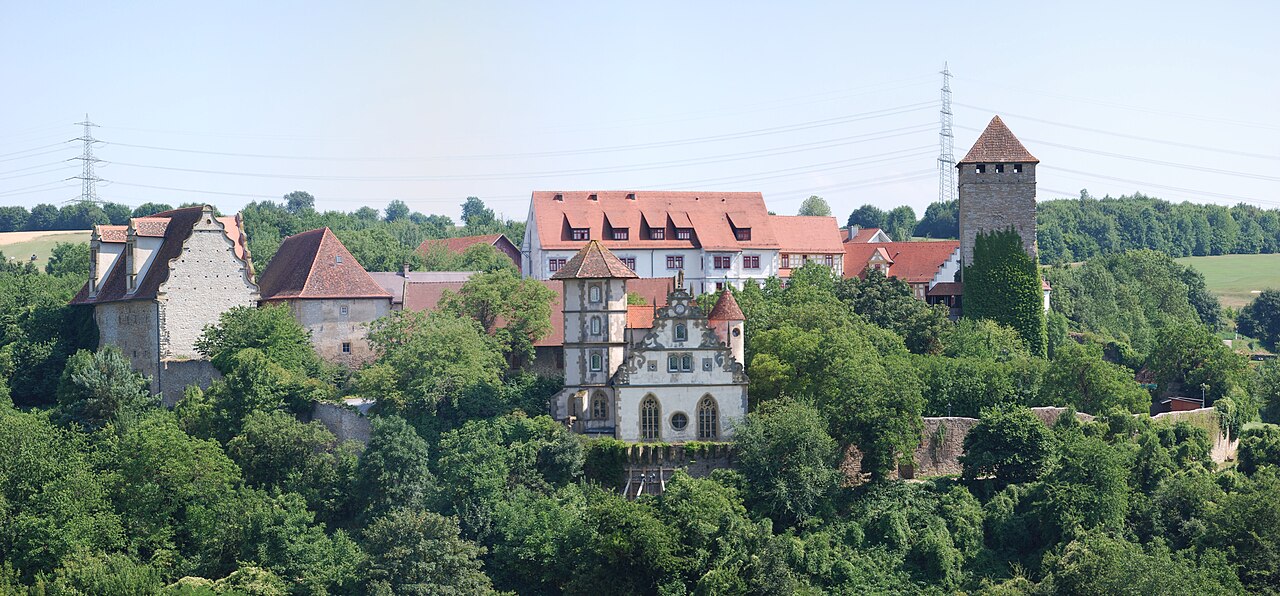
Schaubeck Castle
Schaubeck Castle stands as a remarkable example of a 13th-century hill castle in Kleinbottwar, Germany, embodying a rich architectural and historical legacy that spans from the High Medieval period through the Renaissance and Baroque eras. Erected on the foundations of a Roman villa, the castle's origins are deeply intertwined with the region's ancient past, reflecting a continuity of occupation and strategic significance over centuries.
The earliest documented mention of Burg Schaubeck dates to 1272, when the Schauwecker family, ministeriales serving the Margraviate of Baden at Besigheim, established the fortress atop a steep hillside. This positioning leveraged the natural topography for defense and oversight of the surrounding landscape. The castle's initial function was predominantly military and administrative, serving as a stronghold for feudal lords and their retainers.
Medieval origins and strategic importance
The castle's construction on the remains of a Roman country house is a testament to the site's long-standing significance. Archaeological evidence confirms the reuse of Roman foundations and building materials, integrating ancient craftsmanship into medieval fortifications. The surviving fragments of the original medieval tower, primarily wall sections and foundational stones, highlight the castle's defensive priorities during the 13th century.
Strategically located between Steinheim an der Murr and Kleinbottwar, the castle commanded key routes and served as a symbol of feudal authority. The presence of a defensive moat, suggested by terrain depressions near the site, aligns with common fortification practices intended to deter sieges and assaults.
Ownership transitions and architectural evolution
Throughout the Late Middle Ages, Schaubeck Castle experienced several changes in ownership, reflecting the shifting political landscape of the region. In 1392, the castle passed to Hans von Urbach, followed by the Truchsessen von Stetten in 1435, and later to Georg von Nippenburg. These transitions often entailed modifications to the castle's structure and function.
A pivotal moment in the castle's history occurred in 1480 when Count Eberhard V of Württemberg granted the estate to Dietrich von Plieningen. Under Plieningen's stewardship, the castle underwent significant renovations that marked a shift from a purely defensive fortress to a more comfortable and representative noble residence. This transformation extended into the early 17th century, culminating around 1642.
Renaissance and baroque enhancements
Following the extinction of the Plieningen male line in 1645, the castle changed hands to the Gaisberg and subsequently the Kniestedt families. Between 1749 and 1765, the Kniestedt owners introduced notable Renaissance and Baroque decorative elements, particularly evident in the castle's facades.
The north and west facades feature painted corner quoins in striking red and violet hues, a hallmark of Baroque aesthetics. These embellishments enhanced the castle's visual appeal and signaled its evolution into a stately residence rather than a mere military installation.
Architectural features and layout
The castle's quadrangular layout centers around an inner courtyard adorned with frescos on both the courtyard walls and the external facades. This courtyard is enclosed by half-timbered facades dating from renovations between the 15th and 17th centuries, showcasing the blend of medieval and early modern architectural styles.
A distinctive stair tower remains a prominent feature, reflecting the castle's dual role as a fortress and a noble residence. The tower's design balances defensive considerations with the need for comfortable access to upper floors.
Defensive elements are still apparent, such as the lower floors' lack of windows, a deliberate measure to enhance security. Remnants of an outer bailey wall suggest the former extent of the castle's defensive perimeter, which would have included additional wards and protective structures.
Modern usage and preservation
Today, Burg Schaubeck is well preserved and functions as the headquarters of the Graf Adelmann winery. The castle remains a private residence, with limited public access primarily related to wine sales and occasional events held in the surrounding park.
The castle grounds include a beautiful park with mature trees, enhancing the estate's aesthetic and recreational value. Renovations initiated by Raban Adelmann from 1935 onwards have sensitively adapted the castle for modern residential use while respecting its historical character.
Viticulture heritage and cultural significance
The tradition of wine production at Schaubeck Castle is deeply rooted, with documented viticulture dating back to at least 1297. Historical records also indicate vineyards in the nearby village of Kleinbottwar as early as 950, underscoring the region's long-standing association with winemaking.
This enduring viticultural heritage is integral to the castle's identity, linking its medieval origins with contemporary economic and cultural activities. The ongoing operation of the winery within the castle grounds exemplifies the harmonious blend of historical preservation and modern enterprise.
Visitor information and accessibility
As a private estate, public access to Schaubeck Castle is limited. Visitors interested in the castle's history and architecture may attend occasional events or visit the winery for tastings and purchases. The castle's location on a hilltop offers picturesque views of the surrounding landscape, contributing to its appeal as a heritage site.
Those planning to visit should check for scheduled events or contact the winery in advance to arrange visits, as general tours are not regularly available. The castle's well-maintained condition and the preservation of key architectural features make it an important cultural landmark in the Baden-Württemberg region.
Frequently asked questions (FAQ)
- How do I visit Schaubeck Castle?
- Schaubeck Castle is a private residence with limited public access. Visitors can attend occasional events or visit the winery for tastings by appointment. It is recommended to contact the winery in advance for visiting arrangements.
- What is the historical significance of Schaubeck Castle?
- Schaubeck Castle was built in the 13th century on Roman villa remains and served as a strategic stronghold and noble residence. It reflects architectural evolution from medieval fortification to Renaissance and Baroque styles.
- When was Schaubeck Castle built?
- The castle was first documented in 1272 and constructed during the 13th century on the foundations of a Roman villa, marking its origins in the High Medieval period.
- Can I see original medieval features at Schaubeck Castle?
- Yes, parts of the original medieval tower and defensive walls remain visible, including the foundational stones and sections of the outer bailey wall, showcasing the castle's early defensive architecture.
- What architectural styles are present in Schaubeck Castle?
- Schaubeck Castle exhibits a blend of High Medieval defensive architecture with Renaissance and Baroque decorative elements, particularly in its facades and courtyard frescos.
- Is Schaubeck Castle accessible for visitors with mobility issues?
- Due to its historic structure and private ownership, accessibility may be limited. Visitors with mobility concerns should inquire in advance about accommodations during events or winery visits.
- What are the best times to visit Schaubeck Castle?
- The castle is best visited during scheduled events or wine-related activities, typically in spring and summer. Checking the winery's event calendar will provide the most accurate visiting opportunities.
Information
Sources & official resources
Verify the information above using these authoritative references.
Loading map...
Visitor reviews
No reviews yet. Been here? Write the first review and help other travelers!
Write the first reviewVisited this castle? Share your experience
Your review helps other travelers and adds first-hand knowledge to our encyclopedia.