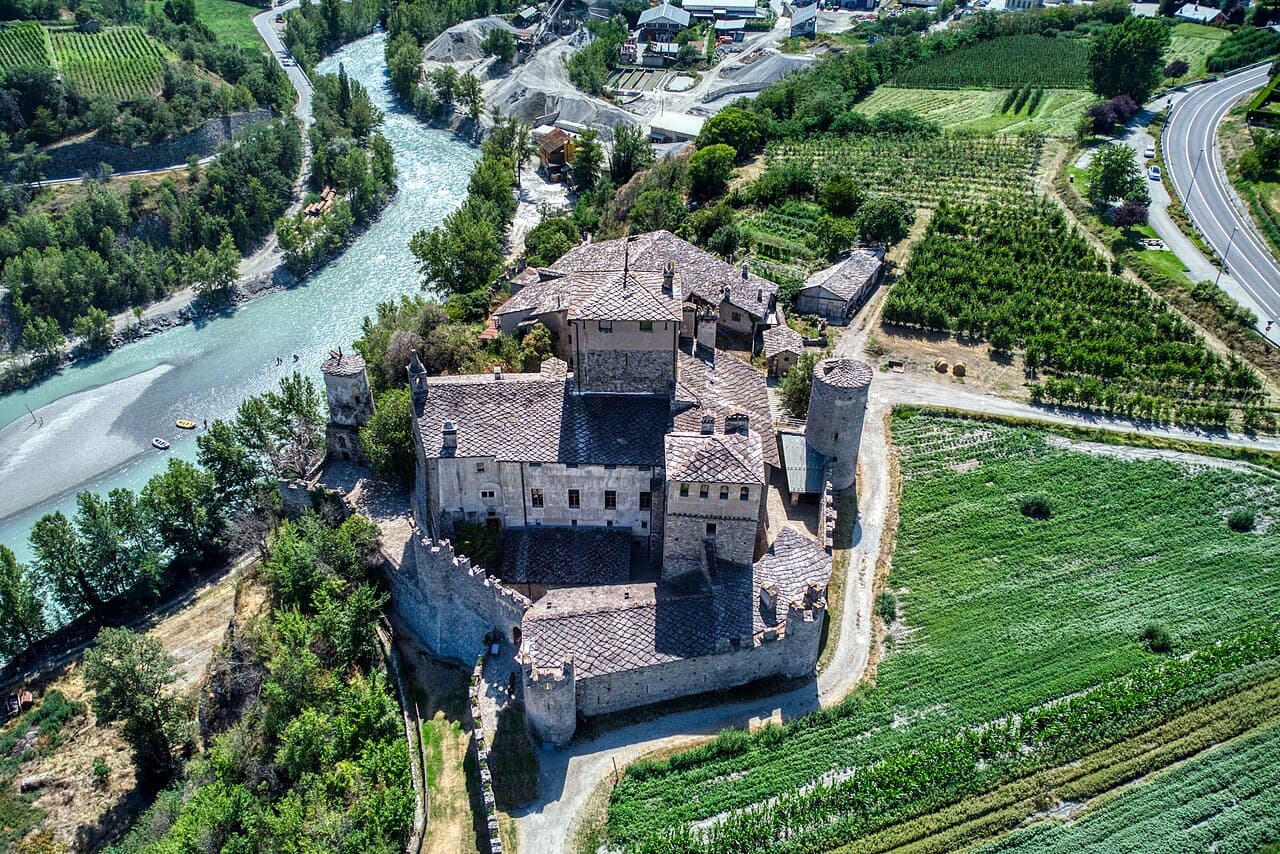
Sarriod de la Tour Castle
Sarriod de la Tour Castle is a remarkable late medieval hill castle located in the picturesque Aosta Valley region of Italy. This historic fortress embodies centuries of architectural evolution and noble heritage, serving as a testament to the strategic and residential needs of the Sarriod de la Tour family who inhabited it from the medieval period until the early 20th century. The castle's origins trace back to the early 14th century or possibly earlier, centered around a square donjon tower typical of early medieval fortifications in the region.
The castle's location near the Dora Baltea river provides both natural defense and stunning panoramic views of the surrounding valley. Its complex structure showcases a blend of defensive and residential architecture, reflecting the changing needs and tastes of its noble owners over several centuries. Visitors today can explore lavishly decorated interiors, including ancient frescoes, intricately carved wooden ceilings, and a rich collection of period furniture, all preserved within the castle's robust stone walls.
Medieval origins and early construction
The earliest part of Sarriod de la Tour Castle is the square donjon, a massive stone tower that served as the original stronghold. This central keep, known as the turris Sariodorum, was constructed during the early medieval period, possibly in the 13th or early 14th century. It reflects the typical defensive design of hill castles in the Aosta Valley, with thick walls and narrow cross-shaped windows that allowed defenders to shoot arrows while remaining protected.
Alongside the donjon, a small chapel dedicated to the Virgin Mary and Saint John the Evangelist was built near the southern wall overlooking the river. This chapel, constructed around the mid-13th century, highlights the early religious significance of the site in addition to its military function. The chapel's walls were adorned with biblical frescoes including the Adoration of the Magi and the Crucifixion, some of which survive as fragments today.
Expansion and enhancement in the 15th century
The castle underwent significant expansion and refurbishment in the 15th century under the ownership of Jean Sarriod and his son Antoine. In 1420, Jean Sarriod expanded the original donjon and added new residential buildings, transforming the fortress into a more representative noble residence. One of the most notable additions from this period is the Hall of Heads (Sala delle teste), built around 1430 in the northern wing. This ceremonial hall features a remarkable wooden ceiling supported by 171 intricately carved corbels, depicting a wide array of figures including noble portraits, mythical creatures, animals, and carnival characters. The carvings are stylistically linked to the woodwork of the nearby Aosta Cathedral, suggesting the involvement of regional artisans such as Jean de Chetro.
Antoine Sarriod de la Tour continued the enhancements in 1478, refurbishing the chapel with new frescoes depicting the Virgin Mary, Saint John the Evangelist, the Crucifixion, and Saint Christopher. He also commissioned the construction of a small bell tower adjacent to the chapel. During this period, the castle's defensive features were strengthened by adding circular and semi-circular towers to the walls and creating a new fortified entrance on the eastern side. The main gate is notable for its pointed arch topped with the Sarriod de la Tour coat of arms and a battlemented extension supported by two rows of stone corbels, designed to protect defenders from attacks below.
Architectural evolution in the 16th and 17th centuries
Following the major medieval expansions, the castle saw further additions in the 16th and 17th centuries. A dovecote tower was added in the 16th century, reflecting the practical needs of the estate. In the 17th century, a north tower was constructed, continuing the trend of enhancing both the defensive and residential aspects of the complex.
The chapel's interior was modified around 1700 with the installation of a Baroque vaulted ceiling, which unfortunately obscured some of the original medieval frescoes. Despite these changes, the chapel remains an important repository of religious art spanning several centuries.
Historical significance and ownership
The Sarriod family, politically allied with the powerful Bard family in the County of Savoy, maintained ownership of the castle for several centuries. The castle served as their family residence and a symbol of their regional influence. The Sarriods' stewardship saw the castle evolve from a purely defensive stronghold to a noble residence with artistic and cultural significance.
Ownership remained with the Sarriod family until 1923, when the castle was transferred to the Genoese Bensa family. In 1970, the autonomous Region Aosta Valley acquired the property, initiating preservation efforts and opening the castle to the public. Today, Sarriod de la Tour Castle is a protected heritage site and a popular destination for visitors interested in medieval architecture, art history, and regional culture.
Architectural features and interior highlights
The hall of heads
The Hall of Heads is the castle's most famous interior space. Its wooden ceiling is supported by 171 corbels, each uniquely carved with grotesques, mythological creatures, animals, and human figures wearing period attire. This hall served as the main ceremonial room and reflects the artistic tastes and social status of the Sarriod family in the 15th century.
The chapel and frescoes
The castle's chapel is notable for its collection of frescoes spanning from the mid-13th to the late 15th century. Despite later modifications, fragments of these paintings remain visible, including scenes such as the Adoration of the Magi and the Crucifixion. The exterior frescoes of the chapel, painted in the late 15th century, depict the Virgin Mary, Saint John the Evangelist, and Saint Christopher, adding to the castle's rich artistic heritage.
Defensive structures
The castle's defensive layout includes the original square donjon, surrounded by circular and semi-circular towers added in the late 15th century. The enclosing walls, reinforced over time, feature battlements and a strategically designed main gate. The eastern entrance, created during the 15th-century renovations, improved the castle's defensive capabilities and control over access.
Visitor experience and cultural importance
Today, Sarriod de la Tour Castle is open year-round to visitors. It offers a unique opportunity to explore a well-preserved medieval castle with richly decorated interiors and significant architectural features. The panoramic views of the Aosta Valley enhance the visitor experience, providing a scenic backdrop to the historical ambiance.
The castle also hosts exhibitions such as the "Fragmenta picta" display, featuring fresco fragments from nearby Quart Castle, enriching the understanding of the region's medieval artistic traditions. Sarriod de la Tour Castle stands as a cultural landmark, reflecting the history, art, and architecture of the Aosta Valley across centuries.
Frequently asked questions (FAQ)
- What is the historical significance of Sarriod de la Tour Castle?
- Sarriod de la Tour Castle, dating back to the 13th century, is a remarkable example of medieval architecture in the Aosta Valley. It served as a strategic fortress and residence for the noble Sarriod family, reflecting the region's feudal history and the importance of defense during that era.
- When was Sarriod de la Tour Castle built?
- The construction of Sarriod de la Tour Castle began in the 13th century, with various modifications and renovations occurring over the centuries. Its enduring structure showcases the evolution of defensive architecture in response to changing warfare tactics.
- Can I visit Sarriod de la Tour Castle?
- Yes, visitors are welcome to explore Sarriod de la Tour Castle. The castle is open to the public, offering guided tours that provide insights into its rich history and architectural features.
- What are the opening hours for Sarriod de la Tour Castle?
- Sarriod de la Tour Castle typically opens from 10 AM to 6 PM, with varying hours depending on the season. It is advisable to check the official website for the most current information on hours and any special events.
- Is it possible to access Sarriod de la Tour Castle with mobility issues?
- While Sarriod de la Tour Castle has some accessibility features, the medieval architecture, including staircases and uneven paths, may pose challenges for those with mobility issues. It is recommended to contact the castle administration in advance to inquire about specific accessibility options.
- What is the best time to visit Sarriod de la Tour Castle?
- The best time to visit Sarriod de la Tour Castle is during the spring and early autumn months when the weather is pleasant, and the surrounding landscapes are vibrant. These seasons also tend to have fewer tourists, allowing for a more enjoyable experience.
- Are there any nearby attractions to visit while at Sarriod de la Tour Castle?
- Yes, visitors can explore several nearby attractions, including the charming village of Saint-Pierre and the stunning views of the Aosta Valley. Additionally, the Aosta Roman Theatre and the beautiful Gran Paradiso National Park are within a short drive, offering a wealth of historical and natural sights.
- What are the ticket prices for Sarriod de la Tour Castle?
- Ticket prices for Sarriod de la Tour Castle are quite reasonable, typically ranging from €5 to €10 for adults, with discounts available for students and seniors. Children under a certain age may enter for free, making it an affordable outing for families.
Photo gallery

Information
Website
Visit websiteSources & official resources
Verify the information above using these authoritative references.
Loading map...
Visitor reviews
No reviews yet. Been here? Write the first review and help other travelers!
Write the first reviewVisited this castle? Share your experience
Your review helps other travelers and adds first-hand knowledge to our encyclopedia.



