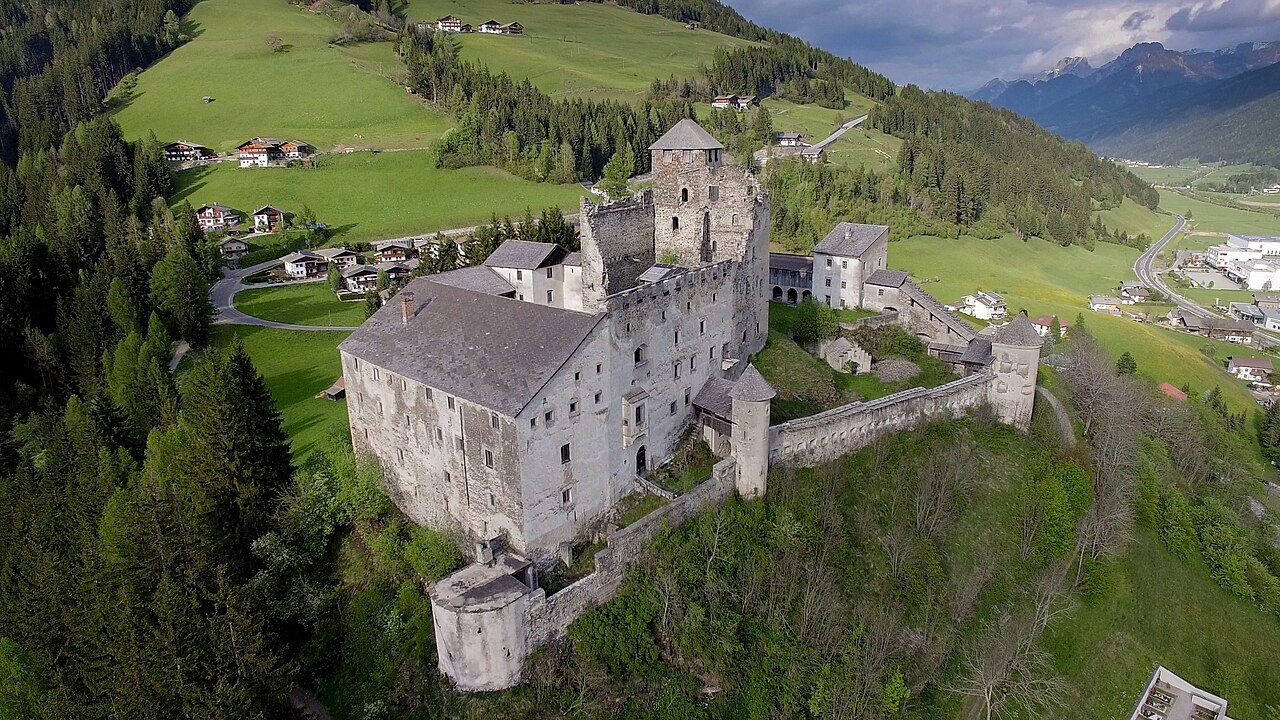
Saquidic Castle
Saquidic Castle stands prominently above the Tagliamento River within the municipality of Forni di Sopra in Italy. This medieval hill castle originated in the late 12th century, built atop a site with a much older history dating back to late antiquity. Its strategic position along an ancient route connecting Stinsans and Sampuont underscored its importance as a military and commercial waypoint for travelers moving from the Adriatic Sea across the Mauria Pass toward Northern Europe.
Early history and strategic significance
The site of Saquidic Castle was occupied as early as between the 2nd and 4th centuries AD, during the decline of the Roman Empire. Archaeological evidence indicates a fortified structure existed here before the medieval castle, serving as a control point on the vital corridor used by military forces, pilgrims, and merchants. This continuous occupation highlights the location's long-standing strategic importance.
Medieval construction and architectural features
The castle's earliest surviving element is its bergfried, a tall, robust stone tower characteristic of medieval fortifications. Constructed at the end of the 12th century, the bergfried functioned as a stronghold and lookout, dominating the surrounding landscape. Enclosing this tower was a fortified wall that formed the core defensive perimeter. On the northern slope, a natural ditch acted as a dry moat, enhancing the castle's defenses against potential attackers.
Residential and defensive expansions
In the early 13th century, a significant addition was made with the construction of a multi-story residential building on the eastern side. This structure combined habitation and storage: the ground floor served as a storeroom, the piano nobile above was the main living area, and a further upper level featured a defensive platform protected by a wooden roof. This design reflects the castle's dual function as both a home and a fortress.
Further fortifications were added during the 13th century, including strengthened walls on the north and east sides. A zwinger wall was built in the castle's final phase, creating a narrow enclosed courtyard designed as a killing zone to trap and expose intruders. Access to the castle was controlled through a gate managed from the defensive platform of the residential building, integrating security measures with everyday life.
The illicit minting operation and destruction
Saquidic Castle's history took a dramatic turn in the late 13th century when it was deliberately set on fire. Research suggests that soldiers associated with the Savorgnan family, who controlled the surrounding territory known as Forni Savorgnani by 1326, orchestrated the burning to halt an illicit activity within the castle walls—the unauthorized production of counterfeit currency. The destruction abruptly ended this operation and led to the castle's abandonment.
Archaeological investigations and discoveries
After centuries of neglect, the castle remained largely untouched until the late 19th century when German amateur archaeologist Alexander Wolf conducted early excavations between 1889 and 1901. His work helped prevent further deterioration, though comprehensive scholarly study awaited later efforts.
Renewed archaeological and restoration work began in 2004 under architect Fabio Piuzzi from the University of Venice. These investigations uncovered numerous artifacts that shed light on the castle's operational life and abrupt end. Finds included metal bars and rings used in coin production, arrowheads and other weaponry, ceramic fragments, pieces of armor such as a cuirass, and rare glass vessels. These discoveries illustrate the castle’s dual role in military defense and illicit economic activity.
Site layout and surviving remains
Saquidic Castle is situated on Colle Sacuidic, a small, narrow wooded hill between the Tagliamento River and the Rio Sacuidic stream. The hill's southern face drops steeply about 100 meters toward the river, providing a naturally strong defensive position that influenced the castle’s design.
The surviving structures include the bergfried, the multi-level residential building, the zwinger wall, and the natural moat on the northern side. These stone ruins remain on the hilltop, offering tangible evidence of the castle’s medieval occupation and its historical role within the region.
Architectural significance
The combination of a bergfried with a multi-story residential building topped by a defensive platform exemplifies the medieval approach to integrating habitation with fortification. The addition of the zwinger wall reflects evolving military architecture designed to create layered defenses. The castle’s layout takes full advantage of the natural terrain for defense, a common feature of hill castles in the medieval period.
Cultural heritage and tourism
Today, Saquidic Castle is an important archaeological site that attracts visitors interested in medieval history and architecture. Although partially ruined, the site’s preserved elements allow for an understanding of its historical functions and the turbulent events leading to its destruction. Ongoing preservation efforts ensure that Saquidic Castle remains a valuable cultural landmark within the Friuli-Venezia Giulia region.
Frequently asked questions (FAQ)
- How do I get to Saquidic Castle?
- Saquidic Castle is located near Forni di Sopra in the Friuli-Venezia Giulia region of Italy. Visitors can reach the site by car or local transport, followed by a hike up Colle Sacuidic hill.
- What is the historical significance of Saquidic Castle?
- Saquidic Castle was a strategic medieval fortress built in the late 12th century, known for its role in controlling trade routes and its involvement in illicit coin minting.
- Can I visit the ruins of Saquidic Castle?
- Yes, the ruins of Saquidic Castle are accessible to the public. Visitors can explore the remains of the bergfried, residential building, and defensive walls, although facilities may be limited.
- When was Saquidic Castle destroyed?
- The castle was deliberately set on fire in the late 13th century to stop unauthorized counterfeiting activities within its walls.
- What architectural features are notable at Saquidic Castle?
- Key features include the tall bergfried tower, multi-story residential building with a defensive platform, a zwinger wall, and a natural dry moat enhancing the castle's defenses.
Information
Loading map...
Visitor reviews
No reviews yet. Been here? Write the first review and help other travelers!
Write the first reviewVisited this castle? Share your experience
Your review helps other travelers and adds first-hand knowledge to our encyclopedia.