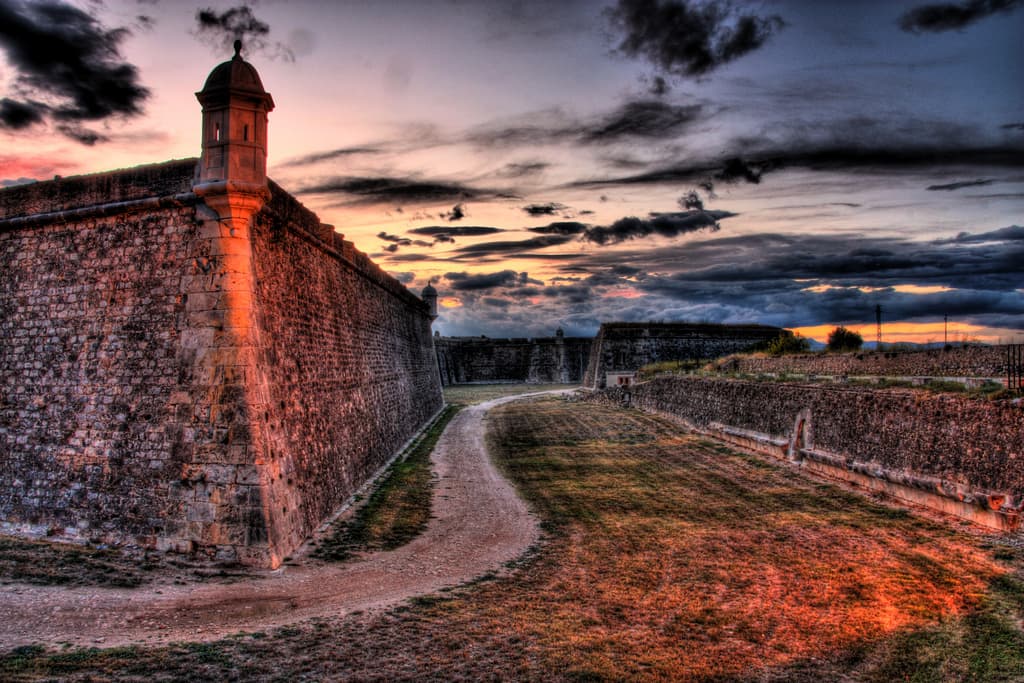
The Sant Ferran Castle (Catalan: Castell de Sant Ferran) is a monumental military fortress located on a strategic hill overlooking the town of Figueres in Catalonia, Spain. Constructed in the 18th century, it stands as the largest man-made monument in Catalonia and one of the most significant examples of post-Renaissance military architecture in the region.
Historical context and construction
The castle was built during a period of intense military and political tension in Europe, following the War of the Spanish Succession (1701–1714). The fortress was commissioned by the Spanish Crown to strengthen the defensive capabilities of the northeastern frontier of Spain, particularly against French incursions. Construction began in the mid-18th century, with key military engineers such as Pedro Martín Cermeño and Juan Martín Cermeño playing crucial roles in its design and execution.
Its location on a hill provided a commanding view of the surrounding landscape, allowing defenders to monitor and control access routes effectively. The fortress was designed to withstand the artillery and siege warfare techniques of the time, reflecting the evolution of military engineering from medieval fortifications to modern bastioned systems.
Architectural features and layout
Sant Ferran Castle is a classic example of an 18th-century hill castle with a complex bastioned fortress layout. It features an extensive system of defensive walls, bastions, ravelins, and moats designed to provide overlapping fields of fire and resist prolonged sieges.
The fortress covers an area of approximately 320,000 square meters, making it one of the largest fortifications in Europe. Its polygonal shape is adapted to the terrain, with thick stone walls and earthworks absorbing artillery fire. The main gate is heavily fortified and accessed via a drawbridge crossing a deep moat.
Inside, the castle contains numerous barracks, magazines for ammunition storage, officers' quarters, and cisterns to ensure water supply during sieges. The internal layout was designed for efficient troop movement and logistical support, emphasizing functionality and defense.
Military significance and historical use
Throughout its history, Sant Ferran Castle served as a strategic military base for various Spanish armies. It played roles in the Peninsular War (1808–1814), where it was used by Spanish and allied forces against Napoleonic troops. Later, it functioned as a prison and military garrison during the 19th and early 20th centuries.
The fortress was never taken by force, demonstrating the effectiveness of its design and strategic location. Its large capacity allowed it to house thousands of soldiers, making it a critical asset for Spain's border defense.
Preservation and current status
Today, Sant Ferran Castle is well preserved and open to the public as a cultural and historical site. It is managed as a heritage monument, attracting visitors interested in military history and architecture. The castle offers guided tours, exhibitions, and events that highlight its historical importance and architectural features.
Efforts have been made to maintain the fortress's structural integrity and to restore certain areas to their original condition. Its vast size and impressive construction make it a unique example of post-Renaissance fortification in Spain.
Architectural style and influences
The design of Sant Ferran Castle reflects the principles of post-Renaissance military architecture, particularly the bastioned fortress style that became prevalent in Europe during the 17th and 18th centuries. This style emphasizes angular bastions projecting from curtain walls, allowing defenders to cover adjacent walls with gunfire and eliminate blind spots.
The fortress incorporates elements of Vauban-style fortifications, inspired by the famous French military engineer Sébastien Le Prestre de Vauban, who revolutionized fortress design. The use of layered defenses, including moats and outworks, demonstrates the influence of these advanced engineering concepts.
Materials and construction techniques
The castle was constructed primarily using local stone and earthworks, combining natural materials with engineered structures to create robust defensive walls. The thick masonry walls were designed to absorb cannon fire, while the earth-filled ramparts provided additional protection and stability.
Interior spaces and functionality
Inside the fortress, the spaces were planned to support prolonged military campaigns. Barracks accommodated large numbers of soldiers, while storage magazines ensured a steady supply of ammunition and provisions. Water cisterns and wells were integrated to maintain supplies during sieges, reflecting careful logistical planning.
Frequently asked questions (FAQ)
- What is Sant Ferran Castle known for?
- Sant Ferran Castle is renowned for its impressive military architecture and strategic location in Spain. Built in the 18th century, it served as a fortress to defend against naval attacks and is one of the most well-preserved examples of military fortifications in Europe.
- When was Sant Ferran Castle built?
- Construction of Sant Ferran Castle began in 1751 and was completed in 1763. It was commissioned by King Ferdinand VI as a response to the need for coastal defense during that period.
- What are the opening hours for Sant Ferran Castle?
- Sant Ferran Castle is typically open to visitors from 10 AM to 6 PM, with extended hours during the summer months. It is advisable to check the official website for any seasonal changes or special events that may affect visiting hours.
- Can I take guided tours of Sant Ferran Castle?
- Yes, guided tours are available at Sant Ferran Castle, providing visitors with in-depth insights into its history and architecture. These tours are highly recommended for those looking to fully appreciate the castle's significance and intricate design.
- Is Sant Ferran Castle accessible for visitors with disabilities?
- Yes, Sant Ferran Castle has taken measures to ensure accessibility for visitors with disabilities. Ramps and designated pathways are available, allowing everyone to enjoy the castle's historical features.
- What is the best time to visit Sant Ferran Castle?
- The best time to visit Sant Ferran Castle is during the spring and fall when the weather is mild and pleasant for exploring. Additionally, visiting during weekdays can help avoid larger crowds typically seen on weekends.
- Are there any nearby attractions to Sant Ferran Castle?
- Yes, visitors can explore nearby attractions such as the historic town of Figueres, home to the Salvador Dalí Theatre-Museum, and the beautiful beaches along the Costa Brava. These destinations make for great complementary visits when touring the castle.
- How much do tickets cost for Sant Ferran Castle?
- Ticket prices for Sant Ferran Castle vary, but generally, adult tickets are around €5, while discounts are available for children and seniors. It's best to check the official website for the latest pricing and any special offers.
Photo gallery

Information
Loading map...
Visitor reviews
No reviews yet. Been here? Write the first review and help other travelers!
Write the first reviewVisited this castle? Share your experience
Your review helps other travelers and adds first-hand knowledge to our encyclopedia.



