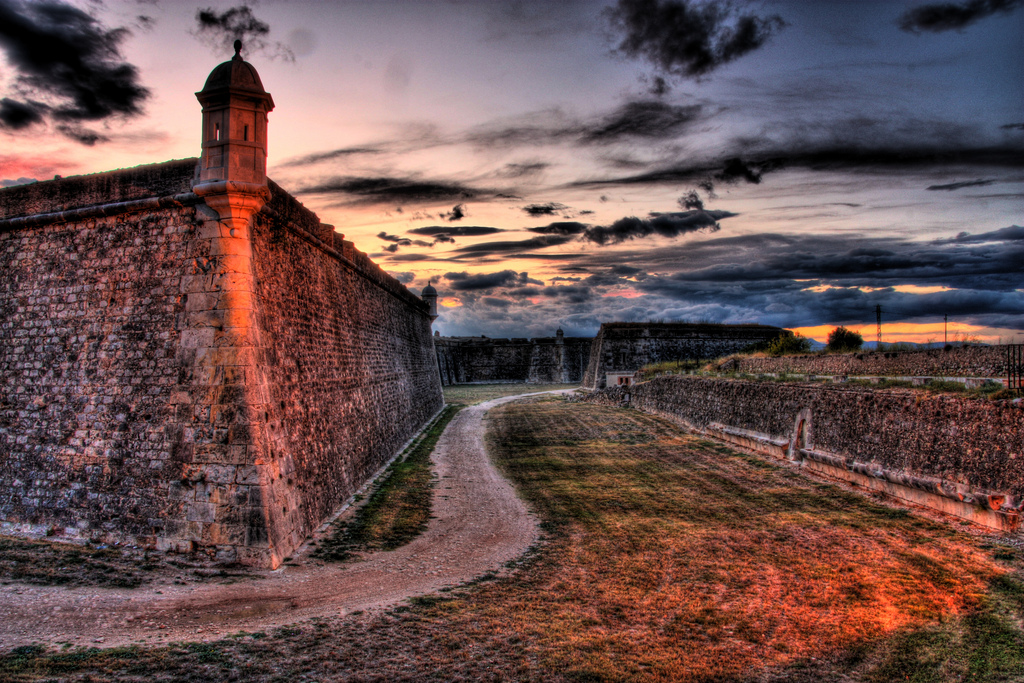
Castell de Llers
The Castell de Llers is a prominent medieval fortress located in the municipality of Llers, within the Catalonia region of Spain. This hill castle stands as a significant example of Romanesque military architecture from the 13th century, reflecting the turbulent history and strategic importance of the borderlands between the historic counties of Besalú and Empúries.
Historical references to the site date back to the 10th century, with early documentation mentioning Arnau de Llers in the late 11th century. These records indicate the presence of a noble family closely tied to local counts and religious institutions, suggesting the castle’s origins as a fortified noble residence during a period of territorial consolidation in Catalonia. By the late 11th century, it is believed that a castle existed at Llers, serving as a defensive bastion on the frontier between the counties of Besalú and Empúries.
Medieval strategic importance and ownership
Following the extinction of the counts of Besalú in 1111, the castle came under the control of the counts of Barcelona, who were expanding their influence over Catalonia. In 1128, the castle was briefly seized by Ponç Hug of Empúries during regional conflicts but was soon recovered. Throughout the 12th century, the Llers family maintained close ties with the counts of Barcelona, often acting as executors and witnesses in significant legal matters, reinforcing the castle’s role as a local power center.
The 13th century saw the castle pass to the noble Rocabertí family, who undertook substantial fortifications in 1276. These enhancements prepared the fortress for the conflicts of the era, notably the siege of Girona in 1285, when the castle resisted a French army before ultimately falling after fierce fighting. The fortress’s capture was marked by the coronation of Charles I of Valois as "king of the land of Catalonia," underscoring its strategic and symbolic significance during the Aragonese-Catalan conflicts.
Architectural features and construction details
The castle follows a traditional Romanesque layout typical of 13th-century defensive architecture, featuring a central circular keep approximately 11.8 meters in diameter, with walls about two meters thick. This tower, constructed from carefully cut ashlar stone blocks laid in horizontal rows and bonded with lime mortar, rises to about 12 meters today, though it was likely taller originally. The original entrance was situated around six meters above ground level, a common defensive feature to deter attackers.
Surrounding the keep is a rectangular courtyard enclosed by a curtain wall approximately 10 meters high. On the southern side of the courtyard lies a large rectangular hall measuring 28.5 by 6.35 meters, with all four walls preserved up to the vault springing. The presence of sockets along the vault spring indicates the use of scaffolding during construction. The northern wall of this hall contains a doorway with a semicircular arch composed of wedge-shaped voussoirs, a hallmark of Romanesque masonry.
To the west of the courtyard, two additional halls are identifiable, one approximately 11 by 5.7 meters, and another adjoining hall measuring 12.6 by 5.7 meters, which still retains evidence of vaulted ceilings. A well-preserved semicircular arched doorway is found in this latter hall, demonstrating consistent medieval architectural techniques throughout the complex.
The eastern curtain wall features the main gate and includes a fragment constructed with stones arranged in a distinctive opus spicatum (herringbone) pattern. Near the base of this wall are courses of large, finely cut ashlar blocks, representing some of the oldest visible fabric of the castle and providing insight into its early construction phases.
Later history and decline
Throughout the late medieval and early modern periods, Castell de Llers remained a military stronghold on Catalonia’s northern frontier. After passing through various noble hands, including the Rocabertí family who restored sole ownership in 1625, the castle’s military importance waned. It briefly fell into the hands of local insurgents during the Remences revolt of 1485 and was later affected by the upheavals of the War of Spanish Succession and the French Revolution.
These conflicts caused substantial damage to the fortress, contributing to its decline as a defensive structure. Despite this, significant portions of the castle’s walls, towers, and halls remain intact, offering valuable insights into medieval fortification techniques and the region’s feudal history.
Preservation and cultural significance
Today, the Castell de Llers stands as a largely well-preserved example of medieval Romanesque military architecture in Catalonia. Its combination of a circular keep, extensive curtain walls, vaulted halls, and distinctive masonry techniques make it a key site for understanding 13th-century castle construction in the Iberian Peninsula.
Visitors to the castle can explore the remains of its imposing walls and towers, gaining a sense of the strategic importance this fortress held during centuries of regional conflict. The site also reflects the complex feudal relationships and shifting political landscape of medieval Catalonia, bridging the history of local noble families with broader European power struggles.
Overall, Castell de Llers offers a compelling glimpse into the military, architectural, and social history of medieval Spain, preserved through its enduring stone structures and historical legacy.
Frequently asked questions (FAQ)
- How do I get to Castell de Llers?
- Castell de Llers is located in the charming village of Llers, Spain. You can reach it by car via the N-260 road or by public transport from nearby cities like Figueres. Local bus services also connect Llers to major transport hubs.
- What is the historical significance of Castell de Llers?
- Castell de Llers dates back to the 11th century and played a crucial role in the defense of the region during the Middle Ages. It is a symbol of the area's rich history and has witnessed many historical events, making it a significant landmark in Catalonia.
- When was Castell de Llers built?
- The construction of Castell de Llers began in the late 10th century and was completed in the 11th century. Throughout the centuries, it has undergone various renovations and restorations, reflecting the architectural styles of different eras.
- Can I visit Castell de Llers year-round?
- Yes, Castell de Llers is open to visitors throughout the year, although hours may vary by season. It’s advisable to check the official website for the most current visiting hours and any special events that might alter regular access.
- Why is the architecture of Castell de Llers unique?
- The architecture of Castell de Llers showcases a blend of Romanesque and Gothic styles, which is characteristic of many medieval castles in Catalonia. Its strategic design includes strong defensive walls and towers, reflecting its original purpose as a fortification.
- Is it possible to take guided tours of Castell de Llers?
- Yes, guided tours of Castell de Llers are available and provide in-depth insights into the castle’s history and architecture. These tours are often led by knowledgeable guides who can answer questions and enhance your understanding of the site.
- What are the ticket prices for visiting Castell de Llers?
- Ticket prices for Castell de Llers are generally affordable, with discounts available for children, students, and seniors. It’s best to check the official website for the latest pricing information and any special offers.
- What is the best time to visit Castell de Llers?
- The best time to visit Castell de Llers is during the spring and early autumn when the weather is mild and pleasant for exploring. Additionally, visiting during these seasons allows you to enjoy the beautiful surrounding landscapes in full bloom.
- Are there any nearby attractions to visit while at Castell de Llers?
- Yes, nearby attractions include the picturesque village of Llers itself, as well as other historical sites like the nearby Sant Ferran Castle and the Dalí Theatre-Museum in Figueres. These sites offer a great opportunity to explore the rich cultural heritage of the region.
Information
Website
Visit websiteSources & official resources
Verify the information above using these authoritative references.
Loading map...
Visitor reviews
No reviews yet. Been here? Write the first review and help other travelers!
Write the first reviewVisited this castle? Share your experience
Your review helps other travelers and adds first-hand knowledge to our encyclopedia.