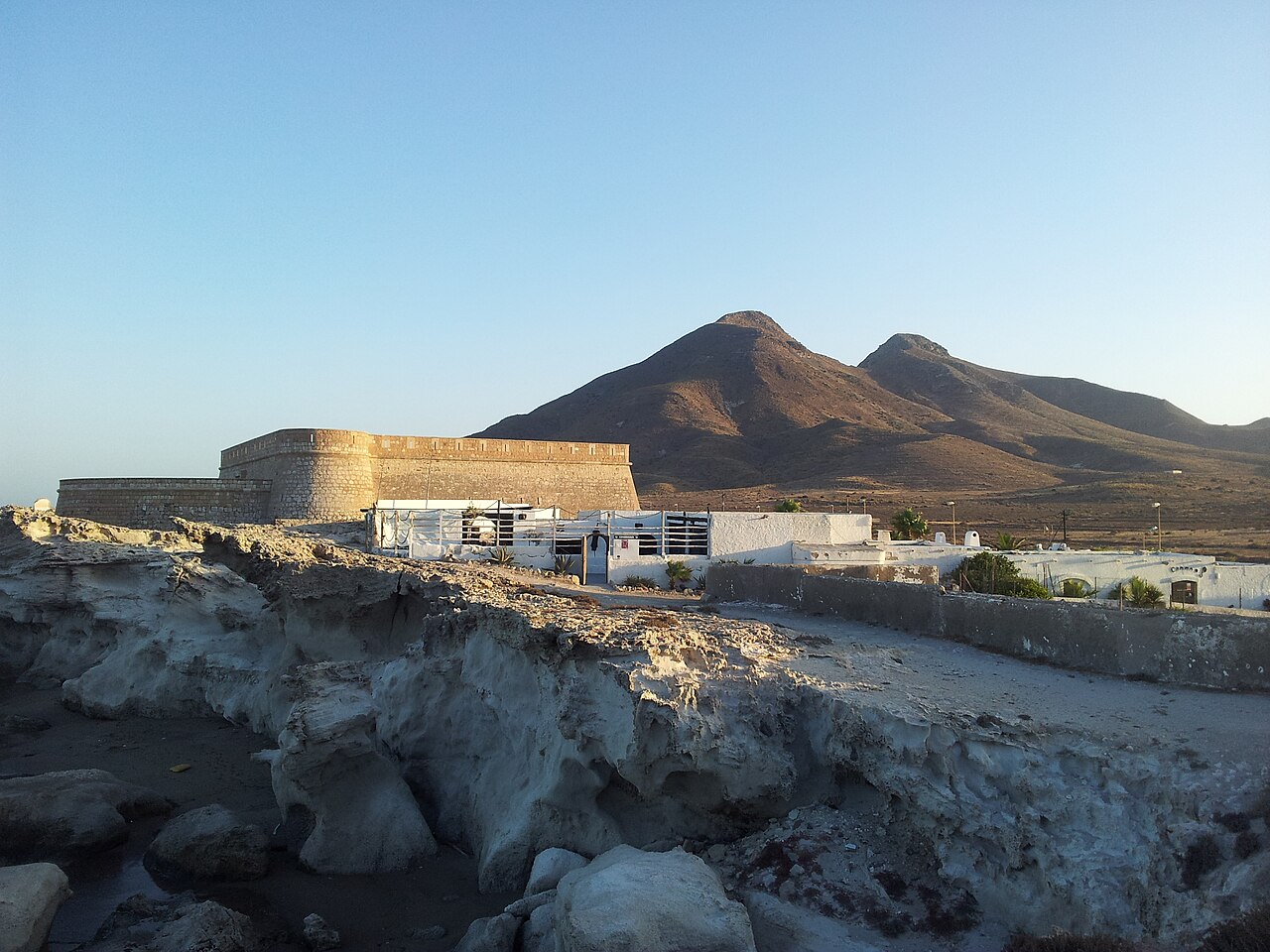
San Miguel Tower

San Miguel Tower, Cabo de Gata, Spain
Cabo de Gata, Spain
Post-Renaissance (17th–18th c.)
Well Preserved

San Miguel Tower, locally known as Torreón de San Miguel, is a historic coastal defense structure located on the beach adjacent to the village of Cabo de Gata in the province of Almería, Spain. This tower stands as a significant example of 18th-century military architecture designed to protect the coastline and nearby settlements from maritime threats.

Historical background and strategic importance

The tower was constructed in 1756 under the orders of King Ferdinand VI of Spain, replacing an earlier fortification likely dating back to the 16th century. Its primary purpose was to defend the nearby settlement of La Almadraba de Monteleva and the valuable salt marshes in the area, which were important economic resources at the time. The tower's location near the coast allowed it to serve as an early warning post against pirate raids and other maritime incursions common during the post-Renaissance period.

Architectural features and construction

San Miguel Tower is a water castle type structure, built directly on the beach to maximize its defensive coverage of the coastline. The original tower was a robust, square-shaped stone building designed to withstand attacks and provide a vantage point for surveillance. The thick walls and elevated position allowed defenders to spot approaching ships from a distance.

In the 1980s, a square defensive wall with corner turrets was added around the tower, enhancing its fortification. These additions, however, are modern and not part of the original 18th-century design. The tower's entrance has since been sealed, preventing access to the interior, but the exterior remains well-preserved and accessible to visitors.

Later uses and current status

After the Peninsular War began in 1808, the tower was abandoned as a military post. In 1941, it was repurposed as a house-barracks for the Guardia Civil, Spain's national law enforcement agency. Although no longer in active use by the Guardia Civil, the tower remains under their ownership.

Today, visitors can freely explore the tower's exterior and appreciate its historical significance and coastal views. The interior is not accessible due to the walled-up entrance. Nearby, the García Tower offers additional insight into the coastal defense system of the region.

Significance in coastal defense heritage

San Miguel Tower represents an important element of Spain's extensive network of coastal fortifications built during the post-Renaissance period. These towers were crucial in protecting the Spanish coastline from frequent attacks by pirates and enemy forces during the 16th to 18th centuries. The tower's survival and preservation provide valuable insight into the military strategies and architectural techniques of the era.

Visiting information and accessibility

The tower is located next to the AL-3115 road near Cabo de Gata, making it easily accessible by car. Visitors can walk around the tower and view its exterior freely at any time, as there are no entrance fees or restricted visiting hours. However, due to the sealed entrance, interior tours are not possible, which limits the exploration to external observation only.

Frequently asked questions (FAQ)

How do I visit San Miguel Tower?
San Miguel Tower is freely accessible for exterior viewing at any time. It is located next to the AL-3115 road near Cabo de Gata, making it easy to reach by car or on foot.
Can I enter the interior of San Miguel Tower?
No, the entrance to San Miguel Tower is walled up, so visitors cannot access the interior. Only the exterior can be viewed.
What was the original purpose of San Miguel Tower?
San Miguel Tower was built in 1756 to defend the nearby settlement of La Almadraba de Monteleva and its salt marshes from maritime attacks, serving as a coastal defense tower.
Who owns San Miguel Tower today?
The tower is currently owned by the Guardia Civil, who used it as a barracks starting in 1941 but no longer occupy it.
Is there any other historic tower near San Miguel Tower?
Yes, the García Tower is located nearby and is part of the region's historic coastal defense system.

Information

Water Castle

Current owner

Guardia Civil

Address

Next to AL-3115 road, Cabo de Gata, Almería, Spain

Loading map...

Visitor reviews

No reviews yet. Been here? Write the first review and help other travelers!

Write the first review

Visited this castle? Share your experience

Your review helps other travelers and adds first-hand knowledge to our encyclopedia.

Write a review

(5/5)

0/2000 characters

Your review will be visible after admin approval

Nearby castles

7 km

García Tower

Retamar, Spain

García Tower, locally known as Torre García, stands as a notable example of Renaissance coastal defense architecture from the 16th century. Located near the beach southwest of the village of Retamar in the province of Almería, Spain, this tower was part of a comprehensive network of watchtowers built to protect the Spanish Mediterranean coast from the frequent raids of Barbary pirates. The early 16th century saw a significant threat to the Spanish coastline following the establishment of the Turkish settlement in Algiers in 1516. This event intensified pirate activity, with Barbary corsairs launching attacks that involved looting coastal towns and capturing inhabitants for slavery. To counter this threat, a series of defensive watchtowers were commissioned, initially in 1552 during the reign of Charles V, Holy Roman Emperor. However, the majority of these towers, including García Tower, were constructed or completed under the reign of his son, Philip II of Spain, in the latter half of the 16th century. Historical context and construction García Tower was built between 1571 and 1575, likely on the foundations of an earlier Arabic fortification. This strategic location between the nearby Perdigal and San Miguel towers allowed it to serve as an effective lookout point against naval threats. The tower's primary role was to detect approaching enemy ships and communicate their presence to neighboring towers through a system of signals—smoke by day and fire by night—enabling a coordinated coastal defense. Architectural features The tower is characterized by its round design, a common feature among Renaissance watchtowers along the Spanish coast, which provided better resistance to cannon fire and improved visibility. Its robust stone construction, typical of the period, ensured durability against both natural elements and attacks. The tower's height and placement afforded wide-ranging views of the Mediterranean Sea and the surrounding coastline. Defensive capabilities The tower's design included thick walls and limited entry points to withstand assaults. Its elevated position and circular shape minimized blind spots, allowing guards to monitor the sea effectively. The communication system involving smoke and fire signals was a crucial element of the coastal defense network, enabling rapid alerts across multiple towers. Use and maintenance through the centuries By 1759, García Tower was reported to be in good condition and manned by two guards from the Guardia Civil. It underwent repairs in 1773, reflecting its continued strategic importance. Documentation from 1849 indicates the tower remained well-preserved, with guards residing in a nearby house rather than inside the tower itself. During the 20th century, the tower was abandoned as military needs evolved and the threat of pirate raids diminished. However, in the 1980s, restoration efforts were undertaken to preserve this historical monument. Today, García Tower is accessible to visitors, although the tower's interior is fenced off for protection. Surroundings and cultural significance Adjacent to the tower is a modest hermitage, adding to the site's cultural interest. The location near the beach and the village of Retamar enriches its appeal as a historical landmark within the Almería province. García Tower exemplifies the extensive coastal defense strategy implemented by Spain during the Renaissance to safeguard its Mediterranean territories. As a Renaissance-era watchtower, García Tower offers insight into the military architecture and maritime defense systems of 16th-century Spain. Its preservation and accessibility allow visitors to connect with the region's historical struggles against piracy and the broader geopolitical dynamics of the Mediterranean during that period.

Renaissance (15th–17th c.)
Details
13.5 km

Perdigal Tower

Retamar, Spain

Perdigal Tower, locally known as Torre del Perdigal, is a Renaissance coastal watchtower situated next to the beach southwest of the village of Retamar in the province of Almería, Spain. This tower is part of a network of defensive structures built during the 16th century to protect the Spanish Mediterranean coast from frequent attacks by Barbary pirates. Historical context and strategic importance Following the establishment of the Turkish settlement in Algiers in 1516, the entire Spanish Mediterranean coastline faced a persistent threat from Barbary pirate raids. These pirates regularly landed on the coast, targeting towns and rural settlements, looting property and enslaving inhabitants. To counter this menace, the Spanish Crown initiated a comprehensive coastal defense strategy. In 1552, under the reign of Charles V, Holy Roman Emperor, construction began on a series of watchtowers stretching from Alicante to Cádiz. These towers were intended to serve as lookout points to detect pirate ships early and provide warnings to inland settlements. Most towers were built or completed during the reign of Philip II of Spain in the latter half of the 16th century, reflecting the heightened need for coastal defense during this turbulent period. Architecture and features of Perdigal Tower The Perdigal Tower is a round tower typical of the Renaissance military architecture designed for coastal defense. Its circular shape was advantageous for deflecting cannon fire and providing a 360-degree field of vision for lookouts. The tower's robust masonry construction allowed it to withstand attacks and harsh coastal weather conditions. Strategically located, the tower communicated visually with the city of Almería and the nearby García Tower. This communication was achieved through a system of smoke signals during the day and fire signals at night, enabling rapid transmission of warnings about approaching enemy ships to other towers and settlements along the coast. Possible earlier origins While the tower is generally dated to the end of the 16th century, some historians suggest that Perdigal Tower could have originated as an Arab watchtower from the 13th century. This theory is based on the strategic location and certain architectural elements that may predate the Renaissance reconstruction. However, the predominant historical consensus attributes the current structure to the Renaissance period defensive efforts. Role in coastal defense and historical significance Perdigal Tower played a vital role in the early warning system against Barbary pirate incursions. Its presence helped protect the local population by providing timely alerts that allowed residents to seek shelter or prepare defenses. The network of towers along the Spanish Mediterranean coast represents an important aspect of Spain's military and maritime history during the 16th century. Current condition and visitor information Today, Perdigal Tower stands as a well-preserved Renaissance watchtower open for public visitation. It remains a simple yet evocative structure, offering insight into the coastal defenses of historic Spain. Visitors should be cautious as there have been reports of the tower being inhabited by a vagabond, and the interior is minimal without extensive facilities. The tower's location next to the AL-3113 road makes it accessible for visitors exploring the province of Almería. While it does not have extensive tourist infrastructure, it is an important cultural heritage site that illustrates the military architecture and historical challenges faced by coastal communities in the Renaissance period. Architectural legacy and preservation Perdigal Tower exemplifies the Renaissance military architectural style adapted for coastal defense, emphasizing functionality, visibility, and communication. Its preservation contributes to the understanding of Spain's response to maritime threats during the 16th century and the evolution of coastal fortifications.

Renaissance (15th–17th c.)
Details
16.2 km
San Felipe Castle — Spain castle

San Felipe Castle

Níjar, Spain

San Felipe Castle, also known locally as Castillo Batería de San Felipe, is a prominent 18th-century coastal fortification located in the hamlet of Los Escullos, within the municipality of Níjar, in the province of Almería, Spain. Perched on the Esparto height, approximately eight meters above sea level, it commands strategic views over the Mediterranean coastline and the surrounding natural landscape of the Cabo de Gata Natural Park. This Neoclassical artillery fort was constructed in 1765 during the reign of King Charles III as part of a broader defensive network designed to protect the southern Spanish Mediterranean coast from frequent attacks by Berber pirates and other maritime threats. Historical context and construction During the 18th century, the southern coast of Spain was vulnerable to raids by pirates operating from North Africa, prompting the Spanish Crown to strengthen its coastal defenses. In 1764, King Charles III ordered the construction of nine fortifications along the coast of the Kingdom of Granada. San Felipe Castle was among these, designed by military engineer José Crame. The fort shares architectural similarities with contemporaneous batteries such as San Ramón, Jesús Nazareno, Guardias Viejas, Carchuna, and La Herradura. The castle was built as a rectangular artillery fort featuring a semicircular counterguard facing the sea to enhance its coastal defense capabilities. It was originally armed with four cannons and included a drawbridge over the main entrance, underscoring its defensive design. The garrison typically consisted of an officer, three corporals, and twenty soldiers, reflecting its role as a modest yet strategically important fortification. Architectural features and design San Felipe Castle exemplifies the Neoclassical military architecture of the late Post-Renaissance period, incorporating Enlightenment principles such as geometric precision and mathematical application in fortress design. The fort’s layout is characterized by a strong geometric plan, with stone masonry construction typical of the era’s durable military structures. The fort’s defensive system includes protruding walls that cover the flanks, enhancing the fort’s ability to repel attacks from both land and sea. The semicircular counterguard was a key feature for coastal artillery defense, allowing the fort to cover a wide arc of fire against enemy vessels approaching from the Mediterranean. The use of a drawbridge at the entrance also reflects traditional defensive measures designed to control access and improve security. Historical use and military significance Throughout its history, San Felipe Castle played a vital role in the coastal defense system of southern Spain. It was part of a network of fortifications built to protect the region from pirate incursions and later adapted to evolving military needs. During the Spanish War of Independence (early 19th century), the fort was temporarily disarmed by French forces, reflecting the turbulent geopolitical situation of the era. By the mid-19th century, the castle was occupied by special forces tasked with littoral surveillance, highlighting its continued military relevance. However, as military technology and strategies evolved, the fort gradually lost its frontline defensive role and was eventually abandoned during the 20th century. Restoration and current status Significant restoration efforts were undertaken in 1990-1991 to preserve the structural integrity and historical value of San Felipe Castle. These works helped stabilize the fort and maintain its characteristic features, allowing it to be accessible to the public today. Although the interior areas may sometimes be closed to visitors, the castle remains an important cultural and historical landmark. Currently, the castle is freely accessible and is managed as part of the cultural heritage of the region. Its location within the Cabo de Gata Natural Park enhances its appeal, combining natural beauty with rich historical significance. The castle serves as a tangible reminder of Spain’s coastal defense efforts during the 18th century and offers visitors panoramic views of the Mediterranean Sea and the surrounding landscape. Cultural heritage and significance San Felipe Castle is recognized as one of the most representative examples of the major fortified batteries constructed in Spain during the 18th century. Its design reflects the Enlightenment-era military engineering principles that emphasized rational geometry and scientific approaches to fortification. The castle’s strategic location and architectural features underscore its importance in safeguarding the southern Spanish coast. Its preservation as a cultural heritage site ensures that this legacy continues to be appreciated by future generations. The fort also contributes to the historical narrative of the Kingdom of Granada and the broader maritime defense strategies of Spain during a period marked by frequent naval conflicts and pirate threats. Comparison with other coastal fortifications San Felipe shares design elements with other contemporary forts such as San Ramón and La Herradura, which were similarly constructed to defend against seaborne attacks. These forts typically feature rectangular layouts with semicircular or angular counterguards, designed to maximize artillery coverage and defensive capabilities. Visitor experience and access Visitors to San Felipe Castle can explore its exterior fortifications and enjoy scenic views of the Mediterranean coastline. The site is accessible without an entrance fee, making it an attractive destination for those interested in military history, architecture, and natural beauty. While interior access may be limited, the castle’s well-preserved walls and battlements provide ample opportunity for exploration and photography. The castle’s proximity to a beautiful beach adds to its appeal, offering a combination of cultural heritage and leisure opportunities for tourists and locals alike.

Post-Renaissance (17th–18th c.)
Details